Voice Typing in Windows 11: Win+H, Voice Access, and the Difference
By Jim Breese ·
How do you use voice typing in Windows 11?
Click into any text box, then press Windows key+H on a hardware keyboard, or tap the microphone button on the touch keyboard if you do not have one. A "Listening..." alert appears, and once it does, you can start talking. Microsoft's own instructions require three things first: the cursor already sitting in a text box, a working microphone, and an internet connection.
That last requirement is easy to miss and explains most confusion later. Voice typing uses Azure Speech services in the cloud, per Microsoft, so it does not work without a network connection. This applies the same way on Windows 10 and Windows 11; the Win+H shortcut has not changed between versions.
Voice typing supports more than 40 languages, including English in several variants, Spanish, French, German, Japanese, Korean, Hindi, and many others listed on Microsoft's support page. Switch languages mid-session using the language switcher on the taskbar, or the Windows key+Spacebar shortcut.
A handful of spoken commands work while dictating: say "stop listening" to end the session, "delete that," "erase that," or "scratch that" to remove your last phrase, "select that" to highlight it, and "undo that" or "revert" to undo. You can also say "press enter," "press backspace," "press tab," or "press space" to trigger those keys without touching the keyboard.
Voice typing vs Voice Access: what is the difference?
Voice typing and Voice Access are two different Microsoft products with two different speech engines, and mixing them up is the single most common source of confusion. Voice typing (Win+H) runs in the cloud on Azure Speech and only dictates text into whatever box has your cursor. Voice Access runs on-device, works without the internet, and can control your entire PC, not just type.
Voice Access requires Windows 11 version 22H2 or later, per Microsoft's support page, and it replaced the older Windows Speech Recognition tool starting in September 2024. Because it processes speech locally, it works even without an internet connection, a real advantage over voice typing's cloud requirement.
The practical gap goes beyond offline access. Voice Access adds full PC control: opening apps, clicking buttons, navigating menus, and creating custom voice shortcuts for actions you repeat often. Voice typing does none of that. It is a dictation box, and only a dictation box.
Real users mix these two up constantly. One person explained the split plainly in an accessibility forum thread: "Win+H is a Microsoft Speech Service... It streams your voice to their servers and then transcribes it on your computer. Happens REALLY fast but is only good for short bursts." Another commenter in the same thread put it more bluntly: "Been using Windows Voice Access and it's 10x better than the Speech (win + H)."
| Voice typing (Win+H) | Voice Access | |
|---|---|---|
| Engine | Cloud (Azure Speech) | On-device |
| Needs internet | Yes | No |
| Windows version | 10 and 11 | 11, version 22H2 or later |
| What it does | Dictates into a text box | Dictates plus controls the whole PC |
| Custom voice commands | No | Yes |
If your PC is a Copilot+ PC, there is a third option worth knowing: Fluid Dictation, which uses on-device models to automatically clean up grammar and filler words as you speak. It is disabled in secure fields like password boxes, and it is the newest addition to this lineup, per Microsoft.
Commands and settings worth knowing
Voice typing has a small settings panel worth checking before you rely on it daily. Open it from the microphone icon or the touch keyboard, and you will find an automatic punctuation toggle, a voice typing launcher that offers the microphone whenever you focus a text box, a profanity filter, a default microphone selector, and a wait-time setting for people who speak more slowly.
Automatic punctuation is the setting most worth understanding. When it is on, voice typing inserts commas, periods, and question marks as you talk, based on pauses and sentence structure. When it is off, you have to say punctuation marks by name, such as "period" or "comma," to get them into the text. Either mode works, but only one is on at a time, so know which one you are in before you start a long dictation.
Beyond punctuation, you can say "new line" to start a new line without touching the keyboard. Combined with the command list above (delete, select, undo, and the keyboard-action commands), this is enough to dictate and lightly edit a short message without ever touching a key. It is not enough to write and reformat a long document by voice; that is a different job, covered below.
The honest limits of Windows voice typing
Windows voice typing works well for short bursts, but real users report the same handful of problems often enough that they are worth naming plainly, sourced to an 80-comment accessibility forum thread and Microsoft's own documentation.
The most common complaint is first-word duplication paired with unreliable automatic punctuation. One user described it this way: "Often it will place the first word twice and doesn't automatically punctuate even though I have turned it on in settings. In order to punctuate I often have to say the word 'full stop' and 'question Mark' multiple times... It has difficulty understanding the words 'full stop' and 'question mark.'" The same user wanted commands voice typing does not offer, like "delete last word" or "delete the whole line."
A separate, well-documented bug: the automatic punctuation setting does not stay on. Two different users in the same thread reported that after their PC slept or restarted, the toggle reset itself back to off, and this happened on both voice typing and Voice Access. A helper in the thread called it a known bug and pointed affected users to Microsoft's Disability Answer Desk for a fix. If your punctuation stops working after waking your PC, check the setting first before assuming you mis-dictated something.
Short-burst timeouts show up repeatedly too. The forum thread describes voice typing as "only good for short bursts," and one independent developer said in the same thread that he built his own alternative tool "because Win+H kept timing out and getting punctuation wrong for me." Voice typing can also fail to activate in some older desktop applications that do not fully support the standard Windows text input field.
There is also a privacy dimension worth stating plainly, since voice typing sends everything you say to Azure servers to be transcribed. An accessibility professional in the same thread offered a general caution about this category of tool: "Everything you say goes through their servers, including logins and passwords." That is a reason to avoid dictating into password fields at all, cloud tool or not, and it pairs directly with the internet requirement covered earlier.
When a dedicated tool wins
The accessibility forum thread that surfaces most of these complaints has a telling ending. The original poster, after listing everything wrong with Win+H, wrote: "For the past month I've been using Wispr Flow and it is absolutely the best." A later reply in the same thread agreed: "Wispr Flow AI is the best speech to text app. Hands down." That arc from frustration to a dedicated tool is common enough in the thread that a dozen smaller Whisper-based alternatives got recommended alongside it, which is itself evidence of a real gap.
If you want dictation that works consistently across every app on your PC, without the timeouts and duplicated first words, Wispr Flow is the tool that thread landed on, and it is worth comparing against Win+H directly. For a broader look at how the built-in options across Windows, Mac, and mobile stack up against paid alternatives, see dictation software compared.
But there is a different problem voice typing was never built to solve. Win+H is designed for short bursts into a single text box: a search query, a quick reply, a line of a document. It is not built for ten minutes of tangled thinking that needs to come out messy and get turned into something usable afterward.
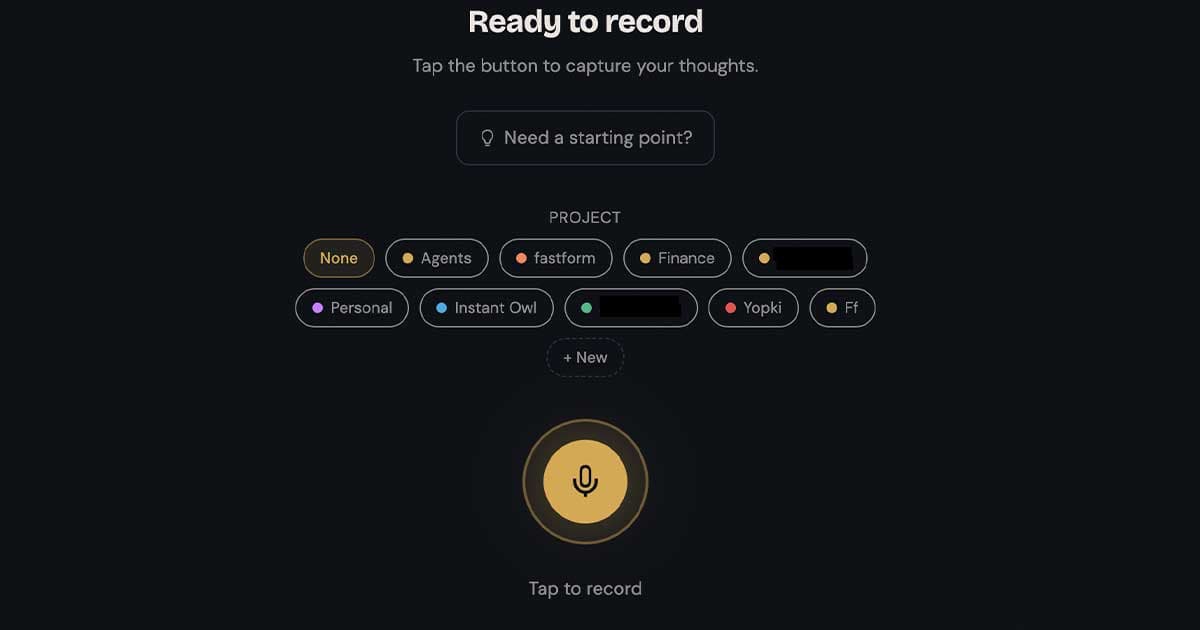
That is a different job than dictation. Full disclosure: InstantOwl is our product, built for that second case, not the first. Instead of typing word for word into a cursor, you record a rambling voice note and InstantOwl turns it into an organized summary, a task list, or whatever shape you actually needed. It does not fight you over punctuation commands or reset a setting after your laptop sleeps, since it is not trying to type live text at all. It listens to the whole recording, pauses included, then hands back structure. InstantOwl is currently free to use.
If Win+H is where you turn for a quick line of text, and Voice Access is where you turn to control your PC hands free, InstantOwl is where you turn when what you actually have is a messy, half-formed idea and you want it back as something organized instead of a wall of dictated text.
Related reading
- Wispr Flow: the cross-platform dictation upgrade the accessibility thread's own users landed on.
- Dictation software compared: how the built-in tools on Windows, Mac, and mobile stack up against paid alternatives.
- InstantOwl: record a rambling voice note and get back organized notes and tasks instead of a transcript.
Frequently asked questions
How do I turn on voice typing in Windows 11?
Click into any text box, then press Windows key+H on a hardware keyboard, or tap the microphone button on the touch keyboard. Wait for the Listening alert, then start talking. You need an internet connection and a working microphone, since voice typing runs on Azure Speech services rather than on your device.
Does Windows voice typing work offline?
No. Voice typing (Win+H) requires an internet connection because it streams your speech to Azure Speech services for transcription, per Microsoft. Voice Access is the Windows 11 feature that works offline, since it uses on-device speech recognition instead of the cloud.
What is the difference between voice typing and Voice Access?
Voice typing (Win+H) is a cloud tool that only dictates text into whatever box your cursor is in, and it needs the internet. Voice Access is a separate, on-device tool for Windows 11 version 22H2 and later that works without the internet and can dictate text plus control your entire PC with voice commands and custom shortcuts.
Why does voice typing stop working after sleep?
Users report that the automatic punctuation setting resets to off after the PC sleeps or restarts, for both voice typing and Voice Access. A helper in an accessibility forum called it a bug and pointed affected users to Microsoft's Disability Answer Desk. Check Settings after waking your PC and re-enable automatic punctuation if it reverts.

Written by
Jim BreeseJim Breese is the founder of InstantOwl. He's spent 15 years building companies, from an Airbnb host community he founded and exited to growth leadership at venture-backed SaaS startups. He built InstantOwl because his best ideas kept arriving mid-walk, out of order, and half-finished.
Stop losing good ideas.
InstantOwl turns a rambling voice note into a clean, organized document in moments. Just talk. We'll organize it.
 Try InstantOwl free