PLAUD Review: What It Costs, What's Free, and Who It's For
By Jim Breese · · Updated
What is PLAUD?
PLAUD is a hardware brand: dedicated AI voice recorders paired with a companion app that transcribes and summarizes what they capture. The lineup is four devices, per plaud.ai: Plaud Note ($159), Plaud NotePin ($159), Plaud NotePin S ($179), and Plaud Note Pro ($189).
The Note and Note Pro are credit-card-shaped recorders, thin enough to slide in a wallet or clip magnetically to the back of a phone. The NotePin and NotePin S are wearable capsules, worn as a necklace, wristband, clip, or pin, per PLAUD's product pages. Since Meta acquired Limitless in December 2025 and stopped selling the Pendant, the NotePins are also the best-known recorder wearables still on sale, a shift our Plaud vs Limitless breakdown covers in full. The Note, NotePin, and NotePin S each list 64GB of local storage on their product pages, per plaud.ai.
PLAUD calls itself "the world's No.1 AI note-taking brand" on its homepage, and says it is "trusted by over 2 million professionals globally." The homepage names its audience directly: executives, sales teams, clinicians, lawyers, educators, and content creators, the people who spend a working day recording other people, not themselves.
Battery life varies by device, per plaud.ai's product pages: the Note runs up to 30 hours of continuous recording, the NotePin up to 20 hours, and the Note Pro up to 50 hours in its Endurance mode. The Note Pro also adds a 5-microphone array PLAUD says "captures voices up to 16.4 ft" away, built for a conference room rather than a solo thought.
The app behind all four devices rates well. On the App Store, the Plaud app carries a 4.9 star rating from 20,000 ratings; on Google Play, it carries 4.6 stars from 9.91K reviews and more than 500,000 downloads, per the respective listings, fetched 2026-07-16. Both numbers back up the transcription-quality praise covered further down.
Does PLAUD require a subscription?
No. Every PLAUD device ships with a free Starter plan, 300 transcription minutes a month, forever, per plaud.ai's pricing page. You do not need to pay anything beyond the hardware itself to transcribe and summarize what you record.
Two paid tiers sit above Starter, per the same page. Pro costs $17.99 a month, or $8.33 a month billed annually, for 1,200 minutes. Unlimited costs $29.99 a month, or $19.99 a month billed annually, for unlimited transcription minutes. A Team plan runs $28 per user per month, a launch price through August 31, 2026, rising to $35 after that.
The catch is what the free plan leaves out. Ask Plaud (a chat feature for querying your notes), AutoFlow (automation), and the MCP server are gated to paid plans only, per plaud.ai. The hardware and the transcription itself are free forever; the more advanced software features are not.
300 minutes a month also works out to about 10 minutes a day. That covers a handful of short voice memos comfortably, but it will not cover someone recording hour-long meetings daily, or a student sitting through back-to-back lectures. Check that math against your own habits before assuming the free tier fits.
For occasional overflow instead of a full subscription, PLAUD also sells one-time minute packs. Its App Store listing prices a 120-minute package at $2.99 and a 600-minute package at $12.99; the website separately offers 600, 3,000, and 6,000-minute packs, per plaud.ai. That gives you a middle option between staying on Starter and committing to Pro or Unlimited every month.
How does PLAUD record phone calls?
Only two of the four devices can do it. The Plaud Note and Note Pro record phone calls; the NotePin and NotePin S cannot, according to PLAUD's own support center. This is a detail most review roundups skip entirely.
The mechanism is a Vibration Conduction Sensor, per PLAUD's support article on the difference between note recording and phone call recording. You attach the Note (or Note Pro) to the back of your phone with the included magnetic case and ring. The sensor then reads the vibrations coming off the phone's own speaker and captures both sides of the call, with no app permission, no carrier support, and no meeting bot involved.
One side effect: you cannot use headphones during a call recorded this way, because the sensor needs the phone's built-in speaker to work, per PLAUD's related FAQ.
The NotePin S explicitly cannot record calls. "Plaud NotePin S does not support phone call recording," per PLAUD's official support article, because it lacks the vibration sensor the Note and Note Pro rely on. PLAUD's own workaround, per the same article, is to put the call on speakerphone and let the NotePin S pick up the ambient sound instead. If phone calls are the main reason you are buying PLAUD, the wearable NotePins are the wrong device.
Can PLAUD transcribe podcasts?
Yes, through audio import, but the free plan's minutes make it an expensive way to do it regularly. PLAUD lets you import existing audio and video files into the app or web dashboard, and PLAUD's audio import article says imported files are "processed the same way as a Plaud device recording": transcribed, summarized, and run through the same templates.
The import cap is 5 hours per file, per the same support article. A file longer than that gets automatically split into two. Supported formats include MP3, MP4, WAV, and AAC, among others, the same file types covered in our MP3 conversion guide.
The real constraint is not the file size, it is the monthly minutes quota. The free Starter plan gives 300 minutes a month, per plaud.ai. A single weekly one-hour podcast episode alone uses roughly 240 of those 300 minutes, leaving almost nothing for anything else you record that month. Transcribing a podcast occasionally works fine on PLAUD; using it as a bulk podcast transcription tool does not, unless you pay for Pro or Unlimited minutes on top of the device cost. If bulk transcription is the actual job, our transcription guide covers tools built specifically for that volume, and our transcription services rate guide lines up the real per-minute prices across AI and human options.
What do real PLAUD users say?
Reviewers consistently praise the transcription quality and criticize the software built on top of it. On Google Play, one reviewer called the recordings "sharp, clear and 99 percent precise," per the Play Store listing, while flagging the Pro and Unlimited plan prices as "very high priced... especially when the product cost is already very high."
A widely read Reddit thread in PLAUD's own user subreddit, titled "Plaud, Should you buy it? (Short Answer: No)," lays out the recurring complaints: "Summaries are way too basic and seem very limited in usage," "CONSUMES BATTERY" (the app drained 49% of a Pixel 8's battery in 6 hours, even with the device not nearby), and "Subscription isn't worth the AI at all." The same original poster's own pros list included "Transcript is pretty accurate" and "Works in group settings."
The top comment in that thread pushes back hard: "It just works...it records well, it transcribes very well. It's quickly become an indespensible tool for me." The most balanced reply frames the real tradeoff: "there are both better and much cheaper apps for transcript / AI summarization... Plaud seems to be reasonable for people that don't want to do that work," meaning the hardware saves setup effort, not money.
Other documented friction, all per the same threads and listings: an App Store reviewer called the combined device-plus-subscription cost "not worth nearly $400," and a Reddit commenter said local export requires a workaround because "you can't just export locally, you can only share." A Google Play reviewer separately reported wireless-only file transfer that is "slower than realtime" and blocks while the device is still recording.
One older complaint deserves an honest update. In that same 2024 Reddit thread, a commenter reviewed PLAUD's terms of service and said it offered "ZERO protection" for customer data, calling it a red flag for business use. Since then, PLAUD's current App Store and Google Play listings advertise ISO 27001, ISO 27701, GDPR, SOC 2, and HIPAA compliance badges. Both facts are worth holding at once: a real complaint from 2024, and a materially different compliance posture today.
Who is PLAUD actually for, and who isn't it for?
PLAUD is a strong fit for someone who records other people for a living: a salesperson on calls all day, a clinician documenting patient visits, a lawyer in client meetings, a journalist doing interviews. That is exactly who PLAUD's own homepage names as its audience, and the transcription accuracy real users describe holds up for that job.
It is a poor fit for someone whose problem is their own thoughts, not other people's conversations. That exact tension shows up inside PLAUD's own user base. One commenter in the Reddit thread above asked it plainly: "Why isn't it just an app? Since the phone can record the attachment seems like a gimmick to justify the price tag. I'd gladly pay the subscription fee if i didn't just blow 160 on this basically useless device." Clinicians specifically should check for a signed BAA before buying hardware like this for patient visits; our medical dictation pricing and BAA guide covers which tools actually offer one.
If your actual need is catching an idea that shows up walking to your car, in a school pickup line, or at your desk mid-thought, you do not need $159 to $189 of hardware and a minutes meter. You need somewhere to talk that turns the ramble into something organized afterward, using the phone already in your pocket. A whole category of voice notes apps does that job with no hardware at all. And our guide to Plaud alternatives compares those software options against the wearables still competing for the same money.
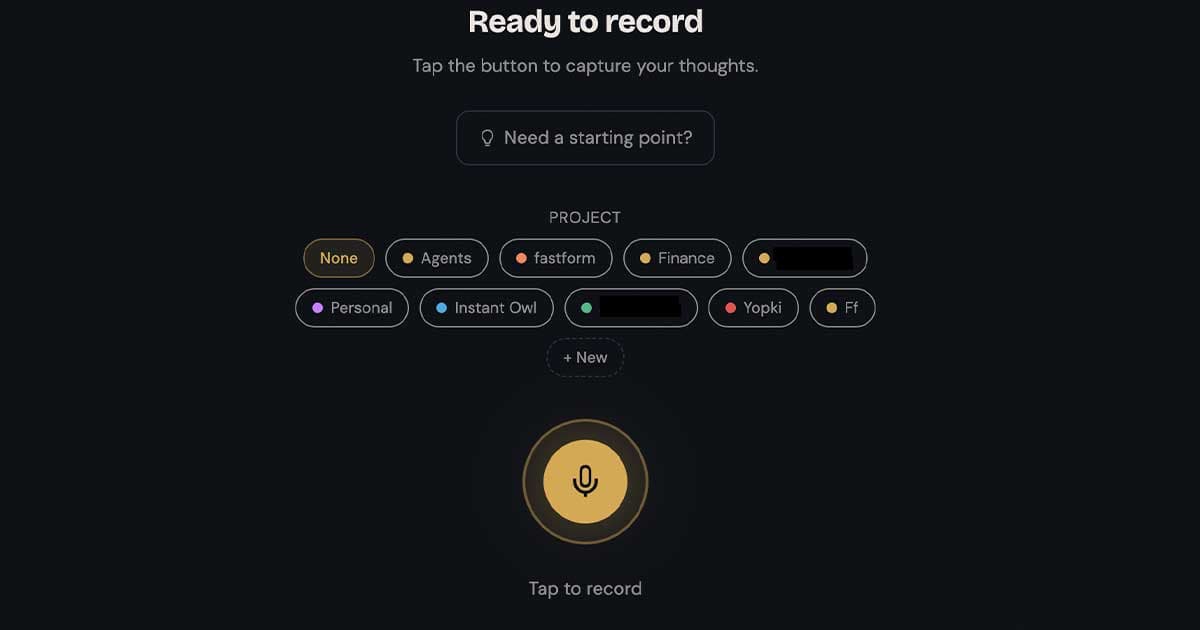
Full disclosure: InstantOwl is our product, and this is our blog. InstantOwl is software, not hardware. It runs on the phone you already own, and is built for your own thoughts rather than other people's conversations or meetings. InstantOwl is currently free to use.
Related reading
- Otter.ai: another AI notetaker, built for meetings rather than personal capture, with its own pricing and auto-join gotchas.
- Voice notes apps compared: more software options for personal voice capture, no hardware required.
- Transcription tools compared: built for bulk audio and podcast transcription, where PLAUD's minutes quota runs out fast.
Frequently asked questions
Is PLAUD a subscription?
No. Every PLAUD device includes a free Starter plan with 300 transcription minutes a month, forever, per plaud.ai. Paid plans (Pro, Unlimited) only add more minutes and a few extra software features. They are optional, not required to use the device.
What is PLAUD AI?
PLAUD is a hardware brand that makes AI voice recorders, the Note, NotePin, NotePin S, and Note Pro, paired with a companion app that transcribes and summarizes recordings in 112 languages, per plaud.ai.
Can PLAUD record phone calls?
Only the Plaud Note and Note Pro can. They use a Vibration Conduction Sensor against the back of the phone to read the speaker's vibrations, per PLAUD's support article. The wearable NotePin and NotePin S cannot record calls at all, per PLAUD's official FAQ.
How much does PLAUD cost?
PLAUD devices run $159 to $189, per plaud.ai. The Note and NotePin are $159, NotePin S is $179, and Note Pro is $189. Every device includes a free 300-minute-a-month transcription plan; paid plans start at $8.33 a month billed annually.

Written by
Jim BreeseJim Breese is the founder of InstantOwl. He's spent 15 years building companies, from an Airbnb host community he founded and exited to growth leadership at venture-backed SaaS startups. He built InstantOwl because his best ideas kept arriving mid-walk, out of order, and half-finished.
Stop losing good ideas.
InstantOwl turns a rambling voice note into a clean, organized document in moments. Just talk. We'll organize it.
 Try InstantOwl free