ADHD Brain Dump: A Kinder Way to Empty Your Head
By Jim Breese · · Updated

What is an ADHD brain dump?
An ADHD brain dump is writing or saying every thought in your head right now, without stopping to sort, fix, or judge any of it. It works the same way a regular brain dump does, but the bar for "doing it right" is lower on purpose, because for an ADHD brain the thought can be gone before you finish the sentence.
That speed problem is the whole reason this deserves its own approach. A neurotypical brain dump can afford a slow, careful pass. An ADHD brain dump cannot, because the value of the method depends entirely on catching the thought before it disappears.
Nothing about a messy dump is a failure. Half sentences, three topics on one line, a task next to a memory next to a worry: that is what it is supposed to look like. The goal is not a tidy list. The goal is that nothing important got lost today.
This works for teens, adults, and anyone managing ADHD at work or at home. An adult juggling a job and a household has different content in the dump than a student does, but the method does not change: catch it fast, sort it later, and never judge the mess in between.
Why does an ADHD brain need this more than most?
An ADHD brain generates thoughts faster than it can act on them, so ideas, tasks, and worries pile up with nowhere to go. A brain dump gives all of them a landing spot, which lowers the background noise of trying to hold everything at once. That gap between having a thought and acting on it is the same one covered in depth in our guide to ADHD productivity advice that actually holds up.
Holding an open thought takes ongoing attention, even a small one. When ten or twenty are open at the same time, that adds up to a mind that feels loud and tired before the day has really started. Getting them out, in any order, quiets the noise because nothing is left rattling around unfinished.
This is not about being more organized. It is about not carrying the whole list in your head all day. Once a thought is written or spoken somewhere safe, your brain can let go of it.
None of this means anything is wrong with how an ADHD brain works. It just moves differently, generating more open threads per hour than most systems, paper or digital, were designed to catch. A brain dump is not a fix for that. It is a place built to match the pace.
How do you do an ADHD brain dump (fast and forgiving)?
You do an ADHD brain dump by picking one place to capture, then getting every thought out as fast as it arrives, with no editing and no order. Speed beats structure every time. If you slow down to organize, the next three thoughts are already gone.
- Pick one spot before you start. A note, a page, a recording. Deciding where to put it later is what kills the habit.
- Start the instant a thought shows up. Do not wait for a good moment. There usually isn't one.
- Say or write it exactly as it comes. Half a sentence is fine. Jumping topics is fine.
- Skip the urge to fix it. No renaming, no reordering, no crossing out while you go. That is a later step.
- Stop whenever it stops. There is no minimum length and no finish line. One thought captured is still a win.
The only real rule is that capture and sorting stay separate. Sorting while you dump is what turns a fast, forgiving habit into a slow, frustrating one, and that is usually where people give up on it.
There is no wrong way to fill the time. Some people do this in one sitting once a day. Others catch thoughts in five-second bursts all day and never sit down for it at all. Both count. The habit that actually happens beats the one that looks better on paper. (And if what you are after is generating ideas on purpose rather than clearing your head, solo brainstorming techniques like brainwriting are built for that job instead.)
What should a brain dump template actually include?
A good ADHD brain dump template gives you loose categories to glance at, not a form to fill out correctly. It should catch tasks, ideas, worries, and things you do not want to forget, without forcing you to decide which bucket something belongs in before you write it down.
Copy this into any notes app, or print it and keep it near where you usually get stuck in your head.
ADHD BRAIN DUMP

Right now, on my mind:
-
-
-

Tasks (things I need to do):
-
-
-

Ideas (things I want to remember or try):
-
-
-

Worries (things I keep circling back to):
-
-
-

Don't-forget (dates, names, small stuff):
-
-
-

Later, sort into: Do today / Do this week / Not now
Fill it out of order. Skip sections that do not apply. If everything ends up crammed into one line at the top, that still counts as done.
This works as an ADHD brain dump worksheet for a single rough day, or as a repeatable ADHD brain dump printable you run through every morning or every night. Neither use is more correct than the other. Use it the way that actually gets used. When you do sort later, anything with a date or time deserves a home you will see again; an ADHD calendar setup is a better place for those than the bottom of a worksheet.
Where can you download the ADHD brain dump template?
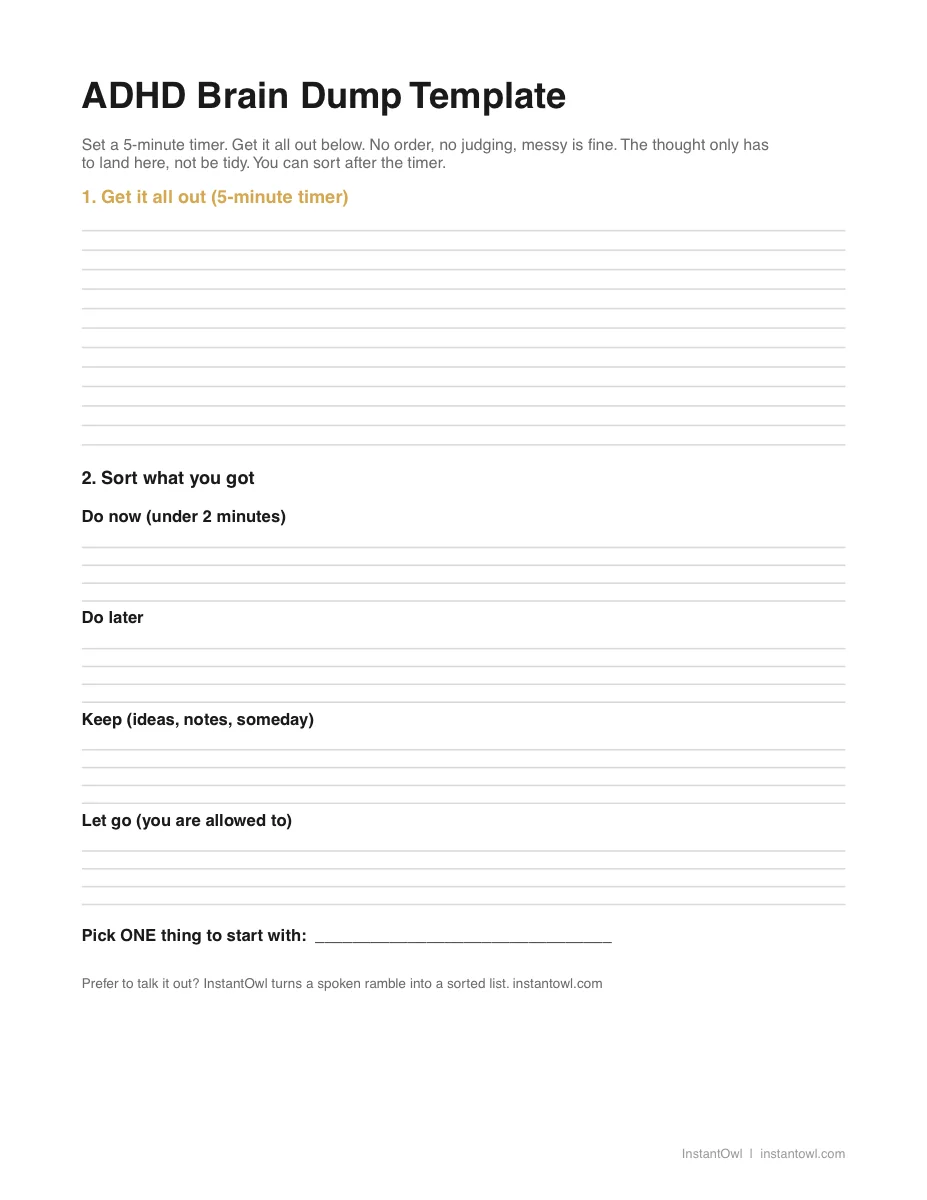
Grab the free template in whichever format is easiest to open right now: PDF for printing, Word (DOCX) for typing directly into it, or Excel (XLSX) if you like sorting in columns. The DOCX and XLSX files open fine in Google Docs and Google Sheets if that is what you already use.
Print the PDF and keep it on the fridge, by the bed, or in a bag. A printable that is not nearby when the thought hits does not help much, so put a copy somewhere your day actually happens.
If you would rather work from a screen, the DOCX opens straight into a doc you can type into during the day, and the XLSX turns each category into its own column, which some people find easier to scan than a page of dashes. Pick whichever one you will actually reopen tomorrow, since the best format is the one that survives past day one.
How do you quiet racing thoughts before they pile up?
You quiet racing thoughts by capturing them as they happen instead of trying to remember them for later. A thought that has somewhere to go tends to stop looping. A thought with nowhere to go keeps circling, because part of your mind is still working to hold onto it. That circling is loudest at bedtime, when the day finally goes quiet; our guide to the nighttime version of racing thoughts covers what to do with them then.
The trick is to make capture available at the exact moment a thought shows up, not after you find a notebook or open the right one of your ADHD apps. The gap between "I had a thought" and "I wrote it down" is where most ADHD brain dumps fail before they start. Catching an idea the second it appears is a system worth building on purpose, not leaving to chance.
A short, regular habit beats one long effort. A thirty-second dump three times a day catches more than a single big session ever will, because it matches how an ADHD mind actually moves: in bursts, not in one long sitting.
Some racing feels manageable, more like a busy but functional day. Other times it feels overwhelming, and that difference is worth noticing without judging it. On the harder days, lower the bar even further: three words scribbled down still counts as a successful dump.
Why does talking work better than writing for an ADHD brain dump?
Talking works better because it removes the two biggest points of friction: the blank page and the lag between thinking and typing. If you are a verbal processor who thinks by talking, speaking is not just faster, it is how the thought takes shape in the first place. You can speak roughly three times faster than you type (a Stanford HCI study measured speech at three times the speed of typing on a phone keyboard), and there is no cursor blinking at you while a thought slips away.
For a mind that moves fast, that lag is the whole problem. By the time you have opened a note app, tapped into a doc, and started typing, the thought that triggered all of it can already be gone. Talking closes that gap because it is instant: open your mouth, the thought is out.
The honest catch has always been what happens after. A voice memo full of rambling thoughts is still a pile, just a spoken one, and most people never go back and sort through it.
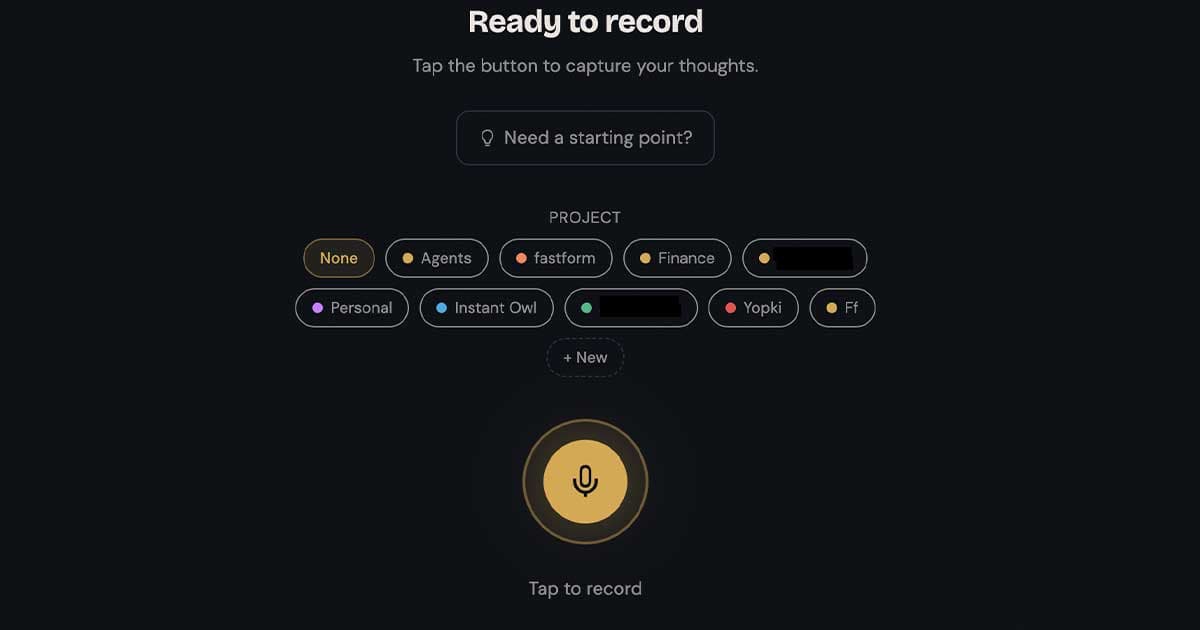
That is the specific gap InstantOwl was built to close. You talk the way your brain actually moves, jumping topics and all, and it turns the ramble into organized tasks, notes, and ideas you can actually use, so the speed of talking does not cost you the sorting.
Related reading
- What is a brain dump? for the core method this page builds on.
- The brain dump template for a general-purpose version of the template above.
- Best ADHD note-taking apps for tools built around fast, forgiving capture.
- InstantOwl if talking beats typing for you too.
Frequently asked questions
What is an ADHD brain dump?
An ADHD brain dump is capturing every thought in your head, right now, with zero sorting or editing. For an ADHD brain the point is speed: a thought can vanish in seconds, so the method has to be faster than the forgetting. Anything captured counts as a win, messy or not.
How do you quiet an ADHD brain?
You quiet an ADHD brain by giving each thought somewhere to land instead of trying to hold it. Racing thoughts often calm down once they are written or spoken out, because the mind stops working to keep them from slipping away. Regular, low-pressure capture works better than one big effort.
What do ADHD racing thoughts feel like?
ADHD racing thoughts often feel like several conversations happening at once, or one thought interrupting another before it finishes. People describe it as a browser with too many tabs open, or a radio stuck between stations. It is not a character flaw. It is how the brain moves.
How is an ADHD brain dump different from a regular one?
An ADHD brain dump is the same core idea, capture everything, sort later, but with looser rules. There is no minimum time, no requirement to finish, and no penalty for switching topics mid-sentence. The only goal is getting the thought out before it is gone, in whatever order it arrives.

Written by
Jim BreeseJim Breese is the founder of InstantOwl. He's spent 15 years building companies, from an Airbnb host community he founded and exited to growth leadership at venture-backed SaaS startups. He built InstantOwl because his best ideas kept arriving mid-walk, out of order, and half-finished.
Stop losing good ideas.
InstantOwl turns a rambling voice note into a clean, organized document in moments. Just talk. We'll organize it.
 Try InstantOwl free