The Brain Dump Journal: A Daily Habit for a Clear Head
By Jim Breese · · Updated

What is a brain dump journal?
A brain dump journal is a dedicated notebook or page where you write down every thought in your head, fast and without editing, on a regular basis. It is not a diary you read back for insight. It exists to get thoughts out of your head and onto paper before they turn into stress.
The format is simple on purpose. You do not write in sentences or paragraphs. You write short bullets, one thought per line, as fast as they come. Tasks, worries, ideas, and half-formed thoughts all go on the same page, unsorted.
Most people keep it separate from a regular journal. A brain dump journal is a release valve you reach for whenever your head feels full, not a place for careful writing.
A brain dump journal can be a standalone notebook, a page in a planner, a single note on your phone, or a voice journal you talk into. The medium matters less than the rule: everything gets written down first, and none of it gets sorted or judged until later.
What is the difference between a brain dump journal and a regular journal?
A brain dump journal is fast release; a regular journal is slow reflection. You brain dump to empty your head in minutes with no order. You journal to sit with one thought or feeling and understand it better, which takes longer and follows a line of thinking.
Think of it as output versus insight. A brain dump gets everything out so nothing is left rattling around unresolved. A journal entry picks one of those things and works through it: why it happened, how you feel, what you learned.
Both are useful, and they solve different problems. Reach for a brain dump when your head is loud and cluttered. Reach for journaling when one specific thing needs thinking through, not just release; if you want an app that responds to what you write, that is what AI journaling does, and if you want a plain, permanent home for that reflective journal, Apple Journal and Day One are the two obvious picks on Apple devices.
Some days a brain dump is all you need. You empty the page, nothing on it needs deeper thought, and you close the notebook feeling lighter. That is a complete session, not an unfinished one.
Why does keeping a brain dump journal work?
A brain dump journal works because unfinished thoughts tend to stay active in your mind until they are written down or resolved, a tendency psychologists call the Zeigarnik effect, first documented in 1927. Writing a thought down closes that open loop, which is why your head feels clearer immediately after.
This is called cognitive offloading: moving information out of your head and into an external place so your brain no longer has to hold it. Each open thought you carry takes a small amount of working memory, even ones you are not actively thinking about.
A daily brain dump journal keeps that load from building up. Instead of one big backlog once a month, you clear small amounts every day, so nothing gets the chance to pile into overwhelm.
Cognitive offloading is well established in psychology research, but no reliable study attaches a specific stress-reduction percentage to it, so treat any number you see attached to "brain dumping reduces stress by X%" with skepticism. The mechanism (fewer open loops, less working memory used) is the honest reason it helps.
How do you start a brain dump journal?
You start a brain dump journal by picking one place you will always use, then writing every thought for five to ten minutes with no editing. Consistency matters more than format. A cheap notebook you use daily beats an elaborate system you abandon after a week.
- Choose your capture spot. A plain notebook, a note app, or a voice recording. Pick one and stick with it.
- Set a daily time. Morning coffee, a commute, or right before bed. Same time each day builds the habit faster than "whenever I remember," the same anchoring that makes morning pages stick.
- Set a short timer. Five to ten minutes. A limit keeps it from becoming a chore.
- Write fast, unsorted. Short bullets, no full sentences required, no judging what comes out.
- Close it and move on. You do not need to act on anything yet. Sorting is a separate, later step.
The habit only survives if it stays frictionless. The moment a brain dump journal feels like homework, people quit, which is the single biggest reason these habits fail after a strong first week.
What does a brain dump bullet journal look like?
A brain dump bullet journal is a dedicated collection page inside your bullet journal, separate from your daily log, where you list every task, idea, and worry as short, unsorted bullets. You log it in your index like any other collection, then migrate items to real spreads afterward.
In bullet journal method terms, a brain dump page comes before migration, not instead of it. You dump everything first, then move real tasks into your daily or monthly log and drop the rest. The page itself is disposable once it is sorted.
A brain dump bullet journal page works well as a weekly reset: one page, five minutes, everything from the week that never made it into a proper spread lands there before it is lost.
Some bullet journalists keep a running brain dump collection instead of a single page, adding to it any time a thought surfaces mid-week, then clearing it during their weekly review. Either version works. Pick whichever one you will actually keep open.
What are good brain dump journal prompts?
Good brain dump journal prompts are open questions that give you a starting point instead of a blank page, especially on days your head feels empty rather than full. A blank page is intimidating even when you have plenty on your mind; a prompt breaks the freeze.
- What is on my plate this week?
- What have I been avoiding?
- What keeps interrupting my focus today?
- What am I worried about right now?
- What ideas have I had that I have not written down yet?
- What do I need to remember before I forget it?
- What is bothering me that I have not said out loud?
Use one prompt to get moving, then let the rest come out unprompted. The prompt is a starting push, not a structure you have to follow for the whole session.
Does a brain dump journal help with anxiety?
Yes, a brain dump journal helps with anxiety because it reduces the number of open, unresolved thoughts your mind is holding onto at once, and that mental load is a known driver of low-grade stress. Getting a worry onto paper does not solve it, but it stops your mind from replaying it on a loop.
For anxious, fragmented minds specifically, the daily habit matters more than the single session. One brain dump gives short-term relief. A daily one keeps the backlog from ever building back up to the point where it feels unmanageable again.
This is not a substitute for therapy or treatment when anxiety is severe or persistent. It is a low-cost daily tool that reduces one specific driver of stress: the mental weight of things you have not written down anywhere.
Why is talking faster than writing a brain dump journal?
Talking is faster than writing because you speak roughly three times faster than you type or handwrite (a Stanford HCI study clocked speech at three times the speed of typing on a phone keyboard), and speaking has no blank-page friction. The habit only holds if it stays under a few minutes, and for a lot of people, writing daily is the exact step that turns into procrastination.
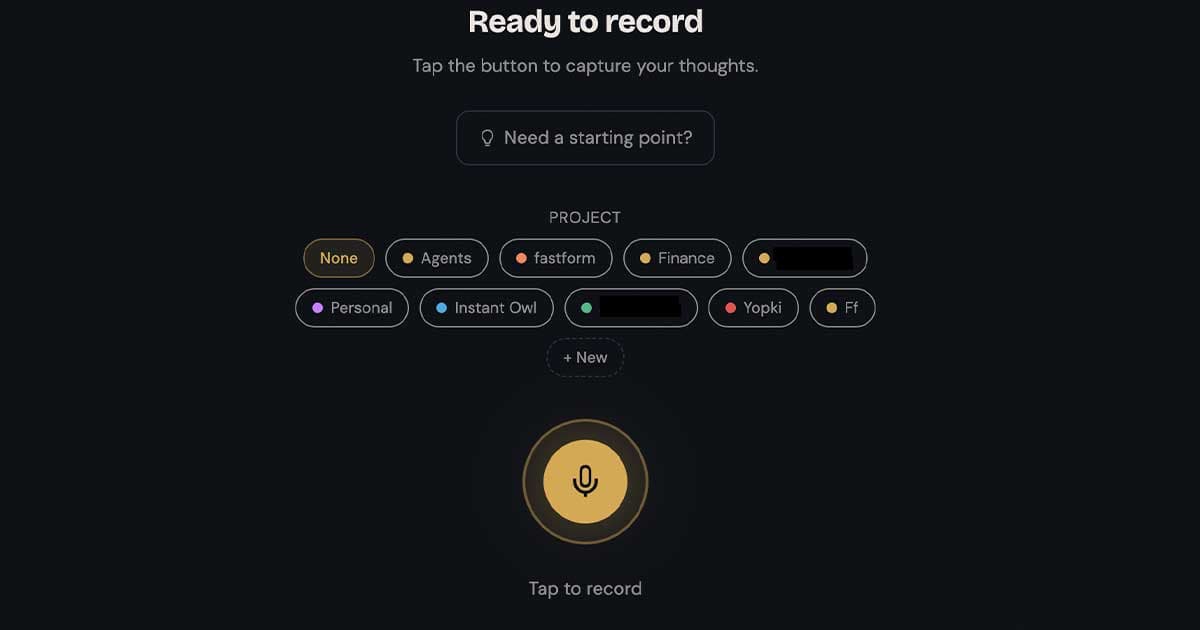
This is the gap InstantOwl was built to close. You talk instead of write, and it turns the ramble into an organized entry, not just a wall of transcribed text you have to sort by hand later. The capture stays as fast as talking; the sorting happens for you.
A daily habit only survives if it is frictionless. Three minutes of talking in the car or on a walk is a brain dump journal entry that a busy day would otherwise skip entirely.
Related reading
- What Is a Brain Dump (and How to Do One): the fundamentals, if you are starting from zero.
- Brain dump template: a copy-paste structure for your first page.
- ADHD brain dump: why fast, judgment-free capture matters most for a fast-moving mind.
- InstantOwl: talk your brain dump instead of writing it, and get an organized entry back.
Frequently asked questions
What is a brain dump in journaling?
A brain dump in journaling is a page where you write down every thought in your head, fast and unfiltered, instead of exploring one topic. It is not meant to be read back like a diary entry. The goal is speed and emptying, not insight.
What is the difference between a brain dump and journaling?
A brain dump is fast, unstructured release: everything out, no order, no editing, usually finished in minutes. Journaling is slower reflection, usually on one topic or feeling, written to be understood. A brain dump empties your head; journaling explores what was in it.
What is a brain dump in a bullet journal?
In a bullet journal, a brain dump is a dedicated collection page, separate from your daily log, where you list every task, idea, and worry as short bullets. You sort it into your index and migrate items to real spreads afterward.
How do you start a brain dump journal?
Pick one notebook or app you will always use, set a timer for five to ten minutes, and write every thought as a short line with no editing. Do this daily at a fixed time, like morning coffee or before bed, so it becomes automatic.
What is an example of a brain dump?
A brain dump might read: call dentist, pitch idea for Q3, forgot to text Sam back, worried about the presentation, buy filter for the sink, book title idea, mom's birthday is next week. No order, no categories, just what was in your head.

Written by
Jim BreeseJim Breese is the founder of InstantOwl. He's spent 15 years building companies, from an Airbnb host community he founded and exited to growth leadership at venture-backed SaaS startups. He built InstantOwl because his best ideas kept arriving mid-walk, out of order, and half-finished.
Stop losing good ideas.
InstantOwl turns a rambling voice note into a clean, organized document in moments. Just talk. We'll organize it.
 Try InstantOwl free