The Best Note-Taking Apps for ADHD (Honest 2026 Picks)
By Jim Breese · · Updated

What makes a note-taking app actually work for an ADHD brain?
A note-taking app works for an ADHD brain when it saves a thought before the thought is gone, not when it has the most features. Speed of capture matters more than organization, templates, or design. If opening the app takes more than a couple of taps, the thought is often already gone by the time you get there.
The apps that actually get used share three traits: they open in one tap from a lock screen or widget, they accept whatever format is fastest for you (typing, voice, or a quick photo), and they do not demand a folder or a title before you can save anything. Structure can be added later. Capture cannot wait.
This list groups apps by the job they do, because no single app does all of it well. Some apps are built for instant capture. Some are built for organizing everything you have already captured. A few are built for talking instead of typing, which is its own category worth taking seriously.
Why is note taking hard with ADHD?
Note taking is hard with ADHD because working memory holds a new thought for only a short window, and most note apps add friction right where speed matters most: open the app, choose a folder, start typing. By the time all of that is done, the original thought has often already slipped.
This is a mechanical problem, not a motivation problem. The thought does not vanish because you are lazy or disorganized. It vanishes because the app made you do four things before it would let you do the one thing you actually needed, which was to get the thought out of your head.
The fix is not a better system or a stricter habit. The fix is an app that removes steps: fewer taps, voice instead of typing, no forced folder choice. Every step you remove is a thought you keep.
The best apps for capturing a thought before it disappears
The best apps for instant capture are the ones already on your phone, because zero installation friction beats every other feature. Apple Notes and Google Keep both lead here, and both are free.
Apple Notes is built into every iPhone and Mac, opens in a tap from a widget, and syncs automatically across devices through iCloud. It can record audio directly inside a note and transcribe it alongside your typed text (on iPhone 12 and later), which is useful if you want to talk and type in the same place. For light organizing it supports #tags and Smart Folders, though nothing gets filed automatically, so it is still closer to a capture box than a system built for hundreds of linked notes.
Google Keep uses color-coded, sticky-note-style cards instead of a document view, which makes a wall of scattered thoughts easier to scan at a glance than a long list of titles. It supports quick voice memos, checklists, and reminders you can set for a time. Like Apple Notes, it is closer to a capture tool than a full second brain, and it works best when you clear it out regularly instead of letting notes pile up.
Both apps solve the same problem: get the thought saved, right now, with nothing in the way. Neither one organizes for you.
The best apps for talking instead of typing
The best apps for a racing mind are voice-first, because talking is faster than typing for almost everyone and does not require staring at a blank page first. Two apps worth knowing here work differently, and our roundup of voice notes apps covers the wider field. If you specifically want to speak into Notion, our voice to text in Notion guide covers the OS-level workaround, since Notion has no page dictation of its own.
Otter.ai transcribes speech in real time and was built primarily for meetings, lectures, and conversations rather than personal note-taking, a tradeoff our full Otter.ai review digs into. Its free plan covers 300 transcription minutes a month, capped at 30 minutes per conversation. It is a strong pick if most of what you need captured happens out loud in a room with other people, and less suited to quick personal thoughts on the go.
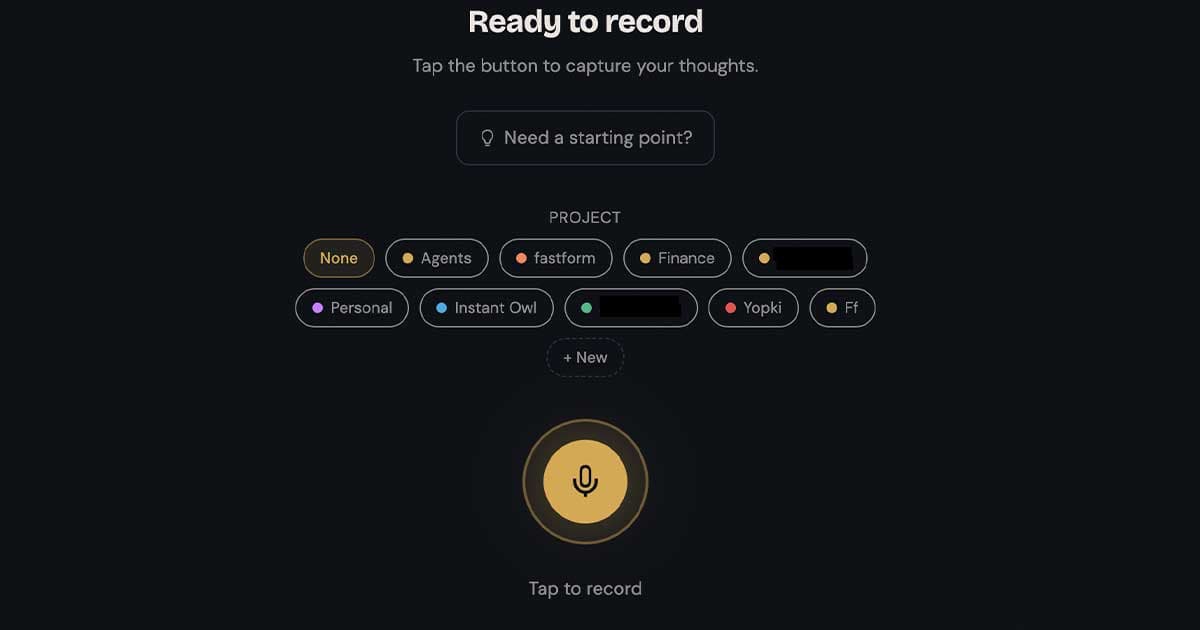
InstantOwl is our product, so take this as a disclosed pick rather than an outside review. It is built for the moment a thought arrives and needs to be caught before it disappears: you talk, and the recording turns into organized notes, extracted tasks, or a document format you actually need, instead of leaving you with a raw transcript to sort through later. The idea behind it is a direct response to the ADHD note-taking problem above: capture should be as fast as talking, and the sorting work should not fall back on you afterward. It is currently free to use.
Voice-first apps solve the "blank page plus typing speed" problem that trips up ADHD note-taking the most. They are not the right fit if you think better by seeing text as you write it.
The best apps for turning scattered notes into a second brain
The best apps for organizing everything you have already captured are built around linking and structure, not speed of entry. Notion and Obsidian are the two most established names in this space. (The second brain method behind them has its own failure points worth knowing before you commit to either.) Our Notion vs Obsidian comparison breaks down which fits which brain, and the wider field is in our best note-taking apps roundup.
Notion combines documents, databases, and task boards in one workspace, which makes it powerful for building a personal system once you have one set up. The tradeoff for ADHD users is real: an empty Notion workspace is a blank-page problem multiplied by dozens of possible layouts, and building your own system can become its own procrastination trap. It works best when you start from a simple template instead of a blank page, and offers a free plan for personal use. For a single document with zero setup, Google Docs' built-in voice typing skips the system-building entirely.
Obsidian stores notes as local markdown files and lets you link ideas to each other, building a web of connected notes over time (a "second brain"). It is free for personal and commercial use and has a large plugin ecosystem, but it has the steepest learning curve on this list and rewards people who already enjoy tinkering with their own systems. If setup itself derails you, this is not the place to start.
Both apps are better at holding a large, connected body of notes than at catching a single thought fast. Use them as a home for ideas after capture, not as the capture step itself.
The best app for turning your notes into an actual plan
The best app for turning notes into a plan is a dedicated task manager, because task management and note capture are different jobs that most all-in-one apps blur together. Todoist is a solid, widely used pick here: it supports natural-language due dates (typing "call the dentist Friday" creates a task due that Friday), recurring tasks, and a free Beginner tier covering 5 personal projects, with Pro at $5 a month billed yearly. Our Todoist and TickTick breakdown covers the cheaper rival worth checking before you commit.
This category matters for a specific reason: a note-taking app for ADHD students or professionals often fails not at capture, but at follow-through, where a captured idea never turns into a task with a deadline. Pairing a fast capture app with a simple task manager, rather than expecting one app to do both jobs perfectly, tends to hold up better over a full semester or work quarter than a single all-in-one tool, the same one-app-per-job approach behind our wider guide to ADHD apps.
Is there a free note taking app for ADHD?
Yes, several good free options exist. Apple Notes and Google Keep are both free and already installed on most phones. Notion offers a free plan for personal use, and Obsidian is free to use. InstantOwl is currently free to use as well.
Free is a fine place to start. The honest tradeoff, if there is one, tends to show up in sync limits, storage caps, or fewer automation features on the free tier of the more powerful apps like Notion. (If a meeting-style tool is what you need, we verified every major AI note taker's real free tier separately, and several of them shrink or expire in ways their marketing pages don't lead with.) For pure capture, though, free options are not a compromise. They are often the right long-term answer.
How do you actually choose?
Choose by matching the app to your fastest, most reliable capture method, not by picking the app with the longest feature list. If you think out loud, start with a voice-first option. If you think in short bursts on your phone, start with Apple Notes or Google Keep. If you already have the discipline to maintain a linked system, Notion or Obsidian will reward the setup time.
No app fixes ADHD, and no app on this list claims to. What a well-matched app does is remove the friction between having a thought and keeping it, so fewer good ideas and fewer important tasks get lost between your head and a place you can actually find them again. The method you use to organize notes once they are captured matters too; our comparison of note-taking methods covers the classic systems like Cornell for students who need structure. Start with whichever app you would actually open in the next five minutes, not the one that looks best on a comparison chart.
Related reading
- What is a brain dump: the underlying method behind fast, judgment-free capture, with or without a dedicated app.
- ADHD brain dump: why instant capture matters even more for a mind that moves faster than it can write.
- Brain dump app: a closer look at dedicated capture apps versus general note-taking apps.
- InstantOwl: talk instead of typing, and let the sorting happen after you capture.
Frequently asked questions
What is the best note taking app for ADHD?
There is no single best note taking app for ADHD, because the right pick matches how your brain works, not a ranking. If a thought disappears before you can type it, a voice-first app removes that gap. If you need color and speed on a phone, Apple Notes or Google Keep wins. Match the app to your fastest capture method first, then worry about organizing.
Why is note taking hard with ADHD?
Note taking is hard with ADHD because a thought can leave working memory in seconds, and most note apps make you open the app, pick a folder, and start typing before anything is saved. That gap between having the thought and capturing it is where the thought gets lost. It is a friction problem more than a discipline problem, which is why the fix is a faster app, not more willpower.
What makes a note app ADHD-friendly?
An ADHD-friendly note app opens fast, saves a thought in one tap or one sentence, and does not force you to organize before you capture. Voice input, lock-screen widgets, and one-tap capture all cut the steps between a thought and a saved note. Sorting and structure can come after, ideally handled by the app instead of by you.
Is there a free note taking app for ADHD?
Yes. Apple Notes and Google Keep are free and already installed on most phones, Notion offers a free plan for personal use, and Obsidian is free to use. InstantOwl is currently free to use as well. A free plan is a reasonable place to start before you decide whether a more specialized workflow is worth paying for.

Written by
Jim BreeseJim Breese is the founder of InstantOwl. He's spent 15 years building companies, from an Airbnb host community he founded and exited to growth leadership at venture-backed SaaS startups. He built InstantOwl because his best ideas kept arriving mid-walk, out of order, and half-finished.
Stop losing good ideas.
InstantOwl turns a rambling voice note into a clean, organized document in moments. Just talk. We'll organize it.
 Try InstantOwl free