Voice Notes: How to Send Them, Keep Them, and Actually Use Them
By Jim Breese · · Updated
What is a voice note?
A voice note is a short recording of your voice, made on a phone, used one of two ways: sent to another person as a message, or kept for yourself as a personal recording. Both use the same basic tool, a microphone and a record button. That is where the similarity ends.
Voice notes you send are audio messages, the clips you record in WhatsApp, iMessage, or Telegram for a friend or family member to listen to. Voice notes you keep are recordings you make for yourself, in an app like Apple's Voice Memos, meant to capture an idea, a task, or a thought before it slips away.
The two uses come with different rules. A sent voice note has etiquette (length, timing, tone) because someone else has to stop and listen to it. A kept voice note has no audience but you, so the real question is simpler: does it turn into something useful, or does it just sit there as an audio file you never open again.
The word covers a wide range of everyday moments: a two-line reply to a friend, a rushed reminder to buy milk, a three-minute recap of an idea that showed up in the shower. What connects them is that a voice note is casual by design, informal enough that nobody expects a script.
How do you send a voice note on iPhone and WhatsApp?
On iPhone, open Messages, tap the plus button next to the text field, tap Audio, and start talking. Tap again to stop, then send it, listen to it first, add more, or cancel. In WhatsApp, open a chat, tap the microphone icon, speak, and tap send, or slide up to lock the recording so you can talk hands free.
iPhone audio messages have a detail most guides miss. According to Apple's support pages, the recording deletes itself from your own phone 2 minutes after you send it or listen to it. The recipient can still play it anytime after receiving it, but has to tap Keep within 2 minutes of listening if they want to save it. To stop this from happening, go to Settings > Apps > Messages > Expire (under Audio Messages) and set it to Never.
iMessage also transcribes audio messages automatically, in the language set in the sender's Settings, per Apple. Transcription is only available in select languages, so a message recorded in an unsupported language plays as audio only, with no text version.
WhatsApp works the same way in spirit: tap the mic, record, send. The mic icon on your sent message shows whether it has been played by the recipient. Voice message transcripts exist too, but per WhatsApp's FAQ, they are off by default and have to be turned on in WhatsApp Settings > Chats. Once enabled, only the recipient sees the transcript, generated on their own device. The sender never sees it. Transcripts currently work in English, Portuguese, Spanish, and Russian, and WhatsApp says plainly that they can be inaccurate.
On iPhone, Raise to Listen lets you play an incoming audio message just by lifting the phone to your ear, then reply by speaking after the tone and lowering the phone to send, per Apple's guide. In WhatsApp, you can preview a recording before sending it, pause partway through, and continue recording within the same message rather than starting over, according to WhatsApp's FAQ.
Why do people love (and hate) voice notes?
People are genuinely split on this. A June 2022 YouGov poll found 22% of smartphone users like receiving voice notes and 25% dislike them, according to etiquette authority Debrett's, which also cites roughly 7 billion voice notes sent daily on WhatsApp worldwide. Whatever side someone lands on, the format has clearly gone mainstream.
The case for voice notes is emotional. A 2023 YouGov poll found 30% of Americans communicate through voice messages weekly, daily, or multiple times a day, reported in TIME. Natalie Pennington of Colorado State University described the format as a sweet spot: it carries tone and emotion a text cannot, without requiring both people to talk in real time. A 2021 study by Amit Kumar and Nicholas Epley found that voice based interactions, including voice messages, built stronger social bonds than text did.
The same TIME piece cites Vox reporting that voice carries "paralinguistic cues" text cannot, the small vocal signals that convey mood without an extra word. It also points to loneliness being declared a public health epidemic in 2023, part of why a voice message that sounds like a friend in the room can land differently than a text ever does.
The case against is about burden, not sound quality. Writer Jenny Lim, in a Medium essay, described an unwanted voice note from a school parent this way: the sender's convenience is placed above the recipient's, since a text can be skimmed anywhere but a voice note demands a quiet moment and full attention. Both cases are correct. The format rewards the sender's speed and costs the recipient's time, which is exactly why etiquette matters.
Voice note etiquette
Keep a voice note under 2 minutes, according to Debrett's. If what you have to say is under about 5 words, send a text instead. Debrett's other rules: never for work communication, never for practical details like dates or addresses, never late at night, never to someone unfamiliar with voice notes, and never while intoxicated.
On content, Debrett's advises cutting the rambling: no long pauses, no filler, lead with your point instead of burying it at the end. On delivery, record somewhere quiet enough to be heard clearly, and use headphones when you listen back in a public place.
Debrett's also flags timing beyond the clock. Never deliver big news, like a marriage or a birth, by voice note. Never assume someone is comfortable with the format without checking first, since older generations in particular may not expect it.
Transcripts change some of this math, though not all of it. Debrett's rule against practical details exists because a recipient cannot glance back at spoken words the way they can scan text. A transcript partly solves that: WhatsApp and iMessage both offer one, so a recipient can scroll back to check an address instead of re-listening. It is a partial fix, not a full one. WhatsApp's transcripts only cover English, Portuguese, Spanish, and Russian, and WhatsApp itself warns they can be inaccurate. The safest habit is still Debrett's original one: save practical details for text.
How do you keep voice notes for yourself?
On iPhone, open Voice Memos, tap record, and tap stop when you are done. According to Apple's support guide, it syncs automatically across your iPhone, iPad, and Mac as long as Voice Memos is turned on in your iCloud settings.
Turn on Voice Isolation from Control Center to filter out background noise while you record. If your iPhone is a 12 or later, Voice Memos also transcribes what you said, in English and several other languages including Spanish, French, German, and Japanese, per Apple. You can search by the words inside a transcript, not just a recording's title, and tapping a result jumps playback to that exact moment.
One gotcha worth knowing: Voice Memos stops recording if another app on your phone starts playing audio, according to Apple's guide. If you are mid recording and a podcast or a notification sound starts playing, the recording ends right there.
Off iPhone, options range from simple to more capable. Gawk's Android app, Voice memos - text and audio, is a straightforward recorder app that uses the phone's built in speech recognizer and works offline with a downloaded language pack. Speechnotes.co takes a different approach among dictation tools: its free dictation notepad delegates the actual voice recognition to Chrome, Edge, or your phone's operating system rather than to its own servers.
Among people who talk out loud to capture ideas, a few requests come up again and again: capturing notes while driving or walking, a companion app for a smartwatch, and a way to pull voice notes already sent through WhatsApp into one place, based on a Reddit discussion among note taking app users. Privacy comes up just as often. People want to know whether a spoken thought stays on the device or gets sent to a server to be processed.
For anyone whose mind moves faster than it can hold onto a thought, the method matters less than the speed of capture. That is the whole premise behind an ADHD brain dump: the thought has to be caught the second it shows up, or it is gone.
Why a transcript alone is not enough
A transcript alone is not enough, because a transcript of a ramble is still a ramble. Recording your voice is free now, since every phone has a recorder built in. Transcribing audio to text is becoming free too: Apple ships it in Voice Memos, WhatsApp ships it in chats, and Android phones have built in speech recognition. None of that touches the actual problem, which is turning what you said into something you can use.
Speaking is also the fastest form of capture there is, as we cover in what is a brain dump, but speed of capture and usefulness of the output are two different problems.
This shows up in real reviews of AI note apps. On the App Store, reviewers of Voicenotes.com's app have praised its transcription while separately criticizing weak organization and unreliable summaries, and some report recordings stopping mid session without warning. Even a well built AI tool with over a million downloads has not fully closed the gap between a raw transcript and organized output.
Say a voice note to yourself is: "call the dentist, follow up with Sam, the Thursday deadline is stressing me out, look into that espresso machine." A transcript gives that back to you word for word. It does not give you a task list, a note titled correctly, or a way to find it again next week. Speaking is the fast part now. Organizing what you said is the part nobody has handed you for free yet.
Where InstantOwl fits
Full disclosure first: InstantOwl is our product, and this blog belongs to it. InstantOwl is built for the voice notes you keep, the ones you record for yourself, not for meetings. If your problem is running meetings and needing a summary and action items afterward, Voicenotes.com is a strong, purpose built tool for that. It now positions itself as an AI meeting notetaker, rated 4.8 stars from more than 6,600 App Store ratings; our full Voicenotes review covers its pricing and privacy in depth.
Its free plan is capped in a way that is honest about what it is for: 100 weekly transcription minutes shared across everything you record, and 30 day history, after which older notes are no longer accessible, per its own pricing page. That is a reasonable limit for occasional meeting notes. It is a real constraint if you talk to yourself daily.
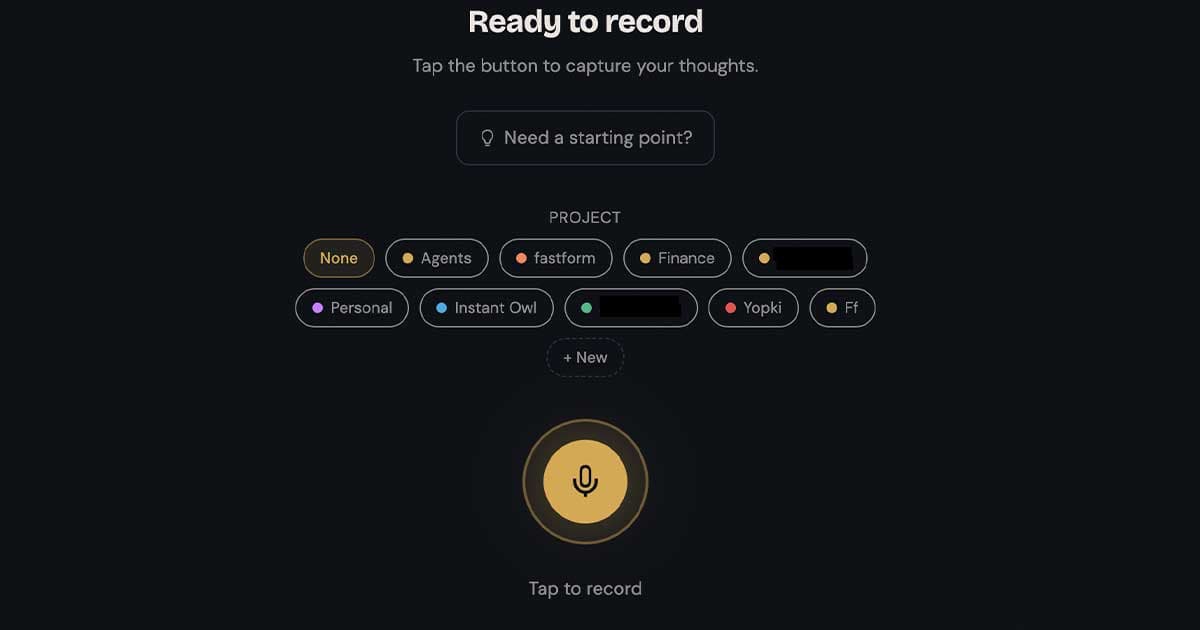
InstantOwl does not try to be a meeting notetaker. It is built for the voice note you record walking to your car, in the school pickup line, or at your desk when an idea shows up faster than you can type it: the ramble that needs to become a task list, a note, or a plan, not a meeting recap. One recording turns into organized, usable output instead of a wall of transcript text. InstantOwl is currently free to use.
The people this fits best are the ones a meeting notetaker was never built for: a mind that generates ideas faster than it can act on them, a parent who only has three minutes between other things, a family caregiver tracking medications and appointments in their head, someone who thinks out loud better than they write. The job is the same every time. Get the thought out fast, then hand back something organized instead of a transcript to sort through alone.
If you are comparing capture apps beyond InstantOwl and Voicenotes, a broader look at the brain dump apps landscape covers more of the field.
Related reading
- What is a brain dump: why speaking is the fastest way to get a thought out of your head.
- ADHD brain dump: why capture speed matters most for a racing mind.
- Brain dump apps compared: more options if you are shopping beyond voice notes.
Frequently asked questions
What are voice notes?
Voice notes are short recordings of your voice, used two ways: sent to someone as a message (in WhatsApp or iMessage) or kept for yourself as a personal recording (in an app like Voice Memos). The word covers both meanings, so context tells you which one a person means.
How do I make a voice note?
On iPhone, open Messages, tap the plus button, tap Audio, and speak, or open WhatsApp, tap the microphone icon in a chat, and speak. To keep a recording for yourself instead of sending it, use Apple's Voice Memos app: open it, tap record, and tap stop when you are done.
Is there a free voice notes app?
Yes. Apple's Voice Memos is free and built into every iPhone, with automatic iCloud sync and transcription on iPhone 12 or later. Voicenotes.com also has a free plan with 100 weekly transcription minutes and 30 day history, and InstantOwl is currently free to use.
What is the difference between a voice note and a voicemail?
A voicemail is left automatically when a phone call goes unanswered. A voice note is recorded deliberately, whenever you choose, and sent through a messaging app like WhatsApp or iMessage instead of through a phone call.
Why do people use voice notes?
People use voice notes because a voice carries tone and emotion that text cannot, and because talking is often faster than typing. A 2021 study by Amit Kumar and Nicholas Epley found voice based interactions built stronger social bonds than text, and a 2023 YouGov poll found 30% of Americans use voice messages weekly, daily, or multiple times a day.
Can voice notes be transcribed?
Yes. iMessage automatically transcribes audio messages. WhatsApp can transcribe voice messages too, but the feature is off by default, has to be turned on by the recipient, and currently works only in English, Portuguese, Spanish, and Russian. Apple's Voice Memos transcribes recordings on iPhone 12 or later.

Written by
Jim BreeseJim Breese is the founder of InstantOwl. He's spent 15 years building companies, from an Airbnb host community he founded and exited to growth leadership at venture-backed SaaS startups. He built InstantOwl because his best ideas kept arriving mid-walk, out of order, and half-finished.
Stop losing good ideas.
InstantOwl turns a rambling voice note into a clean, organized document in moments. Just talk. We'll organize it.
 Try InstantOwl free