Voice Journaling: How to Keep an Audio Journal You'll Actually Use
By Jim Breese · · Updated
What is a voice journal?
A voice journal is journaling done by speaking instead of writing: you record yourself talking through your day, a feeling, or a problem, instead of putting it on a page. Also called an audio journal or audio diary, it uses journaling's oldest tool, just a different way in. You talk, a recording captures it, and what happens next, nothing, transcription, or a written summary, is up to you.
Unlike writing, a voice journal does not force you to slow to the speed of your hand. You can talk as fast as you think, walking, driving, or lying in bed in the dark, the classic hour when racing thoughts at night show up with nowhere to go. That is the format's entire appeal, and also the source of most of its problems, covered below.
A voice journal is not the same thing as a brain dump journal, which is built for fast release of scattered thoughts rather than reflection over time. A voice journal is also built from smaller pieces: a single recording overlaps with what we call a voice note you keep for yourself, and a voice journal is the daily habit built from many of them.
Why journal out loud instead of writing?
Talking captures thoughts in a much more raw form than writing does, since tone and emotion come through and you never have to fight to keep your handwriting or typing up with the speed of your thoughts. That description comes from a longtime practitioner in a r/Journaling discussion on audio journaling, who has recorded roughly 700 entries since 1998. Speaking removes the friction writing adds: no legible handwriting required, no waiting for your hand to catch up to your head.
Other commenters in the same thread describe the format as "a personal podcast for myself," with sessions that start as a quick voice memo and stretch to half an hour once the racing thoughts get moving. One commenter said audio journaling helps them feel heard when nobody else is around to talk to. A therapist in the thread said audio journals work well for self-therapy techniques like Socratic questioning, used to challenge automatic thoughts in the moment they show up; therapists have their own version of this habit for the other side of the room, covered in voice notes for therapists.
There is a legacy angle too. The same longtime practitioner said recording daily means having detailed recordings of their own voice for their son to keep after they are gone, adding that they only have scattered voicemail snippets of their own parents, both of whom have died. A voice journal is not just faster than writing. It is also the one journaling format that leaves behind the sound of you, not just your words.
How do you start a voice journal?
Start a voice journal by picking one fixed moment each day, like a commute, a walk, or right before bed, and talking for two to five minutes about whatever is on your mind. Do not write a script or plan what to say first. The entire value of talking over writing is starting mid-thought and letting it go wherever it needs to go. If the problem is not the format but not knowing what to say in the first place, that blank-page fear is the same one that stops written journals, and the beginner's fixes for what to write work just as well spoken out loud.
Do not worry about relistening either, at least not right away. Several people in the r/Journaling thread who journal by voice rarely relisten to what they record, and one worried aloud that expecting to listen back later would make them filter their words instead of speaking freely. Treat the recording as a release, not a performance, unless you decide a specific entry is worth revisiting.
Keep the barrier to starting as low as possible. Use whatever recorder is already on your phone, the same one you would use for a voice memo, so there is no new tool to learn between having a thought and getting it out. A voice journal that requires a new app or a login before you can start talking will not survive past the first week.
What goes wrong with audio journals?
The three problems that come up most with audio journals are that nobody relistens to the raw recordings, organizing a growing pile of audio files gets clunky fast, and privacy around cloud-based AI processing is a real worry. All three surfaced repeatedly in a r/Journaling discussion among people who actually keep audio journals, not people guessing at the format from the outside.
The first problem is the quiet failure mode: audio becomes a write-only archive. Recordings pile up and nobody goes back to listen, so months of raw thoughts sit unused. The second is a workflow problem. One longtime voice journaler described manually merging three to eight WAV files a day into MP3s on a computer, while another maintains a three-tool stack, one app for transcription, a spreadsheet for structure, and cloud storage for backup, just to keep an audio journal usable.
The third is privacy. A commenter in the same thread asked directly about storing recordings on cloud servers, and the answer offered back was a tour of workarounds: transcribing locally instead of in the cloud, running offline AI models, and accepting that anything processed online carries some risk. That answer is honest, but it is also a lot of manual work to ask of someone whose whole reason for choosing voice was less friction, not more.
Does a voice journal work without transcription?
No, not for most people. An audio-only journal tends to become an archive you fill but never open again, since finding one thought inside dozens of untitled recordings takes longer than the entry took to make. Transcription changes that: it turns a recording into text you can scan in seconds, search by keyword, and skim months later without replaying any audio.
This matches the pattern from the pains above. The people in the r/Journaling thread who kept their audio journals useful long-term had built some kind of transcription step into their routine, even a manual one, like transcribing only the best entries at the end of the year. The people who just recorded and stopped there are the ones describing piles of untouched files.
Transcription does not replace the reason to speak instead of write. It closes the gap between fast capture and being able to use what you captured later. Recording without it is still real journaling. It is just journaling you are unlikely to revisit, which for most people defeats part of the point of keeping one at all.
What should you look for in a voice journal app?
Look for four things in a voice journal app: real transcription, automatic organization, a clear policy on whether your recordings train AI models (the same question that applies to any AI journaling app), and the ability to export your own entries. Those four criteria come directly from the pain points above, and from what the format's leading app actually sells.
Audio Diary, an Android app from Soliloquy Apps Limited, rates 4.7 stars from roughly 1.57 thousand reviews with over 50,000 downloads, according to its Google Play listing. Its pitch is built around exactly the problems above: AI transcription and analysis of entries, automatic goal extraction, and a stated GDPR-compliant agreement with OpenAI that its data is never used to train AI models. It also offers a "Session Designer" to turn AI processing off entirely, plus PDF export even on its free tier. Its in-app purchases range from $1.49 to $49.99, per the same listing.
Whatever app you pick, that feature set is the bar: it should transcribe what you say, organize it without manual work, tell you plainly what happens to your recordings, and let you take your entries with you if you ever leave. Notably, in the r/Journaling thread of people actually keeping audio journals, nobody named a purpose-built voice journaling app at all. Most were stitching together phone recorders, notes apps, and spreadsheets by hand, which is exactly the gap a dedicated app exists to close.
If you also keep a typed journal alongside the voice one, the same export-and-privacy checklist applies there: on Apple devices, Apple's built-in Journal app now matches much of what Day One offers, including the ZIP export and end-to-end encryption it lacked a year ago.
Where InstantOwl fits
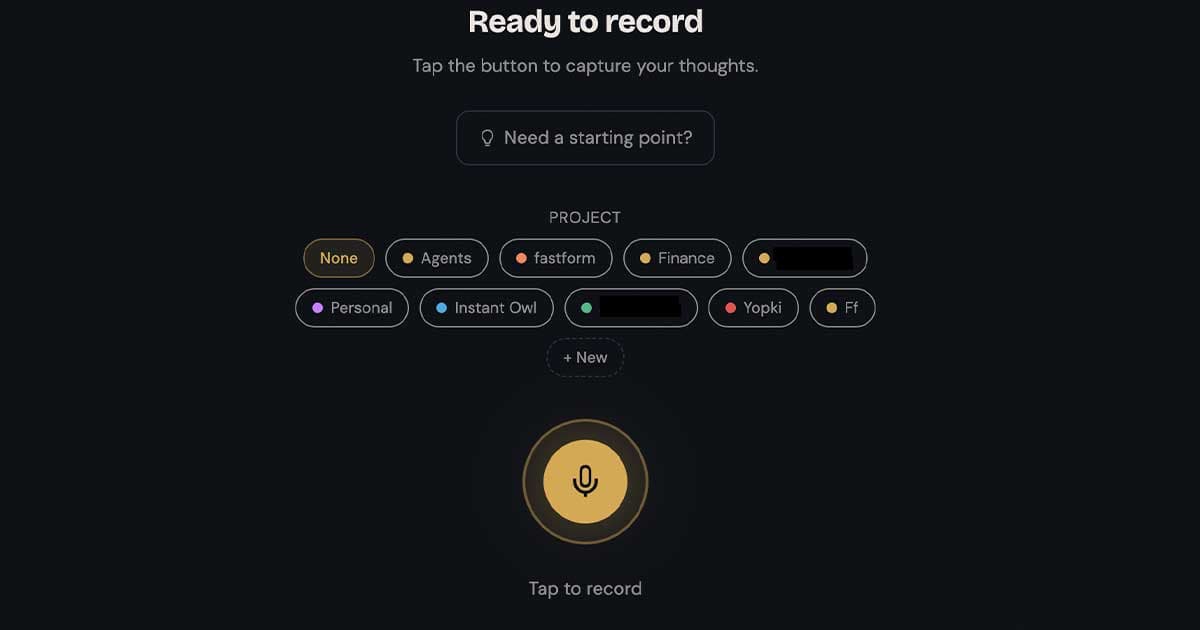
Full disclosure: InstantOwl is our product, and this blog belongs to it. Voice journaling is a core InstantOwl use case: you talk, and InstantOwl hands back an organized, searchable entry instead of a raw file you have to sort through yourself later. That closes the exact gap described above, where a recording without transcription and organization turns into an archive nobody reopens.
InstantOwl is built for someone whose voice journal doubles as a place to think out loud about a problem, a day, or an idea, and who wants to find that entry again weeks later by searching what they said, not scrolling through file names. InstantOwl is currently free to use.
Where InstantOwl is not the right fit: if what you want most is an audio-first archive, meaning you plan to relisten to your own voice the way you would an old recording, plus mood or dream tracking with graphs, a dedicated diary app built around playback, like the one described above, may suit you better. InstantOwl is built around turning what you said into something organized and readable, not around preserving the audio itself as the primary artifact.
If a structured daily writing ritual sounds closer to what you want, see how morning pages work, and how a spoken version of that practice compares to the longhand original.
Related reading
- The brain dump journal: a different kind of daily practice, built for fast release instead of reflection.
- Voice notes: the single recordings a voice journal habit is built from.
- Morning pages: the classic longhand daily practice, and how a spoken version compares.
Frequently asked questions
How do you do an audio journal?
Pick a fixed daily moment, like a commute or right before bed, and talk for two to five minutes about whatever is on your mind, without a script or a plan. Skip worrying about relistening at first. Treat it as a release, and only revisit specific entries later if you decide one is worth it.
Is audio journaling as good as writing?
It is different, not better. Writing forces you to slow down, which some people find helps with reflection. Speaking captures raw feeling faster and removes the friction of handwriting or typing, which suits people whose thoughts move faster than their hands. Neither replaces the other; they serve different moments.
What is the best audio journal app?
There is no single best app for everyone. Look for real transcription, automatic organization, a clear policy on whether your recordings train AI models, and export of your own entries. Judge any app, including InstantOwl, against those four criteria rather than a marketing claim.
Is there a free audio diary?
Yes. Your phone's built-in voice recorder is a free audio diary on its own. Dedicated apps add transcription and organization on top, often with a free tier: Audio Diary offers in-app purchases from $1.49 to $49.99 for its paid features, and InstantOwl is currently free to use.

Written by
Jim BreeseJim Breese is the founder of InstantOwl. He's spent 15 years building companies, from an Airbnb host community he founded and exited to growth leadership at venture-backed SaaS startups. He built InstantOwl because his best ideas kept arriving mid-walk, out of order, and half-finished.
Stop losing good ideas.
InstantOwl turns a rambling voice note into a clean, organized document in moments. Just talk. We'll organize it.
 Try InstantOwl free