How to Transcribe Audio to Text (Every Real Option, With the Fine Print)
By Jim Breese · · Updated
How do you transcribe audio to text?
Every audio-to-text tool on the market falls into one of three price types: taste-then-pay, flat-rate unlimited, or free with a catch. Knowing which type you are looking at before you upload anything tells you exactly what you are about to pay, or where the limit is hiding. For the full 2026 rate comparison, from $0.05 to $1.99 a minute across AI and human options, see our transcription services pricing breakdown.
Taste-then-pay incumbents give a small amount of free transcription, then charge a subscription or per-minute rate once you need more; HappyScribe is the clearest example. Flat-rate unlimited tools charge one flat monthly price for effectively unlimited use; TurboScribe is the honest budget pick here. Free-with-a-catch tools cost nothing but bury the real limit elsewhere, inside a production tool's project caps or an anonymous site's unpublished terms.
None of these three types are wrong; they fit different jobs. Someone transcribing one podcast episode a month (a job our guide to transcribing a podcast covers step by step) has different needs than someone with 40 hours of interview audio on a hard drive. The rest of this post matches each type to the situation it fits, with the exact prices and limits each company publishes. If your file is specifically an MP3, our MP3 to text guide maps the same tools to that exact job.
Taste-then-pay: what does HappyScribe actually cost?
HappyScribe gives you 10 free minutes of AI transcription, one time, with no credit card required, per its site. After that, it moves you to a subscription or pay-as-you-go pricing for longer recordings; the exact numbers are not published on its landing page, so verify current pricing before you commit if the cost matters to your budget.
The accuracy claim on HappyScribe's homepage reads "99% accuracy," which is worth stopping on. That number belongs to HappyScribe's human transcription tier, delivered by native linguists in hours to 24 hours depending on audio length, with accuracy close to 99%, per its own site. Its AI transcription, the fast automated option, is rated separately in HappyScribe's own fine print at up to 96% accuracy on clear audio in common languages. The gap between the headline and the fine print is the whole lesson: a flat "99% accurate" claim almost always describes the human option, not the automated one.
HappyScribe supports 45 or more audio formats including MP3, WAV, M4A, AAC, and FLAC, with no file size limits stated, and exports to TXT, DOCX, PDF, SRT, VTT, and more, per its site. Its own page claims both 150+ and, elsewhere, 120+ supported languages, an inconsistency worth knowing rather than a hard fact to repeat. HappyScribe reports a 4.7/5 Trustpilot rating and more than 6 million users claimed on its site.
HappyScribe is built for people who need a transcript file: podcast episodes, interviews, subtitles. Its 10 free minutes are a taste, not an ongoing free tier, so budget for the subscription if you plan to transcribe regularly. (For podcasts specifically, free podcast summarizers, broken down by output type, often cover the "what did they say" job without transcribing at all; the same goes for summarizing a video instead of transcribing it.)
Flat-rate unlimited: is TurboScribe worth it?
TurboScribe is the honest budget pick for anyone with real transcription volume. Its free tier gives you 3 transcripts a day, each up to 30 minutes, one file at a time, with no credit card required, per its site. That is a real, repeatable free tier, not a one-time taste.
TurboScribe's Unlimited plan costs $10 a month billed yearly ($120 a year) or $20 a month billed monthly, for unlimited transcription for one person, per its site. Its own FAQ states the systems are designed for at least 720 hours of audio or video a month, which is the practical shape of "unlimited" here. Unlimited-plan files can run up to 10 hours or 5GB each, with up to 50 files processed at a time, translation into 134 or more languages, and unlimited storage.
TurboScribe states openly that it is "Powered by Whisper," the open transcription model, and its site claims "99.8% Accuracy," a marketing number to treat as a claim, not a fact, same as any vendor's accuracy figure. French outlet 01net Magazine is quoted on TurboScribe's own site: "Of all the services we tested, TurboScribe offers the best results... the free version allows up to three transcriptions per day of thirty minutes each," confirming the free-tier numbers above.
TurboScribe offers three transcription modes (Cheetah fastest, Dolphin balanced, Whale most accurate), speaker recognition, and AI audio restoration for poor recordings, per its site. It exports to PDF, DOCX, SRT, VTT, CSV, and TXT. For anyone with a backlog of files or a recurring need to transcribe, $10 a month for unlimited use undercuts most named competitors.
Free with a catch: what are Adobe Podcast, audiototext.com, and audioconverter.ai actually free at?
Free-with-a-catch tools cost nothing upfront, but the catch shows up somewhere: inside a production tool's project limits, or inside a site that never publishes its limits at all.
Adobe Podcast offers transcription for free inside Adobe Podcast Studio, its browser-based recording and editing tool, per Adobe's site. You upload audio, get a transcript, correct it in an interactive word-by-word editor, and download it as PDF, DOCX, or TXT. The catch is that transcription itself is not separately capped; the limit lives in Studio's free-plan project caps instead, which allow downloading projects up to 30 minutes long, 2 projects a day, per Adobe's plans page. Its free Enhance Speech noise-cleanup tool separately allows 1 hour a day and files up to 500MB, 30 minutes max duration. Adobe offers a Premium tier with higher caps and video support; its price is not rendered on the pages we checked, so verify it directly on Adobe's site before budgeting around it.
audiototext.com presents itself as "100% free, no signup required, no downloads needed," per its site, with no company or founder named anywhere on the page. Its own FAQ hedges against that framing, stating the site "may offer free or trial-based audio to text conversion options, allowing users to test the speech to text quality before upgrading," which describes an upgrade path the page never prices. No file size or duration limit is published anywhere on the page. The site claims "99% Accuracy Rate" and turnaround "in just 2-5 minutes"; treat both as unverified marketing claims, not facts, the same as any accuracy number in this post.
audioconverter.ai makes a stronger version of the same pitch on its mp3-to-text tool page: "completely free with no signup required," "no limits on the number of MP3 files you can convert," per its site, plus a claimed "99.9% Accuracy" and "200+ Languages." No company is named behind the site. Those specific numbers exceed what current transcription models legitimately claim elsewhere in this post, so we relay them only as the site's own claims, not as fact.
Before uploading audio to an anonymous free site, check for a named company, a retention policy, and a published size or duration limit. Missing all three means treating whatever it transcribes as public, not private.
Tools you may already pay for (or already own)
Before buying anything new, check what is already sitting in a subscription or a device you own. Several mainstream tools include real transcription with limits worth knowing exactly.
Microsoft Word's Transcribe feature requires a Microsoft 365 subscription and caps uploaded audio at 300 minutes a month, or 30,000 minutes a month with a Microsoft Copilot license, per Microsoft's support pages. It accepts .wav, .mp4, .m4a, and .mp3 files, works in Word for the web in Edge and Chrome, and separates speakers with relabelable tags. If the recording came out of a Microsoft Teams call, you may not need Word at all; our guide to transcribing a Teams recording covers the transcript Teams already generates and the limits around it.
Evernote AI Transcribe is available on every Evernote plan including Free, converting files up to 100MB and 2 hours long, in 50 or more languages, per Evernote's page. The catch is not the feature, it is the account around it: Evernote's Free plan caps out at 50 notes total, so a free account fills up fast if transcripts are the main thing you save.
Apple Voice Memos, one of the built-in recorder apps most phones already ship with, transcribes for free on iPhone 12 or later, covering 10 languages, with search across the transcript text, not just the recording title. Google Recorder transcribes for free but only on Pixel phones: real-time transcription from Pixel 3 onward, speaker labels from Pixel 6 onward, and AI summaries from Pixel 8 onward for recordings between 5 minutes and 1 hour. The same already-own-it logic applies to meetings: if the audio you need text from is a Google Meet call, Meet's built-in transcripts cover that job before any tool in this post needs to.
What a transcript doesn't give you
A transcript solves exactly one problem: turning spoken words into written ones. It does not solve the much bigger problem, which is turning what you said into something you can act on.
Say a voice note to yourself is: "call the dentist, follow up with Sam, the Thursday deadline is stressing me out, look into that espresso machine." Every tool in this post, from HappyScribe to Adobe Podcast to Word Transcribe, hands that back to you as one unbroken paragraph of text. None of them split it into a task list, file it under the right project, or make it searchable by anything beyond the exact words used.
A transcript of a ramble is still a ramble: the words are all there, correctly spelled, and just as disorganized as when you said them. Rewriting tools like AudioPen exist for part of that gap, polishing the ramble into clean prose, though they stop short of tasks and projects. Transcription is becoming a commodity, free in Voice Memos and Evernote's free tier, bundled into Microsoft 365 and Adobe accounts many people already pay for. Organizing what a transcript says is the step none of these tools take on.
Where InstantOwl fits
Full disclosure: InstantOwl is our product, and this is our blog. We are not a bulk-file transcription service, and we say that plainly before recommending our own tool.
If you have a folder of interviews, lectures you need to turn into study notes, or someone else's audio to get through, a transcription tool is the right purchase. For volume, TurboScribe's $10-a-month unlimited plan is the honest recommendation. For work that must be near-perfect, HappyScribe's human transcription tier, at accuracy close to 99% per its own site, is the honest recommendation there too.
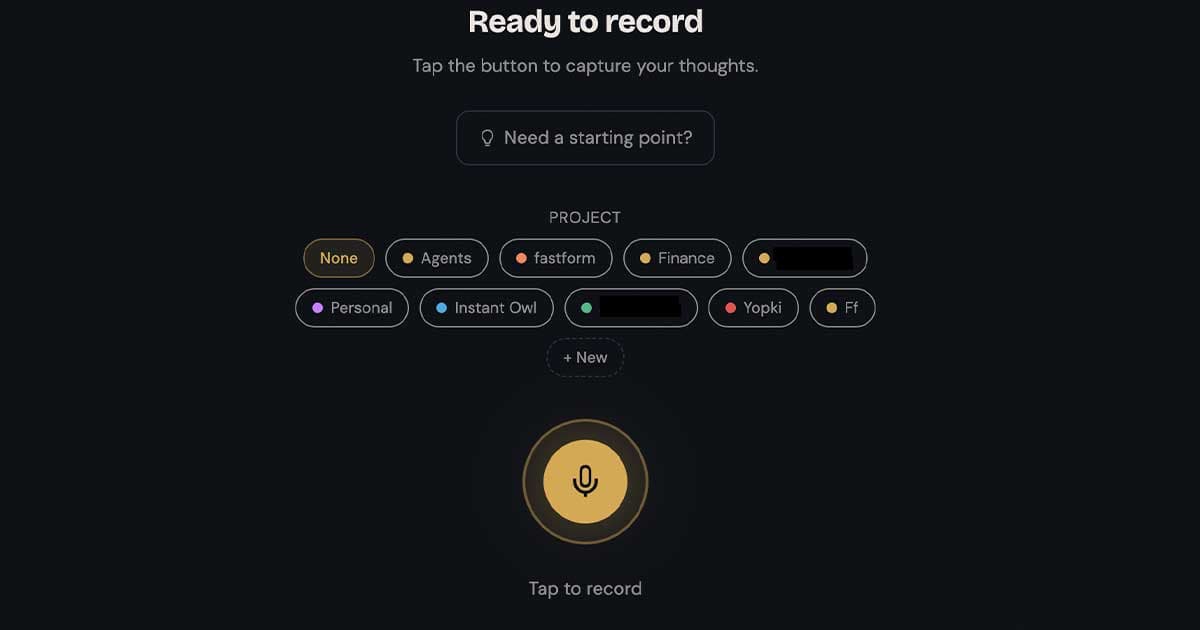
InstantOwl fits a narrower case: the audio is your own voice, recorded to get a thought out of your head (the territory capture apps like Voicenotes also work in), and what you want back is not a transcript file but an organized note, titled, cleaned up, tasks pulled out, filed into the right project. A transcript of your own ramble is still a ramble; InstantOwl's job starts where a transcript's job ends. InstantOwl is currently free to use.
Frequently asked questions
How can I transcribe audio to text for free?
Start with what you already have. Apple Voice Memos is free and built into iPhone 12 or later. Google Recorder is free on any Pixel phone. Evernote AI Transcribe is included on Evernote's Free plan, up to 100MB and 2-hour files, per Evernote's page. If none of those fit, TurboScribe's free tier gives 3 files a day at 30 minutes each with no card required, per its site.
What is the most accurate transcription?
Human transcription. HappyScribe's own site puts its human tier at accuracy close to 99%, delivered in hours to 24 hours. Its own AI transcription is rated separately, at up to 96% accuracy on clear audio, per its own fine print. Treat any flat "99%" claim on an automated tool as marketing, since accuracy always drops with noise, crosstalk, and accents.
Can I transcribe a 2-hour recording?
Yes, depending on the tool. TurboScribe's paid Unlimited plan accepts files up to 10 hours and 5GB. Evernote AI Transcribe accepts up to 2-hour recordings on every plan including Free, per its page, though Evernote's separate web converter tool caps out at 60 minutes, a stricter limit than the app feature. Check the specific tool's file limit, not just its brand's general reputation.
Is there unlimited transcription?
Yes, at TurboScribe's Unlimited tier: $10 a month billed yearly ($120 a year) or $20 a month billed monthly, for unlimited transcription for one person, per its site. Its own FAQ describes the system as designed for at least 720 hours of audio or video a month, which is the real ceiling behind the word "unlimited."
Related reading
- MP3 to text: the how-to version of this post, matched to your exact file and situation.
- Voice notes to text: the personal-voice-memo version of this same taxonomy.
- WhatsApp voice notes: transcribing voice messages specifically, native and third-party.
- InstantOwl: organized notes and tasks from one recording, currently free to use.
Frequently asked questions
How can I transcribe audio to text for free?
Use what you already have first: Apple Voice Memos on iPhone 12 or later, Google Recorder on a Pixel, or Evernote AI Transcribe on its free plan (100MB and 2-hour files, per Evernote's page). If you need a new tool, TurboScribe's free tier gives 3 files a day at 30 minutes each with no card required, per its site.
What is the most accurate transcription?
Human transcription is the most accurate option available, and HappyScribe's own site states its human tier reaches accuracy close to 99% with delivery in hours to 24 hours. Its AI transcription is rated lower in its own fine print, up to 96% accuracy on clear audio, which is the honest ceiling for automated tools generally.
Can I transcribe a 2-hour recording?
Yes, but the tool matters. TurboScribe's paid Unlimited plan accepts files up to 10 hours and 5GB, per its site. Evernote AI Transcribe accepts recordings up to 2 hours on every plan including Free. Its own web converter tool caps out lower, at 60 minutes, so the app and the web tool are not the same limit.
Is there unlimited transcription?
Yes. TurboScribe's Unlimited plan is $10 a month billed yearly ($120 a year) or $20 a month billed monthly, for unlimited transcription for one person, per its site. Its own FAQ notes the system is designed around at least 720 hours of audio or video a month, which is the practical ceiling behind the word unlimited.

Written by
Jim BreeseJim Breese is the founder of InstantOwl. He's spent 15 years building companies, from an Airbnb host community he founded and exited to growth leadership at venture-backed SaaS startups. He built InstantOwl because his best ideas kept arriving mid-walk, out of order, and half-finished.
Stop losing good ideas.
InstantOwl turns a rambling voice note into a clean, organized document in moments. Just talk. We'll organize it.
 Try InstantOwl free