How to Transcribe WhatsApp Voice Notes (Native, Apps, and What's Private)
By Jim Breese · · Updated

Can WhatsApp transcribe voice notes?
Yes. WhatsApp can transcribe voice messages natively, but the feature comes with four real limits worth knowing before you go looking for another app. It is disabled by default, it only shows text to the recipient, it covers just four languages, and it generates the transcript on your device.
To turn it on, go to WhatsApp Settings > Chats and toggle Voice Message Transcripts, then choose your language and either set it up now or wait for Wi-Fi, since WhatsApp downloads a small on-device model the first time. Once it is on, tap and hold any voice message and tap Transcribe to see the text.
The first limit is the one people miss: per WhatsApp's FAQ, "once enabled, the message recipient can see voice message transcripts. The sender can't see the transcripts." If you record a rambling voice note to your sister, only your sister ever gets a transcript. You, the person who spoke it, never do.
The second limit is language. WhatsApp's FAQ states transcription works "at this time, only English, Portuguese, Spanish, and Russian." A voice note in Hindi, Arabic, French, or Japanese plays as audio only, with no text version, no matter who enables the setting.
The upside is privacy. WhatsApp's FAQ describes the process this way: "Voice message transcripts are generated on your device, and your personal voice messages remain protected by end-to-end encryption. No one outside of the chat, not even WhatsApp, can listen to your voice messages, see the content of your voice message transcripts, or share them." WhatsApp also adds a fair caveat: "it's possible that voice message transcripts are inaccurate."
When do you need a third-party transcriber?
You need a third-party transcriber in four specific situations, each mapped directly to one of WhatsApp's native limits. Knowing which one applies tells you exactly which kind of tool to reach for.
Your language is not English, Portuguese, Spanish, or Russian. Native transcription simply will not run. A third-party app that supports more languages is your only option.
You are the sender, not the recipient. WhatsApp's own FAQ confirms the sender never sees a transcript of a note they recorded. If you want text of something you said, you have to route it through another tool yourself.
You want a summary, not just a word-for-word transcript. WhatsApp gives you raw text. If you have a three-minute rambling voice note and want the gist, you need an app built to summarize, not just transcribe.
You want the text out of WhatsApp entirely, into a notes app, a document, or search across old messages, or you want to listen or read without triggering the played receipt. Native transcription keeps everything inside the chat with no export path and no incognito option.
The third-party options, live-verified
Four tools cover most of these situations, at prices from free to $19.97 a month. Here is exactly what each one does, what it costs, and where it falls short, all as shown live on each app's store listing or site.
| Tool | Platform | Price | Notes |
|---|---|---|---|
| Transcriber for WhatsApp | Android | Free with ads and in-app purchases | 4.1 stars, 5.28K reviews, 5M+ downloads |
| Transcriptor for WhatsApp | iOS | From $0.99 for 60 minutes | 5.0 stars from only 16 ratings |
| transcriber.to (bot) | Any device, no install | Free for 15 min/week, $2.99/month unlimited | 109 languages claimed |
| TalkNotes (web) | Any device, browser | Free up to 1 min/5MB, then $19.97/month | Over 50 languages claimed |
Transcriber for WhatsApp (Android, developer Mirko Dimartino) works by sharing a voice message to the app from WhatsApp's share menu, which then shows the text progressively. Its live app description says it transcribes voice messages and "also allows you to listen to them incognito (without activating the blue check)," aimed at moments when listening out loud is not an option.
A newer feature adds automatic summaries for long transcriptions on devices that support Gemini Nano, currently in beta. Its data safety label states "no data collected," though it may share app performance and device IDs with third parties. Real accuracy is not perfect: one Play Store reviewer wrote "not every word is picked up, even with good English spoken," and another reported a three-minute file that never finished processing. If you want Android's own built-in voice input instead of a WhatsApp-specific app, our guide to Gboard's mic button and voice typing fixes covers Android's native option.
Transcriptor for WhatsApp (iOS, developer Luisa Fernanda Castano Jurado) works the same way in reverse: share a voice message to the app from WhatsApp's share sheet. One reviewer described it as "integrated in my whatsapp settings without me needing to download it or transfer it to other apps."
It is free to install, then pay-per-minute: 60 premium minutes for $0.99, 100 minutes for $1.99, plus separate summary credits starting at $0.29 for 10 minutes. Its App Store privacy label states the app does not collect any data. Its 5.0-star rating looks perfect, but it comes from only 16 ratings, a small enough sample that it says little about typical reliability.
transcriber.to is a WhatsApp bot, not an app: you add its contact and forward voice notes to it directly, and it replies in the chat with a transcript, plus an automatic summary for anything over 2 minutes. The free tier gives 15 minutes of transcription a week, roughly 30 average voice notes by the site's own estimate, with no credit card required.
Unlimited use costs $2.99 a month, per the site. It claims support for 109 languages and states a zero-retention policy: "audio is processed instantly to generate the text and then permanently deleted." The tradeoff is structural: forwarding a voice note to the bot moves it outside the original end-to-end encrypted chat, into a third party's hands, before that promised deletion happens.
TalkNotes offers a free web tool: upload a WhatsApp voice message file (under 5MB, up to 1 minute of audio) and get a transcript back, with a stated claim that "your files are deleted right after transcription." The catch is the workflow: forward the message, save it to files, then upload it to the site, clunkier than the two share-sheet apps. Once a voice note is saved as a file, many general audio to text converters can transcribe it the same way; WhatsApp exports voice notes in the Opus format, which not every converter accepts. The same save-and-upload path covers Telegram voice messages and Discord voice messages too.
The free cap of 1 minute is short for a typical voice note. Per TalkNotes' own site, the real product is TalkNotes Plus at $19.97 a month (or $197 a year), which adds up to 2 hours per note and a direct WhatsApp bot of its own.
Which is most private?
Native WhatsApp transcription is the most private option, because it never leaves your device or the end-to-end encrypted chat. The two share-sheet apps come next, since they process audio locally or under a stated no-data-collection label without routing it through a public bot contact. The bot and web-upload tools rank last, since using them means sending your audio to a third party's servers.
Here is the ranking in order, from strongest to weakest privacy position:
- WhatsApp native transcription. Generated on-device, protected by end-to-end encryption throughout, per WhatsApp's own FAQ.
- Share-sheet apps (Transcriber for WhatsApp, Transcriptor for WhatsApp). Both state they collect no personal data, and Transcriber's summary feature runs on-device via Gemini Nano. Still, you are handing the audio file to a third-party app, just not to a public server or bot contact.
- Bot and web-upload tools (transcriber.to, TalkNotes). Both state that audio is deleted right after processing, but that claim belongs to each company, not to something independently verifiable. Forwarding audio to a bot also removes it from the chat's encrypted envelope before that promised deletion happens.
None of this means the third-party options are unsafe to use. It means the tradeoff is real: more languages and more features, in exchange for trusting a company's stated policy instead of a technical guarantee like end-to-end encryption.
What about voice notes you send to yourself?
If you use WhatsApp voice notes as a way to capture your own thoughts, none of the five tools above are built for that job, since every one of them is designed to transcribe messages other people send you. That gap points to a different kind of tool entirely.
Sending yourself a WhatsApp voice note is a common workaround for a real need: getting a thought out of your head fast, without opening a separate app first. It works because WhatsApp is already open on your phone. It falls short because a transcript sitting in your own chat with yourself is not organized into anything, it is just text you have to scroll back through later.
This need is documented, not guessed. In a Reddit thread about a voice-note capture app, importing voice notes people had already sent themselves through WhatsApp was the single most requested feature, described by one user simply as "a lot of users for this use case."
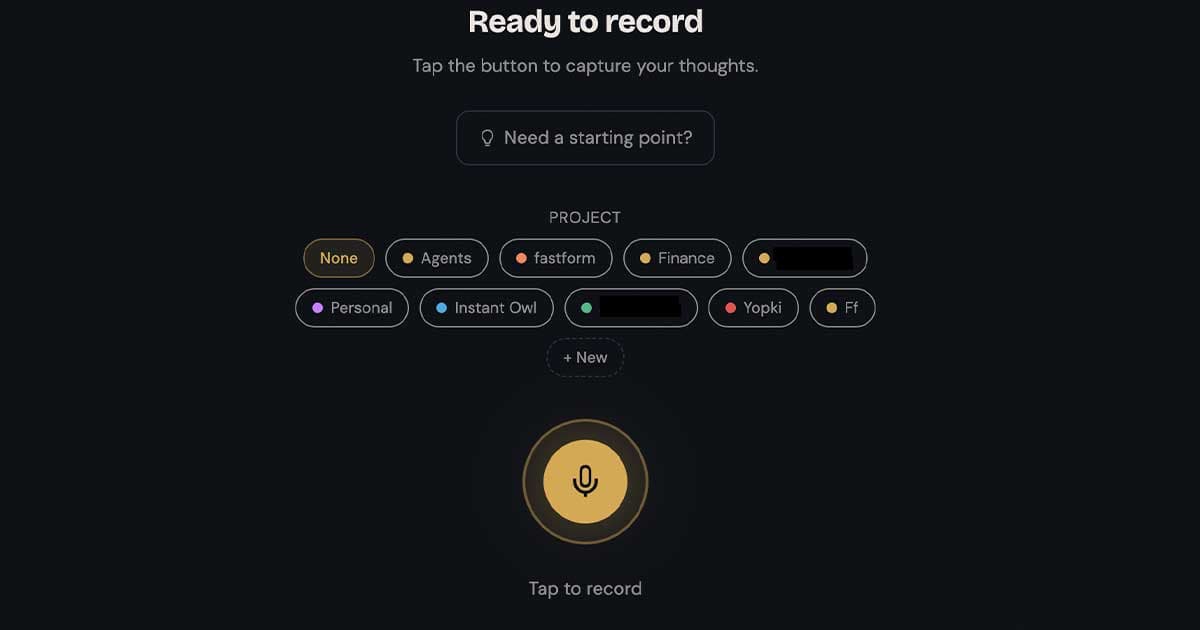
Full disclosure: InstantOwl is our product, and this is our blog. InstantOwl is built for exactly this job: you talk, it transcribes what you said, and it organizes the result into a note, a task list, or whatever format the moment calls for, instead of leaving you with a wall of text to sort through yourself. InstantOwl is currently free to use.
If self-sent WhatsApp voice notes have become your informal memory system, that is a sign you have outgrown a workaround. A tool built for capturing your own thoughts, rather than transcribing someone else's messages, closes the loop that WhatsApp was never designed to close.
Related reading
- Voice notes: how to send them, keep them, and actually use them: the fuller picture of voice notes across WhatsApp, iMessage, and the apps that keep them for you.
- Voice notes to text: more on turning spoken thoughts into usable text once they are out of your head.
- Transcribing voice memos on iPhone: the free built-in path for recordings you keep for yourself, and every fallback when it does not apply.
- Transcription: a broader look at how transcription tools work and where accuracy tends to break down.
Frequently asked questions
How do I get a transcript of a WhatsApp voice note?
Turn on WhatsApp's built-in transcription in Settings > Chats > Voice Message Transcripts, choose your language, then tap and hold any voice message and tap Transcribe. This only works for messages you receive, in English, Portuguese, Spanish, or Russian, per WhatsApp's FAQ.
Can I transcribe a voice note I sent?
Not with WhatsApp's native feature. WhatsApp's FAQ states plainly that once transcripts are enabled, the recipient can see them but the sender cannot. To get text of your own sent voice note, share it to a third-party transcriber app instead.
Is it safe to use a WhatsApp transcriber bot?
A transcriber bot is less private than native transcription because it requires forwarding your audio outside the original end-to-end encrypted chat to a third party. Bots like transcriber.to state a zero-retention policy, but that claim is theirs, not independently verifiable.
What languages does WhatsApp transcription support?
WhatsApp's native transcription currently supports only English, Portuguese, Spanish, and Russian, according to WhatsApp's FAQ. Third-party apps cover more ground: transcriber.to claims 109 languages and TalkNotes claims over 50.

Written by
Jim BreeseJim Breese is the founder of InstantOwl. He's spent 15 years building companies, from an Airbnb host community he founded and exited to growth leadership at venture-backed SaaS startups. He built InstantOwl because his best ideas kept arriving mid-walk, out of order, and half-finished.
Stop losing good ideas.
InstantOwl turns a rambling voice note into a clean, organized document in moments. Just talk. We'll organize it.
 Try InstantOwl free