AI Journaling: What It Actually Does, the Best Apps, and the Privacy Fine Print
By Jim Breese · · Updated

What is an AI journal?
An AI journal is a journaling app that reads what you write or say, then responds: with follow-up questions, patterns it notices across your entries, or a short reflection handed back to you. This guide covers apps like that, Rosebud, Mindsera, Day One, and Reflectly, not academic journals that publish research about artificial intelligence. If you searched "AI journal" looking for a scholarly publication, this is not that page.
The idea sits on top of ordinary journaling. You still write or talk through your day, a feeling, or a problem. The difference is what happens after: instead of a blank page, the app analyzes what you entered and hands something back, a prompt, a spotted pattern, or a direct answer when you ask it a question about your own history.
Does AI defeat the point of journaling?
Whether AI defeats the point of journaling depends on what you journal for. If the value is slowing down to sit with your own thoughts, the way morning pages are built to force, adding a responding AI can feel counterintuitive. If the value is figuring out what a thought means, AI can act as a legitimate second opinion.
The steelman case comes from a 112-comment r/digitaljournaling thread on the best AI-assisted journals. Its top comment argued "AI and journaling does not go well together... using AI to sort that out is a bit counterintuitive."
The thread's highest-scored reply, posted by the original poster, disagreed: "I think I can make the determination about whether it's useful for me, right?... features like prompt generation is kind of helpful." Other commenters built on that. One said they want AI "to help me connect the dots." Another offered a therapist analogy: AI can help you make sense of your own thinking through follow-up questions, but "it can not do the work for you." A commenter who also sees a therapist weekly said the patterns their AI journal surfaces sometimes become topics they later bring into actual therapy sessions.
The original poster's own analogy settles it best: using AI to journal is like using a bike to exercise. "Bikes make you move faster, sure, but you're still exercising." AI does not replace journaling's benefits outright, but it changes the medium, the way any tool does. Whether that trade is worth it depends on why you journal in the first place.
The apps people actually use
Rosebud is the clear favorite among real users. In that same 112-comment r/digitaljournaling thread, Rosebud drew praise from at least nine separate commenters, more than any other app named. One wrote "the way its helped me in such a short amount of the time is insane"; another said "I am ABSOLUTELY blown away." Real complaints surfaced too: one commenter said Rosebud "required payment after 5 minutes of using" on the free web version, with no way to export entries.
Pricing, read live from rosebud.app: Rosebud's paid tier, Bloom, costs $12.99 a month, or $8.99 a month billed annually ($107.99 a year). The site advertises 150,000-plus users and a 4.73-out-of-5 rating from 5,311 ratings.
Mindsera was the second most discussed app in the thread, though its founder, Chris Reinberg, posted about it himself without disclosing that at first, drawing a callout from another commenter: "Don't promote your own app on Reddit without disclosing it." Mindsera's paid tier, Genius, costs $14.99 a month or $10.75 a month billed annually ($129 a year), per its own pricing page. Genius includes Voice Mode, for speaking entries instead of typing, and Call Mode, a back-and-forth voice conversation with the journal.
Day One appeared in the thread only as the traditional journal the original poster used before discovering AI-assisted apps; it is not AI-first. Its pricing, per dayoneapp.com/pricing, is Silver at $49.99 a year or Gold at $74.99 a year, with audio recording and transcription available starting at Silver. Its free tier allows unlimited text entries and journals, capped at one photo per entry. Day One now faces a free rival on Apple devices, too: Apple's built-in Journal app has caught up with ZIP export, iPhone-iPad-Mac sync, and end-to-end encryption, which upends most comparisons written before 2026.
Reflectly, despite ranking for "AI journal" searches, was never mentioned once in the 112-comment thread. Its site publishes no pricing and no specific feature detail, just a tagline calling itself "The World's First Intelligent Journal."
| App | Paid price | Voice input | Stated AI training policy |
|---|---|---|---|
| Rosebud | $12.99/mo or $107.99/yr | Yes, paid feature | Names its AI providers, no explicit no-training statement |
| Mindsera | $14.99/mo or $129/yr | Yes (Voice Mode, Call Mode), paid | States data is not used to train or improve AI models |
| Day One | $49.99/yr (Silver) or $74.99/yr (Gold) | Yes, paid tier only | Not AI-first; end-to-end encrypted |
| Reflectly | Not published on its site | Not detailed on its site | Not stated on its site |
The privacy fine print
Here is what each app's policy actually says, in its own words, read live on rosebud.app, mindsera.com, dayoneapp.com, and reflectlyapp.com.
Mindsera states, verbatim, on its own homepage: "Your writing is fully encrypted at rest and in transit. You can export your data at any time and your data is not used to train or improve AI models." That is the clearest no-training statement among the four apps here.
Rosebud's privacy policy, last updated July 22, 2025, says entries are sent to named third-party AI providers, OpenAI, Anthropic, and Groq, described as "anonymized, containing only the contents of journal entries without any user-identifying information." Rosebud states it has Zero Data Retention agreements and business associate agreements with those providers, plus "HIPAA-aligned data handling." What its policy does not say, in any wording we could find, is that entries are never used to train AI models. Do not read Rosebud's zero-retention language as a no-training guarantee. It is not one.
Day One is not AI-first, but its encryption is real and unconditional: end-to-end encryption applies even on the free tier, with a passcode or biometric lock and full export, per its own site.
Reflectly's landing page makes no privacy claim of any kind. No policy detail appears on the page itself.
Cloud AI processing worries plenty of people, and that concern is well documented in the same r/digitaljournaling thread. One commenter put it plainly: entries flow through "the app's chosen LLM," meaning "somewhere in this flow your journal is not end to end protected." Another described "a sense of prying eyes when data is sent to the cloud for processing... even if you know your privacy won't be compromised." The same contradiction sits at the center of another popular journal: Journey advertises end-to-end encryption while selling an AI that reads across your past entries, a tension we pull apart in Day One vs Journey.
Why not just use ChatGPT?
Because a general chatbot has no memory built for years of entries, no built-in organization, and a weaker search experience than a dedicated journal. Asked exactly this by a commenter in the r/digitaljournaling thread, the original poster answered it well: "There's a limit to how much ChatGPT can store within its memory and context window. A dedicated journaling app can implement a more sophisticated RAG system to connect entries together, or tag them with searchable metadata."
A dedicated AI journal is built to hold years of entries and let you ask questions across all of them, not just the last few messages in an open chat window. That is the entire reason app-specific memory and tagging exist, and why "why not ChatGPT" is close to the first question anyone new to the category asks.
Can you keep an AI journal by voice?
Yes. Rosebud and Mindsera both support talking instead of typing, though voice input sits behind their paid tiers. The strongest evidence that voice belongs in this category comes from the same r/digitaljournaling thread: one commenter described sitting in a parked car running errands, talking to Rosebud back and forth by voice for an hour, and said "I got more out of it than I did in like three years of counseling."
Another commenter said Rosebud is "much better with the transcription (which you gotta pay for) so I can just ramble & brain dump when I need," while also noting occasional transcription dropouts. Voice is clearly what unlocks the format for people who think faster than they type, the same instinct behind AI note tools like Voicenotes and AudioPen, which point it at notes instead of reflection. See voice journaling for what that looks like as its own daily practice, separate from any specific app.
Where InstantOwl fits
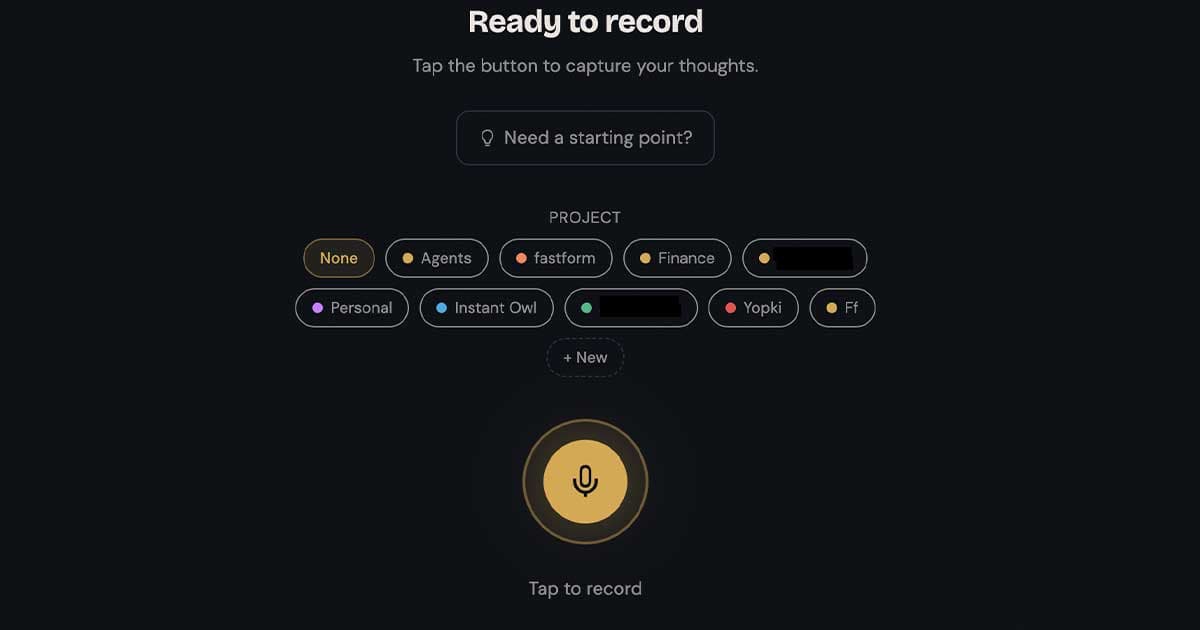
Full disclosure: InstantOwl is our product, and this blog belongs to it. Voice-first AI journaling is InstantOwl's core use case: you talk, and InstantOwl hands back an organized, searchable entry instead of a raw transcript you have to sort through yourself. InstantOwl is currently free to use.
An honest fit note: if what you want is guided, CBT-style prompting or an app that tracks personality traits and habits across months, Rosebud- and Mindsera-style apps are built specifically for that job and do it well. InstantOwl is built for getting a rambling thought out fast and getting back something organized, not for a structured therapeutic prompting system.
Related reading
- Voice journaling: keeping an audio journal as its own daily practice, with or without AI.
- Morning pages: the classic longhand daily writing ritual, and how a spoken version compares.
- The brain dump journal: a faster, less reflective daily habit for emptying your head.
Frequently asked questions
What is an AI journal?
An AI journal is a journaling app that reads what you write or say, then responds with prompts, follow-up questions, or patterns it notices across your entries, instead of leaving a blank page. Apps in this category include Rosebud, Mindsera, and Day One. It is unrelated to academic journals that publish research about artificial intelligence.
Is there a free AI journal app?
Yes, with limits. Rosebud and Mindsera both offer free tiers, though real users report the free web version of Rosebud pushes toward payment quickly. Day One's free tier covers unlimited text entries and journals with one photo per entry, but no AI features. InstantOwl is currently free to use.
Is AI journaling private?
It depends on the app. Mindsera states outright that your data is not used to train or improve AI models. Rosebud names OpenAI, Anthropic, and Groq as processors under zero-data-retention agreements, but its policy does not promise your entries are never used for training. Day One offers true end-to-end encryption but is not AI-first.
Does journaling with AI actually help?
Many users say yes, especially for spotting patterns and getting follow-up questions they would not have asked themselves. In a 112-comment r/digitaljournaling thread, the practice's biggest critics worried AI mediation blunts journaling's benefits, while its defenders compared it to a therapist that helps you make sense of what you already wrote. It depends on what you journal for.

Written by
Jim BreeseJim Breese is the founder of InstantOwl. He's spent 15 years building companies, from an Airbnb host community he founded and exited to growth leadership at venture-backed SaaS startups. He built InstantOwl because his best ideas kept arriving mid-walk, out of order, and half-finished.
Stop losing good ideas.
InstantOwl turns a rambling voice note into a clean, organized document in moments. Just talk. We'll organize it.
 Try InstantOwl free