The Best Voice Notes Apps in 2026 (Honest Picks by Job)
By Jim Breese · · Updated
What is the best voice notes app?
There is no single best voice notes app, because the best one depends on the job you need it for, not a star rating. The category splits into two extremes: plain recorders that do one thing well, and AI apps that have mostly drifted toward business meetings. The middle, an app built for your own personal thoughts, is thinner than it looks, a gap teachers hit head-on when every ranking tool routes their voice notes to students instead.
This list is organized by job, not by rank. It covers plain recording, meetings, cleaning up a single rambling thought, and the daily stream of personal voice notes InstantOwl is built for. InstantOwl is the product this blog belongs to, so treat that entry as a disclosed pick, not a neutral one. Every other entry gets the same honest treatment: what it is genuinely good at, and where it stops.
Best for plain recording: Apple Voice Memos (and Gawk on Android)
If you just want to hit record and keep the file, Apple Voice Memos is the honest default answer. It is free, built into every iPhone, and rated 4.8 stars from about 1 million App Store ratings, a volume no competing app comes close to. Recordings sync automatically across iPhone, iPad, and Mac through iCloud, and on iPhone 12 or later it transcribes what you said, per Apple's own support guide. Our complete Voice Memos guide covers every feature, limit, and recovery trick it ships with.
The honest limit is that recording is all Voice Memos does, the same ceiling every dedicated voice recorder app hits. It hands you a file and, on newer phones, a raw transcript. It does not summarize, organize, extract a task, or notice that three separate recordings are about the same project. For a single memo you will listen back to yourself, that is plenty. For a daily habit of talking through ideas, everything after the recording stops is still on you.
Gawk's "Voice memos - text and audio" is the closest Android equivalent, and it has quietly owned that role for years, rated 4.4 stars from 13.1K reviews with over 1 million downloads. It uses the phone's built in speech recognizer, which works offline once you download a language pack, and adds categories, reminders, and a password lock. It is free, supported by ads and in-app purchases.
Its own Play Store listing discloses a real tradeoff: the app may share location, app info, and device IDs with third parties, and data cannot be deleted once collected, per its own data safety section. That is worth knowing before you make it your default, especially if the voice notes you record are personal.
Best for meetings: Voicenotes.com and Otter
If your problem is meetings, not personal thoughts, Voicenotes.com and Otter are legitimately strong tools built for exactly that. Voicenotes.com has fully pivoted its positioning to "an AI notetaker that works in the background," with copy that reads "tap record at the start of any meeting" and get a summary, action items, and a shareable link. Its App Store listing is rated 4.8 stars from more than 6,600 ratings; our full Voicenotes review digs into its pricing and privacy policy. If Fathom is also on your shortlist, our Otter vs Fathom breakdown compares free-tier limits and auto-join reliability directly, and our Otter vs Fireflies comparison runs the same verified-numbers exercise if Fireflies is the name in the running instead.
Its free Basic plan is real and usable: unlimited recordings, 100 weekly transcription minutes shared across everything you record, support for 100+ languages, and 30 day history, per its own pricing page. Its Pro plan runs $9 per user per month on the web. App Store in-app pricing is higher: $8.99 a week, $14.99 a month, or $89.99 to $99.99 a year, per its App Store listing. If those caps do not match how you record, our Voicenotes alternatives, sorted by job covers what to move to.
The documented weaknesses are worth stating plainly, never as snark. App Store reviewers report recordings stopping mid-session without warning, and separately criticize weak organization and unreliable summaries. Those are real user reports on an otherwise well-rated app, not a reason to avoid it if meetings are genuinely your use case.
Otter comes up the same way in independent discussion. One long comparison thread on r/NoteTaking, reviewing a dozen recording and transcription apps side by side, summed Otter up as reliable but nothing groundbreaking: its free tier "gives you a good taste" of what it can do, without going further on the free plan. For a team that lives in scheduled meetings, Otter and Voicenotes.com are the honest picks, not InstantOwl, and our roundup of Otter alternatives compares more meeting-first options. Fireflies is the other big name in that meetings lane; our Fireflies.ai review checks its unlimited-free-transcription claim against the storage cap sitting underneath it.
Best for cleaning up one thought: AudioPen
If you have one rambling recording you want turned into clean, readable text, AudioPen is the best-reviewed pick for that specific job. It transcribes a voice note and rewrites it: removing filler words, fixing grammar, and applying a writing style you choose. Its own site shows 4.9 out of 5 from 136+ testimonial reviews and claims 200,000+ users; its App Store rating sits at 4.7. Our full AudioPen review goes deeper on where it fits.
Its pricing is unusual in a good way: no subscriptions or auto-renewals, just prepaid terms of 3 months for $33 ($11.00 a month), 1 year for $99 ($8.25 a month, marked "most popular"), or 2 years for $159 ($6.63 a month, marked "best value"), per its own pricing page. Every plan caps each recording at 15 minutes, which is a real constraint worth knowing before you buy.
Real users back up the reputation. On r/NoteTaking, one commenter described AudioPen as "really good at cleaning up messy speech and removing filler words," adding that it "makes your rambling sound coherent." Another user, describing a failed attempt to build the same thing with a DIY Whisper pipeline, concluded that tools like AudioPen are "worth it just to stop thinking about the pipeline."
The honest limit is scope. AudioPen polishes one note at a time; it is not built to take a daily stream of captures and organize them into projects, tasks, and titles you can search later. For a single thought you want to turn into a clean paragraph, that is exactly the job. For everything you say across a week, it is a different job. How that narrow scope stacks up against a rival that chased the meetings market instead is the subject of our AudioPen vs Voicenotes comparison.
What actually makes a voice notes app good?
Star ratings and feature lists miss what users on r/NoteTaking actually care about. A thread asking which audio note-taking apps people use, with 66 comments, converges on a few real criteria that make a better comparison than any spec sheet. The most-praised capability across every recommendation in that thread is cleaning up rambling speech into something structured, not a raw transcript.
The second most common theme is never having to re-listen: users want a summary or structured output automatically, not an audio file they have to replay to remember what they said. Transparent limits matter too. One user asked directly whether "any free app or at least free version" offers a higher time cap, a question the vaguely-worded free tiers in this category rarely answer up front.
Capture speed and hands-free use came up repeatedly: users specifically wanted to capture ideas while driving or walking, without unlocking a phone and finding an app first, a pattern anyone who works out of a car recognizes, like a real estate agent between showings. A few Obsidian users in the same thread insisted on being able to get their notes out into another system, a reminder that lock-in is a real objection even for a good app. Judge any voice notes app against these, not the app's own marketing.
Where InstantOwl fits
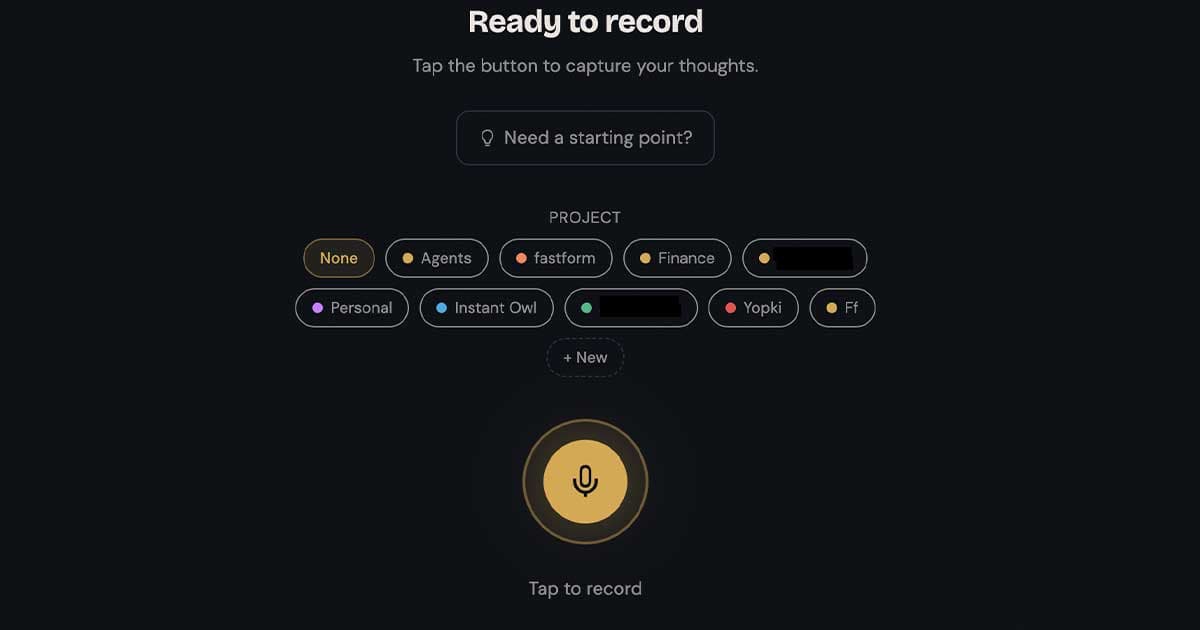
Full disclosure: InstantOwl is our product, and this blog belongs to it. InstantOwl is built for the middle this list keeps circling: not plain recording, not meetings, but the daily stream of personal voice notes a mind produces between those two extremes. You talk the way you would ramble to a friend, and InstantOwl turns that recording into organized output instead of a file you have to sort through later.
Tasks get pulled out automatically. Notes and ideas get organized rather than dumped into one long list. The same recording can come back as a different output depending on what you need next: a summary, a plan, or a to-do list you built by talking. That is the gap every honest source in this post points at: recording is free, transcription is close to free, and organizing what you actually said is the part nobody hands you for free.
The honest not-for: InstantOwl is not built for running meetings. If you need a summary and action items after a call with other people on it, Voicenotes.com or Otter are the better-built tools for that job, and this post says so above. InstantOwl is for the voice note you record alone, walking to your car or at your desk when a thought shows up faster than you can type it. InstantOwl is currently free to use.
How do you choose the right voice notes app?
Pick based on the job, not the app with the most features. If you just want to record and keep a file, Apple Voice Memos (or Gawk on Android) already does that for free, and no other app needs to be involved. If your recordings are meetings with other people on the call, Voicenotes.com or Otter are built specifically for that and do it well.
If you have a single rambling thought you want turned into one clean paragraph, AudioPen's cleanup is the best-reviewed option for exactly that. If your voice notes are a daily habit, the same kind of thought showing up again and again that needs to come back as tasks and organized notes rather than a pile of transcripts, that is the job InstantOwl is built for.
Whichever you pick, the same underlying method matters more than the app: capture the thought the moment it happens, and worry about organizing it after, not while you are still talking. That is the whole idea behind a brain dump, and it applies just as much to a spoken thought as a typed one. For more on what a voice note actually is and how to send or keep one, see our guide to voice notes, and for turning a recording into text specifically, see voice notes to text.
Related reading
- Voice notes: what a voice note actually is, and the etiquette around sending one.
- Voice notes to text: the difference between dictation, transcription, and organized output.
- Brain dump apps compared: a wider look at capture apps beyond voice, including typing-first tools.
- InstantOwl: talk instead of type, and get back organized notes and tasks.
Frequently asked questions
What is the best voice note app?
There is no single best voice note app. It depends on the job. Apple Voice Memos is best for plain recording, Voicenotes.com and Otter are strongest for meetings, AudioPen is best for cleaning up one rambling thought, and InstantOwl is built for a daily stream of personal voice notes that needs to come back organized.
Is there a free voice notes app?
Yes. Apple Voice Memos is free with no meaningful limits and is rated 4.8 stars from about 1 million App Store ratings. Voicenotes.com has a free Basic plan with 100 weekly transcription minutes and 30 day history. InstantOwl is currently free to use.
Is the Voicenotes app free?
Voicenotes.com's Basic plan is free and includes unlimited recordings, 100 weekly transcription minutes, support for 100+ languages, and 30 day history, per its own pricing page. Its Pro plan costs $9 per user per month on the web, while its App Store in-app pricing runs higher, from $8.99 a week up to $89.99 to $99.99 a year.
How do I take voice notes on my phone?
On iPhone, open Voice Memos, tap record, and tap stop when you are done; recordings sync through iCloud and transcribe automatically on iPhone 12 or later. On Android, an app like Gawk's Voice memos uses your phone's built in speech recognizer. For notes that need to come back organized rather than just transcribed, an app like InstantOwl or Voicenotes.com adds that layer on top.

Written by
Jim BreeseJim Breese is the founder of InstantOwl. He's spent 15 years building companies, from an Airbnb host community he founded and exited to growth leadership at venture-backed SaaS startups. He built InstantOwl because his best ideas kept arriving mid-walk, out of order, and half-finished.
Stop losing good ideas.
InstantOwl turns a rambling voice note into a clean, organized document in moments. Just talk. We'll organize it.
 Try InstantOwl free