ADHD Apps That People Actually Keep Using (Honest 2026 Picks)
By Jim Breese · · Updated
What makes an app work for an ADHD brain?
An app works for an ADHD brain when it survives past the first two weeks, not when it has the most features. In a large ADHD community thread asking what apps had actually helped people, the most honest comment wasn't a recommendation at all: "I usually completely forget about these types of apps after about 2 weeks." Another user in the same thread said, "I feel SO overwhelmed." A third added, "I hate trying new apps because I feel like I need to know everything about it all at once."
That abandonment pattern is the real filter, more useful than any star rating. Three traits separated the apps people still use months or years later from the ones they quietly deleted: near-zero input friction (no typing, no setup screens, no decisions before anything gets saved), no punishment mechanics (streak breaks and guilt notifications get uninstalled fast), and the app has to work even on the day memory doesn't, since it can't depend on you remembering it exists. Those three traits map directly onto task initiation, working memory, and time blindness, the mechanics behind why standard ADHD productivity advice backfires in the first place.
This page checks every price below against each app's own official page today, not against an older roundup. That matters here specifically: one app further down (Forest) has had its pricing model change, and older pages still repeat the price it used to charge.
This list is organized by job, not by app category, because that's how the ADHD community actually talks about tools: getting a thought out of your head, remembering a task exists, starting it, staying on it, and knowing when to put the phone down and pick up paper instead.
Get it out of your head: capture that doesn't ask for anything first
The fastest fix for ADHD capture is removing typing entirely, because a blank text field is itself a decision point, and decision points are where thoughts get lost. Voice-first capture solves this by turning a thought into a voice note the instant it exists, with no folder, no title, and no format to pick first.
The evidence for this shows up directly in ADHD community threads. One user described an AI meeting notetaker that "records your meetings... then types up a perfect summary of the conversation, including dates next steps," adding, "I don't take notes in meetings anymore." Another user credited a separate AI task-breakdown tool with something more personal: it "has been reshaping how I perceive tasks," making the steps before a goal visible instead of just the end point.
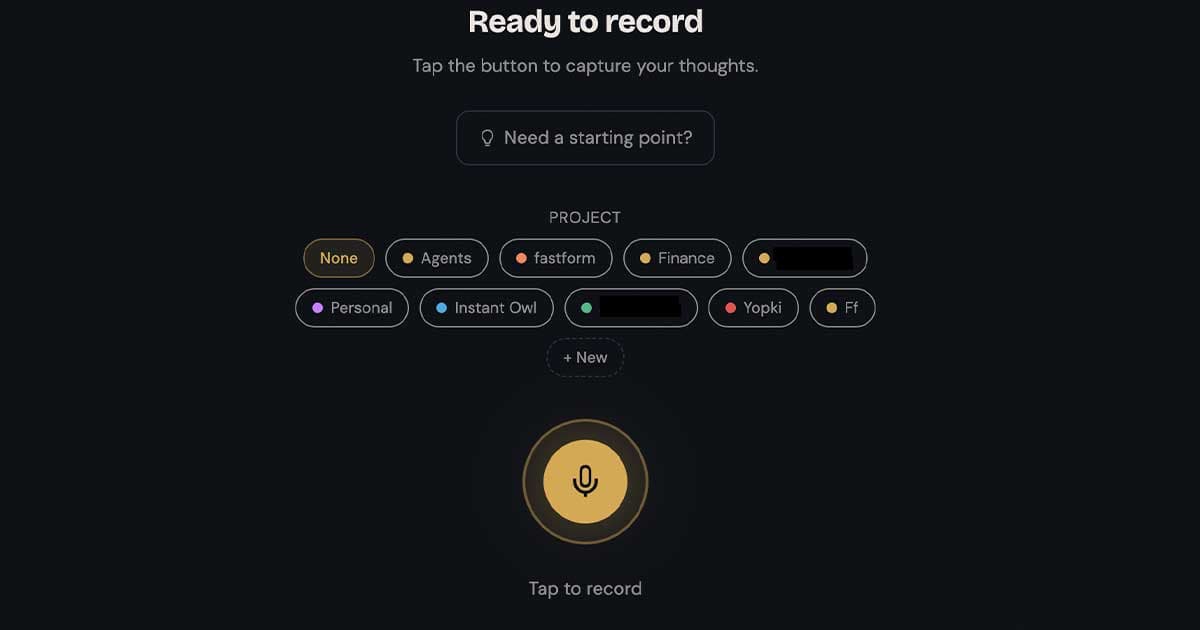
InstantOwl is our product, so treat this as a disclosed pick rather than an outside review. It's built for the same gap those users describe: you talk without organizing anything first, and the recording turns into extracted tasks, a summary, or whatever output format you actually need, instead of leaving you with a wall of transcript to sort through later. It's currently free to use.
Capture only works if it happens before the thought is gone. Anything that asks you to choose a category, write a title, or open more than one screen first is competing with the two or three seconds a thought actually survives.
Remember it exists: task apps that don't rely on your memory
TickTick is the closest thing to a universal favorite in ADHD community threads for tasks and reminders. One user called it "the only app I would pay for indefinitely" after five-plus years of daily use; another said its ability to "see due dates relative to time left instead of just a date" was the reason it stuck where other apps hadn't. TickTick's core app is free, per its own App Store listing ("TickTick is always free, while you could also upgrade to Premium"), with Premium priced at $35.99 a year, or $3.99 a month, according to TickTick's official upgrade page.
Todoist is the next most cited task manager, valued for typing a task like "call the dentist Friday" and having it schedule itself from the words alone. Its free "Beginner" plan covers 5 personal projects; Pro is $7 a month billed monthly, or $5 a month ($60 a year) billed yearly, per Todoist's official pricing page. TickTick is the app people compare it against most, at roughly half the price with a built-in calendar thrown in; our Todoist vs TickTick comparison lines up the real tradeoffs.
Remember the Milk shows up across multiple ADHD sources as the veteran pick, named in one user's own stack as a "complex task organizer." Its Pro tier is $49.99 a year, per Remember the Milk's official upgrade page, adding subtasks, unlimited sharing, and offline access on top of a free tier that caps sharing at two people.
Remembering a task exists is a different job from capturing the thought that created it. A task can be perfectly captured and still get lost the moment it's no longer in front of you, which is why a dedicated reminder app earns its own place even when a capture tool already exists.
One ADHD tax story from that same community thread is worth repeating honestly: a user described paying $42 for a forgotten trial cancellation on TickTick. A task app is only worth the subscription if you're actually using the plan you're paying for.
Start the task: breaking the freeze before it begins
Goblin Tools is a free tool built for the moment a task feels too big to start, breaking it into smaller steps with its "Magic ToDo" feature. The site is "kept free by our sponsors," per Goblin Tools' own homepage, with other tools for reading emotional tone in a message (Judge), explaining something confusing (Professor), and turning a rough brain dump into a list of actions (Compiler). It has mobile apps for iOS and Android.
Initiation is a different problem from remembering a task exists. A task can be sitting right in front of you, fully remembered, and still be impossible to start because the first step isn't obvious. Breaking "clean the kitchen" into "put one dish in the sink" solves a starting problem that no reminder ever will.
The body-double idea works the same way without an app: doing a task alongside another person, in person or on a video call, even if they're doing something unrelated. It comes up often in ADHD communities for exactly this reason. A task that felt impossible alone often becomes possible once someone else is quietly in the room.
Stay on it: focus tools built around trees and pets, not guilt
Forest is one of the most recommended focus apps in ADHD community threads, and it's also the clearest example of a stale price still circulating. Several sources describe Forest as a cheap one-time purchase; one user in the same thread said she paid "a one-time ~$3" for it. That's no longer accurate. Forest's own App Store listing, checked directly, shows the base app is now free with a "Forest Plus" subscription: $5.99 a month, or $32.49 to $35.99 a year, listed there as "Early Bird" pricing.
This isn't a criticism of Forest; plenty of older review pages just haven't caught the change. It's a reason to check a price on the source before you buy, which is the same standard this page holds itself to.
What hasn't changed is the mechanic that makes Forest stick: a tree grows while you stay off your phone, and it dies if you leave the app mid-session. One user in an ADHD community thread said it "motivate[s] me to study, and it helps to break up sessions into chunks." Breaking work into short timed chunks like that is the core idea behind the Pomodoro Technique, a timer method that pairs focused sprints with deliberate breaks.
Finch takes a gentler, no-punishment approach: you take care of a virtual pet by taking care of yourself, with no penalty for a missed day. One user called it "so heavily customizable (even on the free plan)" that it became a full to-do and chore list, adding, "there's no punishment if you don't get something done, just genuine good vibes." Another said plainly, "It's literally been life-altering for me." Finch's base app is free; Finch Plus is $9.99 a month or $69.99 a year, per Finch's official help center pricing page.
The difference between Forest and Finch is worth naming: both use game mechanics, but one grows something and the other cares for something, and neither one scolds you for a missed day. That's a mechanical distinction, not a moral one, and it's the reason both keep showing up in the same threads as the apps that lasted.
When paper beats apps
Sometimes paper is the right answer, and that's a legitimate outcome, not a failure to find the right app. In the same ADHD community thread, one user wrote, "Apps make it worse other than Calendar, timer, and reminders. I'm so much better with an old-school analog card system." Another said, "Nothing has ever worked for me except the built-in Apple Calendar and Notes apps. Anything else I forget about or use to procrastinate."
The paper camp isn't universal even among people who prefer it. One user described carrying a paper agenda everywhere, saying, "if I didn't have my agenda I would probably already be kicked out from my job." A different user in the same thread said the opposite: "physical note taking just does not work for me... I lose them... or I'll just forget they exist. But I'm on my phone very regularly."
Both are correct, for different brains. Paper wins on the physical act of writing (several people say the color coding and handwriting itself helps in a way no app replicates) and loses on reminders that never get set, the same split that runs all the way through ADHD calendar apps. There's no cure here, on paper or in an app, only a match between the tool and how a specific brain holds onto things.
How to choose without the two-week abandonment
Pick one app per job, not one app for everything. All-in-one apps that promise to handle capture, tasks, calendar, and focus in a single system tend to create more setup than they save. ADHD communities consistently favor small, single-purpose tools that do one thing without asking for much in return.
Start with whichever job is costing you the most right now: a task app if things keep getting forgotten, a focus app if starting is fine but finishing isn't, or a capture tool if the real problem is thoughts disappearing before you get anywhere near a task list. Add a second app only after the first one has survived a real two weeks, not just a good first afternoon.
Lowest-friction input wins over every other feature. An app with more customization, more views, and more integrations only helps if you actually open it on your worst day, not just your best one. The moment an app asks you to type, categorize, or configure before it will save anything is the moment it becomes the next app you forget about in two weeks.
Related reading
- Best ADHD note-taking apps: the capture side of this problem, in more depth.
- ADHD brain dump: the method behind getting a thought out fast, with or without an app.
- ADHD calendar apps: where a task goes once you've remembered it exists.
- InstantOwl: talk instead of typing, and let the sorting happen after you capture.
Frequently asked questions
What is the best app for ADHD?
There is no single best app for ADHD, because different apps solve different jobs: capturing a thought, remembering a task exists, starting it, and staying focused on it. TickTick is the closest thing to a universal favorite for tasks and reminders, Finch is the top pick for gentle, no-punishment motivation, and voice-first tools like InstantOwl solve capture. Match the app to the job, not the other way around.
Are there free ADHD apps?
Yes. TickTick, Todoist, Remember the Milk, Goblin Tools, Forest, and Finch all offer a real free tier, and InstantOwl is currently free to use. Free is often the right stopping point for capture and task apps, since paid tiers on Forest and Finch mostly add cosmetic options and analytics rather than the core mechanic that makes the app work.
Do ADHD apps actually help?
ADHD apps do not treat or cure ADHD, and no app on this page claims to. What a well-matched app does is remove friction between having a thought and acting on it: fewer taps, voice instead of typing, no penalty for a missed day. People in ADHD communities describe real relief from apps built this way, and real abandonment, often within two weeks, from apps that aren't.
What app helps ADHD adults remember tasks?
TickTick is the most consistently recommended app for remembering that a task exists, credited for showing due dates relative to time left rather than just a date, plus color coding and recurring reminders. Remember the Milk and Todoist are the next most cited alternatives, each with a free tier and a paid tier of 60 dollars a year or less.

Written by
Jim BreeseJim Breese is the founder of InstantOwl. He's spent 15 years building companies, from an Airbnb host community he founded and exited to growth leadership at venture-backed SaaS startups. He built InstantOwl because his best ideas kept arriving mid-walk, out of order, and half-finished.
Stop losing good ideas.
InstantOwl turns a rambling voice note into a clean, organized document in moments. Just talk. We'll organize it.
 Try InstantOwl free