Wispr Flow Review: What It Costs and Is It Safe?
By Jim Breese · · Updated
What is Wispr Flow?
Wispr Flow is a cloud-based AI dictation tool. You speak, and it types clear, polished text directly into whatever app you have open, from email to Slack to a code editor, per Wispr Flow's own homepage description of turning speech into "clear, polished writing in every app."
It runs on Mac, Windows, iPhone, and Android, per the homepage's platform list. The iPhone app launched in June 2025 and the Android app followed in February 2026, according to Wikipedia's entry on the company. Wispr Flow supports 104 languages with automatic detection, per Wikipedia (the homepage itself advertises "100+ languages").
The company, Wispr AI, Inc., was founded in 2021 by Tanay Kothari and Sahaj Garg. It originally set out to build a non-invasive wearable device and pivoted to dictation software in 2024, per Wikipedia. It has since raised $81 million total across two funding rounds, also per Wikipedia.
Past the pitch, the product itself has real features: an AI layer that auto-edits your speech into clean prose, a personal dictionary for names and jargon it would otherwise mishear, a snippet library for voice shortcuts, and settings that sync across every device you use it on, per the homepage. Wispr Flow's own tagline claims it works "4x faster than typing," per the homepage. If a free built-in is all you need, macOS and Windows both ship one: see our guide to dictation on Mac and our Win+H voice typing walkthrough for the exact toggles and honest limits of each. Writers dictating whole chapters lean on that AI cleanup layer; our dictation for writers guide covers the draft-by-voice, edit-by-hand workflow and where Wispr Flow fits it.
How much does Wispr Flow cost?
Wispr Flow has a free plan and one paid tier, Pro, at $15 a month or $12 a month billed annually. Here is the exact breakdown, per Wispr Flow's pricing page as read live on 2026-07-16.
Flow Basic, the free plan, costs $0 and caps you at 2,000 words per week if you dictate on Mac or Windows, and 1,000 words per week on the iPhone app. Android currently has unlimited words per week, but the pricing page marks that "limited time only," so expect it to change. The free plan still includes the custom dictionary, 100+ languages, Privacy Mode, and HIPAA-ready handling, per the pricing page.
Flow Pro removes the word cap entirely and costs $15 per user per month billed monthly, or $12 per user per month billed annually (works out to $144 a year), a 20% discount, per the pricing page. Pro adds prioritized support, a command mode for hands-free editing, early feature access, and team collaboration tools.
Wispr Flow offers a 14-day free trial of Pro with no credit card required, per both the homepage and pricing page. Students get three months free plus 50% off Pro afterward, per the pricing page; the iOS App Store lists that discounted rate at $7.49 a month or $72 a year, alongside a Pro Weekly option at $4.49, per the App Store listing.
Flow Pro for Teams charges the same per-user price and adds a shared dictionary, centralized billing, and basic usage dashboards, per the pricing page. Flow Enterprise is custom-priced through sales and adds SOC 2 Type II and ISO 27001 certification, enforced HIPAA compliance, SSO and SAML, and volume discounts, also per the pricing page.
Is Wispr Flow safe?
Yes, in the standard SaaS sense: Wispr Flow encrypts data in transit and at rest, maintains SOC 2 Type 2 compliance, and is HIPAA-ready on all plans, per its data-controls page and homepage. But two privacy-relevant settings are on by default, not off, and you should know about both before you dictate anything sensitive. Clinicians should read that HIPAA-ready claim carefully rather than treat it as a substitute for a signed BAA; our guide to medical dictation pricing and compliance covers which tools actually offer one.
First, transcription only happens in the cloud. Wispr Flow's data-controls page states plainly: "Transcription always occurs on the cloud." There is no local or on-device option, unlike some competitors (more on that below).
Second, Wispr Flow trains its AI models on your dictations by default. Per the data-controls page: "If you do not have Privacy Mode enabled, your dictation data may be used to evaluate, train, and improve Wispr features and AI models." Turning this off is a single toggle: open Settings, go to Data and Privacy, and turn on Privacy Mode. With Privacy Mode on, "none of your dictation data (i.e. audio, transcript, edits) will be used to evaluate, train, or improve AI models, by Wispr or any third party," per the same page.
Third, and this is the one Reddit users flag most often: Context Awareness is on by default and sends more than your dictation. Per Wispr Flow's own docs article on the feature, it collects the app you're using, the text before and after your cursor, selected text, a screenshot, on-screen text, conversation history with participant IDs, variable and file names in coding apps, and the list of apps open in your session, sending all of it to Wispr with every dictation, unless Privacy Mode is on.
Password field contents are excluded by design, though the docs note custom or web-based password fields may still be read as regular text. To turn Context Awareness off entirely, go to Settings, then Data and Privacy, and toggle it off; enterprise admins can also disable it organization-wide, per the docs.
This confirms a complaint that circulates on Reddit rather than dismissing it: one commenter wrote that "WisprFlow constantly takes screenshots of your screen," calling it "a massive privacy concern" for regulated industries. That claim is accurate, straight from Wispr's own documentation, not a rumor.
On retention: Wispr Flow only reaches zero data retention when both Privacy Mode is on and Private Cloud Sync is off, per the data-controls page. In that state, audio is "processed in real time and discarded after the request completes." Turn Private Cloud Sync on for cross-device history, and your data persists on Wispr's servers instead. Third-party LLM providers that help process your content delete it "generally within 30 days" and do not train on it, per Wispr Flow's privacy policy.
The fair verdict: Wispr Flow is safe in the mainstream sense, with real certifications behind it. It is a cloud product whose two most privacy-sensitive behaviors, model training and screenshot capture, are opt-out rather than opt-in. If you handle sensitive material, flip both toggles before your first dictation.
What do real users say about Wispr Flow?
Real users rate Wispr Flow highly on iPhone and mixed on Android. The iOS app holds 4.8 out of 5 stars from more than 12,000 ratings, per its App Store listing. The Android app sits at 3.8 out of 5 from 2,975 ratings with over 1 million downloads, per its Google Play listing. Part of the gap is age: Android launched in February 2026, per Wikipedia, so the app has had far less time to mature than iOS, which launched in June 2025.
iOS reviewers praise the transcription quality and automatic formatting. One App Store review reads: "This app changes everything. It is context-aware. It capitalizes and adds punctuation properly." Reviewers also credit it for accessibility and for beating Apple's native dictation, per the App Store listing.
The recurring iOS complaints are stability and hardware conflicts. One review states plainly: "If you're a creator who uses the Apple Keyboard or any external keyboard, the app simply doesn't function properly." Other reviewers report crashes needing a restart and slow customer support, per the App Store listing.
A March 2026 Reddit thread in r/Productivitycafe gives a useful outside read. The original poster, who types 30 to 35 words per minute unassisted, reported an effective 102 words per minute using Wispr Flow, and said it replaced a workflow of dictating into ChatGPT and copy-pasting, since Wispr Flow works directly in any text field. Their listed pros: it works everywhere, English accuracy is solid, it handles longer AI prompts well, and setup is minimal. Their cons: it struggles in noisy environments, a laptop microphone is inconsistent (AirPods work better), and the free tier runs out quickly.
Other commenters in the same thread raised the exact Context Awareness behavior confirmed above, and one trilingual user reported language mixing, including a German phrase mistranscribed as its near-opposite. Not every review is glowing: one commenter called it "worse than Microsoft in-built dictation" and uninstalled it within a week.
Is Wispr Flow worth it?
Wispr Flow is worth it if you dictate across multiple apps and multiple devices and want the most polished, best-supported cloud dictation software available today. The 4.8-star iOS rating, four-platform coverage (Mac, Windows, iPhone, Android), and 104 supported languages back that up, per the sources above.
It is a harder sell in three specific situations, all sourced from the user reports above. If you dictate in noisy environments regularly, expect accuracy to drop. If you want your voice processed only on your device rather than in the cloud, Wispr Flow cannot offer that; it has no local processing option, per its own data-controls page. And if you dictate daily on the free plan, the 2,000-words-a-week desktop cap and 1,000-words-a-week iPhone cap will likely feel tight within days, per the pricing page and the Reddit thread's own free-tier complaint.
If local processing or a one-time payment matters more to you than polish, the natural alternative is superwhisper, which processes audio locally by default and offers a lifetime purchase option. See our superwhisper review for the full breakdown of its pricing, privacy model, and honest downsides, or our Wispr Flow vs Superwhisper comparison if you want the two weighed head to head.
Wispr Flow vs InstantOwl: different jobs
Full disclosure: InstantOwl is our product, and this is our blog. Wispr Flow and InstantOwl are not competitors; they solve two different moments.
Wispr Flow is dictation: you talk, and your words appear as text in whatever field is open right now, in real time, formatted and punctuated. It is built for the moment you already know what you want to say and just need it typed for you, an email reply, a Slack message, a code comment.
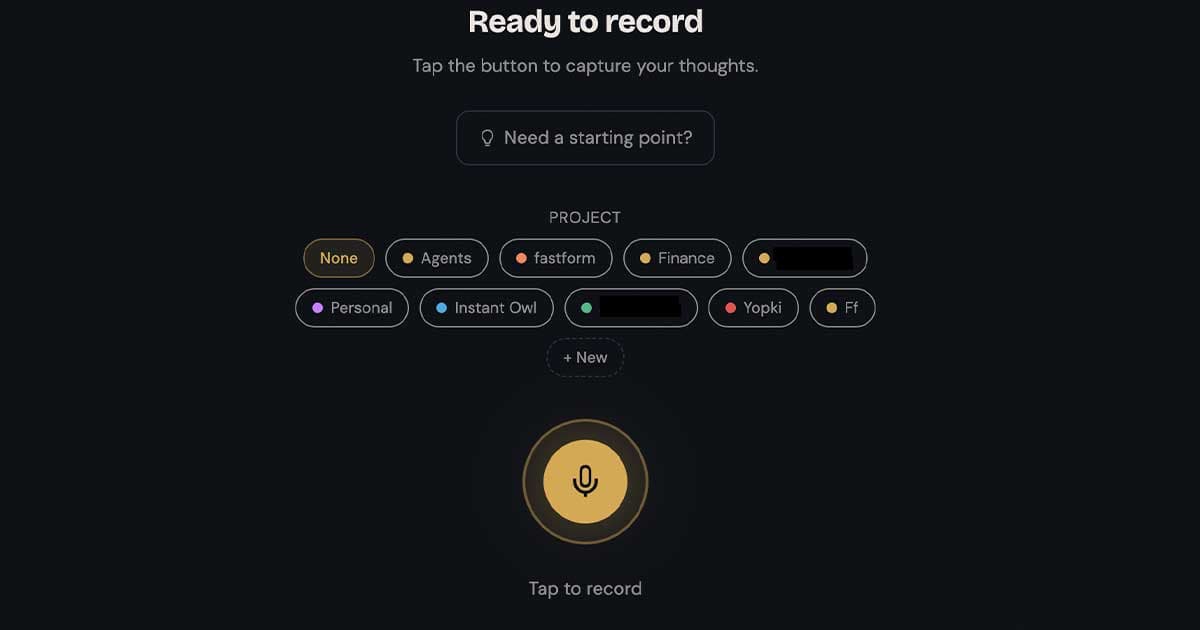
InstantOwl is built for the opposite moment: when what comes out of your mouth is a messy brain dump, not a finished sentence, and what you actually need back is organized notes, extracted tasks, or a plan, not a wall of raw text you still have to sort through yourself. Say "call the dentist, follow up with Sam, the Thursday deadline is stressing me out" into Wispr Flow and you get that exact sentence, typed. Say the same thing into InstantOwl and you get a task list.
The two fit together rather than compete. Some people dictate quick replies with Wispr Flow and save the longer, messier thinking-out-loud sessions for InstantOwl. InstantOwl is currently free to use.
If fast, accurate, cross-app dictation is your main need and Wispr Flow's cloud-only privacy model gives you pause, read our superwhisper review next; it runs locally by default. For the bigger picture on what happens after any dictation tool hands you a transcript, see voice notes to text and our general guide to voice notes.
Related reading
- superwhisper review: the local-processing, privacy-first alternative to Wispr Flow.
- Voice notes to text: what happens after dictation, turning a transcript into something usable.
- Voice notes: how voice notes work on iPhone and WhatsApp, and why a transcript alone is not enough.
Frequently asked questions
What exactly does Wispr Flow do?
Wispr Flow is cloud-based AI dictation. You speak, and it types clear, polished text directly into whatever app you have open, on Mac, Windows, iPhone, or Android, per Wispr Flow's homepage.
Is Wispr Flow free?
Yes, Wispr Flow has a free plan called Flow Basic that costs $0, capped at 2,000 words per week on Mac or Windows and 1,000 words per week on iPhone, per Wispr Flow's pricing page.
How much does Wispr Flow cost?
Wispr Flow Pro costs $15 a month billed monthly or $12 a month billed annually ($144 a year), with a 14-day free trial and no credit card required, per Wispr Flow's pricing page.
Is Wispr Flow safe?
Yes in the standard sense, with TLS encryption, SOC 2 Type 2 compliance, and HIPAA-ready plans, but AI training on your dictations and Context Awareness screenshots are both on by default; turn them off in Settings under Data and Privacy, per Wispr Flow's own data-controls page and docs.

Written by
Jim BreeseJim Breese is the founder of InstantOwl. He's spent 15 years building companies, from an Airbnb host community he founded and exited to growth leadership at venture-backed SaaS startups. He built InstantOwl because his best ideas kept arriving mid-walk, out of order, and half-finished.
Stop losing good ideas.
InstantOwl turns a rambling voice note into a clean, organized document in moments. Just talk. We'll organize it.
 Try InstantOwl free