The ADHD Calendar Problem: Paper, Apps, and What Sticks
By Jim Breese · · Updated

What makes a calendar work for ADHD?
A calendar works for an ADHD brain when getting a thing into it is almost as fast as the thought that produced it, and when looking at it takes no real effort. The calendar grid itself, whether it costs $2 or $30 a month, is rarely the actual problem. Capture and attention, the two steps around the grid, are where most calendar systems for ADHD fail, and our wider guide to the working memory and time blindness behind ADHD productivity advice digs into why those two steps break down.
This is worth saying up front because the two camps rarely talk to each other. A search for "adhd planner" on Amazon returns page after page of physical paper planners, a sign that a real slice of ADHD searchers want a physical product, not an app. Reddit threads about ADHD apps and about Mac calendar apps are both full of people firmly on each side, some of whom tried the other camp and switched back.
Neither camp is wrong. A planner that gets used, paper or digital, beats a perfect system abandoned in week two. This post treats both as legitimate starting points, not a strawman to clear out of the way before "the real answer."
Why does a planning ritual work for some ADHD brains and repel others?
A planning ritual works for a brain that finds comfort in a repeatable morning or evening routine, the same instinct that makes a daily AI journaling habit stick for some people, and repels a brain that experiences any daily setup step as a chore it will eventually skip. Both reactions show up constantly wherever ADHD calendar apps get discussed, which is why no single planning app wins across the board.
The clearest evidence for this split comes from a Reddit thread on calendar apps for ADHD, where one commenter described trying Sunsama, a guided daily-planning app, for a month. She loved the weekly planning view, but said it felt like too much setup every day, and that her ADHD brain "just wants to drop things in quickly and not overthink it."
Other commenters in the same thread land on the opposite end. One recommended a plain, simple calendar app, no gimmicks, similar to Apple Calendar or Google Calendar, adding that the more features a planner had, the more it distracted the person using it. A separately upvoted comment in the same thread warned against "all-in-one" apps like Notion or Sunsama altogether, arguing that people end up "spending more time setting up, configuring, and tweaking than actually doing the work."
Neither side is describing a flaw. A ritual-loving brain gets real structure from a guided daily plan. A drop-it-fast brain gets real relief from skipping the ceremony. The tools later in this post are grouped by which side they serve, not ranked against each other.
Is paper or digital better for ADHD?
Neither paper nor digital is universally better for ADHD. Paper wins on visibility and on having zero notifications to dismiss. Digital wins on reminders and on reaching you wherever you already are, which a paper planner cannot do once it is left in a bag or a drawer.
The case for paper shows up directly in search results: Amazon's results for ADHD planner queries are dominated by physical paper planners, not apps, a sign that a meaningful share of searchers want something they can hold. One Reddit commenter put it plainly, describing herself as "so much better with an old-school analog card system" than with any app she had tried.
A commenter in the separate thread about Mac calendar apps described switching back to "a good old paper calendar and a pencil" after trying digital options. The reasons people give for paper are consistent: it is visible without opening anything, and it never interrupts with a notification to dismiss and then forget to act on.
Paper's honest failure mode is just as consistent: it is not with you the moment a thought hits if you left it at home, at a desk, or in last month's bag. A planner in a drawer reminds you of nothing. That gap is why people who abandon paper often try an app next, and why people who abandon an overloaded app often try paper next.
What are the best digital calendar apps for ADHD?
The strongest digital options split into two tiers by price and by how much ritual they ask of you: lighter tools built for quick capture (Google Calendar, Structured, Tiimo), and premium planning systems built around a guided daily ritual (Morgen, Sunsama). All five prices below were checked on each vendor's own official page on 2026-07-16.
| App | Free tier | Paid price | Ritual required |
|---|---|---|---|
| Google Calendar | Yes, included with a Google account | None | Low |
| Structured | Yes | Roughly $6.99/month or $29.99/year, $99.99 lifetime (App Store listing) | Low |
| Tiimo | Yes, mobile app only (web needs Pro) | Roughly $12/month, discounted yearly plan (exact price shown at App Store checkout) | Low to medium |
| Morgen | No free plan, 14-day trial | $15/month billed yearly, or $30/month billed monthly | High |
| Sunsama | No free plan, 14-day trial | $17/month billed yearly, or $22/month billed monthly | High |
Google Calendar is the free baseline nearly everyone already has. Its features page highlights tasks that automatically appear on the calendar once they have a date, one-click event creation from email, and focus time blocking. It is not built for ADHD specifically, and more than one Reddit commenter said that was exactly the point: a friend with ADHD found a plain, simple calendar app worked better for him than anything with more features.
Structured turns your day into a single visual timeline instead of a list, importing your existing calendar and letting you drag tasks around it. A commenter in the Mac calendar apps thread recommended it directly, and a separate ADHD community thread praised its energy-level tags on tasks, meant to stop you from overcommitting a low-energy day. The app is free to start. Structured does not publish prices on its own site, so the numbers above come from its App Store listing, where Pro runs roughly $6.99 a month or $29.99 a year, with a $99.99 lifetime option.
Tiimo is built specifically for neurodivergent planning, with a visual color-coded timeline, a focus timer, and AI task breakdown you can trigger by typing or speaking. Its free tier covers the mobile app; the web planner requires Pro. Tiimo does not publish exact prices anywhere on its site. Its own pricing FAQ says only that "your local price will be shown in the App Store at checkout," and its App Store listing shows Pro at roughly $12 a month with a discounted yearly plan.
Morgen has no free plan, only a 14-day free trial with full access. Per its official pricing page, Pro runs $15 a month billed yearly or $30 a month billed monthly. Every plan includes AI-assisted time blocking and unlimited calendar and task integrations, which fits the ritual-loving side of the split above, not the drop-it-in-fast side.
Sunsama is the guided-ritual app from the abandonment quote earlier in this post. Per its official pricing page, it costs $17 a month billed annually or $22 a month billed monthly, with a 14-day free trial and, in its own words, no free forever plan planned. It rewards a daily planning session, the same nightly-list habit behind paper methods like the Ivy Lee method, where you write and rank tomorrow's short task list the evening before. It does not reward dropping things in quickly.
Is there a free ADHD planner app?
Yes. Structured and Tiimo both have a genuine free tier, and Google Calendar is free for anyone with a Google account. Morgen and Sunsama are premium only, with no free plan and a 14-day trial as the only way to test them before paying.
Free does not mean identical. Structured's free version covers its core visual timeline. Tiimo's free tier is mobile-only, with the web planner locked behind Pro. Google Calendar needs no upgrade at all for basic scheduling, which is part of why several ADHD users across both Reddit threads researched for this post said it, or Apple Calendar, was the only calendar app that ever actually stuck.
Why doesn't a calendar fix the real problem?
A calendar only helps once something is actually in it, and getting things in is the step ADHD planning keeps failing at, not the calendar grid itself. The Sunsama quote above says this directly: the daily setup ritual, not the calendar, was what her brain refused to keep doing.
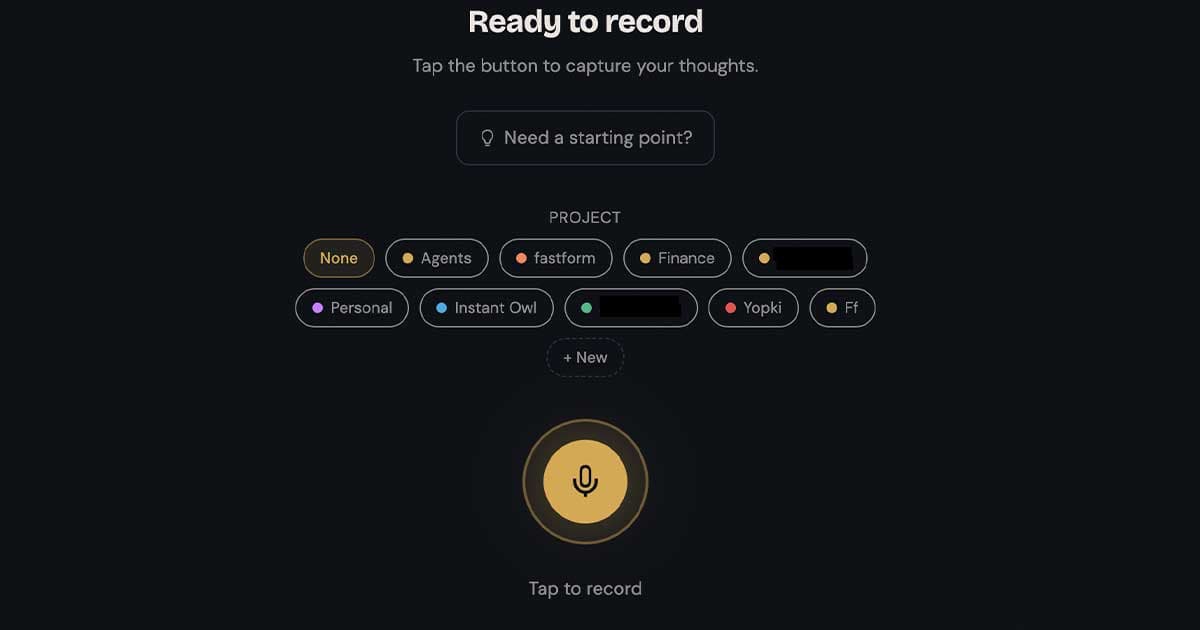
Disclosure: InstantOwl is our product, so take this section as a disclosed pick, not a neutral review. InstantOwl does not compete with any calendar named on this page and does not build or claim scheduling features. What it does is sit in front of whichever calendar you already use. You talk out loud, the way a thought actually shows up in your head, and the recording turns into organized tasks you can put wherever you plan, whether that is Google Calendar, Structured, Tiimo, or a paper planner on the counter.
This is the same gap a commenter in the Mac calendar apps thread described wanting closed, the one whose brain "just wants to drop things in quickly and not overthink it." InstantOwl is built for that exact moment, the one before the calendar, not instead of it. It is currently free to use.
What is the best calendar app for ADHD?
The best calendar app for ADHD depends on which side of the ritual split you land on, not a single universal winner. Match the tool to your brain first, then worry about features.
- If you like a daily ritual and want structure built for you: Sunsama or Morgen give you a guided planning session each day, at a premium monthly price.
- If you want to drop things in fast with minimal setup: Structured, Tiimo, or a plain Google Calendar, paired with a fast capture habit, fit better.
- If you are paper-first: keep the paper planner, and pair it with a fast capture app for the moments the planner is not in reach.
None of these choices is more legitimate than the others. The only wrong choice is a system heavy enough that you quietly stop opening it by week three, whichever category it came from.
Why can't I stick to a planner?
Most people can't stick to a planner because the daily setup costs more effort than the benefit it delivers, not because they lack discipline. That mismatch, not willpower, is the actual failure point.
The Sunsama quote earlier in this post is the clearest example: she loved the weekly planning view and still quit within a month because the daily ritual felt like too much setup. A separate commenter in the same thread put the general pattern even more bluntly, warning that all-in-one planning apps cost more time in configuration than they ever save in actual planning.
The fix is rarely more willpower. It is usually a lighter tool, matched to how much ritual your brain can tolerate on an average day, plus a fast way to get things in before the thought is gone.
Related reading
- The best ADHD apps: the wider picture beyond calendars, organized by the ADHD job each app solves.
- ADHD brain dump: why capture speed matters most for a mind that moves faster than any calendar.
- Best ADHD note-taking apps: tools built around fast, forgiving capture before anything reaches a calendar.
- InstantOwl: talk out loud, and let the sorting happen before the calendar does.
Frequently asked questions
What is the best calendar app for ADHD?
There is no single best calendar app for ADHD, because the tools split by how much ritual a brain can tolerate. Structured and Tiimo both offer a real free tier and stay light on setup. Morgen and Sunsama are richer planning systems built for a guided daily ritual, at a monthly cost. Match the app to your capture style before comparing feature lists.
Is paper or digital better for ADHD?
Neither paper nor digital is better for ADHD across the board. Paper wins on visibility and zero notifications to dismiss, which is part of why paper planners still dominate search results for this topic. Digital wins on reminders and reaching you wherever you are. The honest answer is whichever one you will actually open tomorrow, not the one that looks more organized today.
Is there a free ADHD planner app?
Yes. Structured and Tiimo both have a real free tier, and Google Calendar is free with any Google account. Morgen and Sunsama are premium only, starting around $15 to $17 a month with no free plan. InstantOwl is currently free to use as a capture layer that feeds whatever calendar you already have.
Why can't I stick to a planner?
Most people abandon a planner because the daily setup costs more effort than the benefit it delivers, not because they lack discipline. One ADHD user described trying Sunsama for a month and loving the weekly view, but said her brain just wants to drop things in quickly and not overthink it. The fix is usually a lighter tool, not more willpower.

Written by
Jim BreeseJim Breese is the founder of InstantOwl. He's spent 15 years building companies, from an Airbnb host community he founded and exited to growth leadership at venture-backed SaaS startups. He built InstantOwl because his best ideas kept arriving mid-walk, out of order, and half-finished.
Stop losing good ideas.
InstantOwl turns a rambling voice note into a clean, organized document in moments. Just talk. We'll organize it.
 Try InstantOwl free