ADHD Productivity: Why the Standard Advice Fails and What Works Instead
By Jim Breese · · Updated

Why is productivity hard with ADHD?
Productivity is hard with ADHD because the ADHD brain is wired to run on interest, not importance. William Dodson, M.D., a member of ADDitude's ADHD Medical Advisory Panel, describes this as an interest-based nervous system: "People with ADHD primarily get in the zone by being interested in, or intrigued by, what they are doing," he writes. A neurotypical brain can motivate itself with a deadline or a sense of duty. An ADHD brain needs interest, challenge, novelty, or real urgency to reach the same state, per Dodson. The "zone" he describes is close to what researchers call a flow state: full absorption in a task interesting enough to hold attention on its own.
This is not a willpower problem. The Attention Deficit Disorder Association (ADDA) puts it plainly in its guide to ADHD and motivation: "This isn't because you're lazy or lack willpower." ADDA points to dopamine pathway disruption as one mechanism, citing Volkow et al. (2011) in Molecular Psychiatry, which limits how strongly the brain registers rewards, especially rewards that are far in the future. ADDA also cites Sethi et al. (2018) in Brain: A Journal of Neurology to explain why the ADHD brain favors novel, stimulating tasks over repetitive ones.
Georgia Behavioral Health (GBH) describes the same territory as executive function, the brain's "management system responsible for planning, organization, task initiation, and follow-through." Dr. Neha Khurana, MD, a psychiatrist quoted in GBH's coverage, puts it this way: ADHD brains "thrive on novelty, urgency, connection, and reward, not the traditional structures of routine and discipline that neurotypical strategies rely on." Three sources point to one conclusion: the operating system is different, not broken.
Why does standard productivity advice backfire for ADHD?
Standard productivity advice backfires for ADHD because it assumes three things the ADHD brain does not reliably deliver: accurate time estimates, steady energy all day, and cheap task-switching. Linda Walker, PCC, an ADHD coach writing for ADDitude, breaks down popular systems that fail on exactly these assumptions, with an alternative for each.
The first is David Allen's two-minute rule from Getting Things Done: if a task takes under two minutes, do it right now. Walker points to two failures. People with ADHD tend to misjudge how long a "two-minute" task will actually take, so it is often not two minutes at all. Worse, switching away from what you were doing costs 10 to 20 minutes of refocusing to get back into it, per Walker, which the rule does not account for. Her fix is a catch-all capture notebook for interrupting tasks, reviewed later instead of acted on immediately.
The second is "Eat That Frog," Brian Tracy's advice to do the hardest task first thing every morning. It assumes energy is the same every day, which does not hold for ADHD brains, according to Walker. Her alternative maps tasks to three zones: a genius zone for demanding work, a kinetic zone for short interactive tasks, and a recharge zone for 10 to 15 minute breaks.
A large r/productivity thread on Reddit echoed this in practice, as community experience rather than research. A comment pushing eat-the-frog as ADHD advice was the most downvoted reply in the thread, while comments describing energy-matched planning and external re-entry points earned the most upvotes.
The two "two-minute rules" are opposite advice with the same name
Two well-known ADHD productivity tips are both called "the two-minute rule," and they tell you to do opposite things. This mix-up trips up a lot of people looking for adhd productivity tips, so it is worth untangling directly, since no other guide resolves it clearly.
David Allen's original GTD rule, the one Walker's ADDitude piece critiques above, says: if a task takes under two minutes, finish it right now. Georgia Behavioral Health's "two-minute launch rule" says something close to the opposite: commit to starting a bigger, harder task for just two minutes, to lower the activation barrier, and let momentum carry you past it. One rule is about finishing small things instantly. The other is about starting big things tiny. Same name, opposite mechanism.
For an ADHD brain, GBH's version tends to hold up better. The problem it targets, task initiation, is one of the three mechanisms below, and starting small sidesteps it directly. Allen's version runs into the time-misestimation and transition-cost problems Walker describes. If someone recommends "the two-minute rule" for ADHD, ask which one they mean before you try it.
What are the three mechanisms behind ADHD productivity problems?
Three mechanisms show up across every source: task initiation, working memory, and time blindness. Naming them matters because each one points to a different fix, and generic advice usually targets none of them directly.
Task initiation is the wall at the start of a task, not the middle. Dodson's interest-based nervous system explains why: without interest, challenge, novelty, or urgency, the brain does not generate the activation energy to begin. GBH's two-minute launch rule and its "what's one first step?" reframing both target this wall directly, as does ADDA's advice to break tasks into smaller goals.
Working memory drops new information fast. A thought that arrives mid-task, or a task interrupted partway through, is genuinely at risk of disappearing rather than just being easy to forget. Walker's capture-notebook fix, GBH's "externalize memory" framing for visual lists, and the r/productivity thread's habit of writing tasks down as a re-entry point after going off task all converge on one move: get it out of your head and onto something you can look at again.
Time blindness cuts both ways. Walker's time-misestimation point explains why the two-minute rule fails, and a commenter in the r/productivity thread described the same pattern from the other direction, reporting they chronically overestimated how long tasks would take until a timed 30-minute sprint showed them how much they could actually get done. Timers and artificial deadlines work by replacing an unreliable internal clock with an external one.
What tactics actually work, and how should you use them?
No single system works for every ADHD brain, so treat what follows as a menu, not a program. Pick one or two, run them for a few weeks, and keep what actually gets more done, not what looks disciplined on paper. That matches how the r/productivity thread itself converged: no universal combo, measured by what actually gets accomplished.
Externalize everything. Do not trust working memory with anything you need later. That means a capture inbox for interrupting thoughts (Walker's alternative to the two-minute rule), visual or color-coded lists (GBH's "externalize memory" framing), and notes-to-self describing exactly where you left off, a habit one r/productivity commenter called their most useful trick for picking a task back up after getting derailed. This is the mechanism with the strongest support across every source.
Shrink the start. Use GBH's two-minute launch rule, ADDA's advice to break a task into smaller goals, or the informal five-minute promise some r/productivity commenters described: commit to five focused minutes and let the task carry you past that point on its own.
Make time visible. Since an internal clock runs unreliable in both directions, replace it with an external one: a timer, a Pomodoro sprint, or an artificially shortened deadline, what GBH calls Parkinson's Law. This works for energy too, by mapping tasks to Walker's genius, kinetic, and recharge zones instead of assuming flat energy all day.
Borrow other brains. Body doubling, working alongside someone else in person or over video, is a top recommendation from ADDA, from GBH (which names Focusmate-style apps), and from r/productivity commenters describing accountability check-ins with a teacher or friend. It works through social presence and mild social pressure, and it is one of the more consistently recommended tactics across every source here.
Bound the work with rituals. One r/productivity commenter described "bootup" and "shutdown" sequences: a fixed routine (tea, checking the inbox count, reviewing yesterday's notes) that signals now is the time to work, and a matching shutdown routine that closes the day and writes a note for tomorrow's brain. Years later, other replies in the same thread still called it the most useful comment in the discussion.
Feed the interest system, not around it. Since interest and novelty are the real motivators per Dodson, rotate your environment, add background music, or gamify a task instead of fighting your brain's actual reward system. ADDA's advice to keep things "fun and interesting" and GBH's novelty rotation point the same direction: work with the system you have.
Reward immediately. The dopamine research ADDA cites (Volkow et al., 2011) explains why distant rewards register weakly. Break tasks into chunks with an immediate reward after each one, rather than saving the payoff for the very end.
Where do note-taking, calendar, and capture apps fit into this?
Each mechanism above points to a different kind of tool, so match the tool to the mechanism you are actually fighting, not the other way around. If working memory is the problem, an ADHD brain dump is the capture-first method built for exactly that moment. If you need a place for notes-to-self and re-entry points once a thought is captured, see our picks for the best ADHD note-taking apps.
If time blindness is the bigger issue, an ADHD-friendly calendar makes time visible instead of leaving it to an internal clock that misjudges in both directions. If you want a broader menu of tools mapped to these same tactics, our ADHD apps roundup covers more ground than any single mechanism above.
None of these tools replace the tactic behind them. A calendar does not fix time blindness by existing on your phone. It fixes it by being checked. The tool only removes friction from doing the tactic consistently, which is the part that actually matters.
Where does InstantOwl fit into ADHD productivity?
Full disclosure: InstantOwl is our product, and this is our blog. Externalizing thoughts before they disappear is the one mechanism we genuinely serve, and it happens to be the mechanism with the strongest support across every source above: Walker's expert-recommended capture notebook, GBH's "externalize memory" framing for lists, and the r/productivity thread's re-entry-point habit all point the same direction.
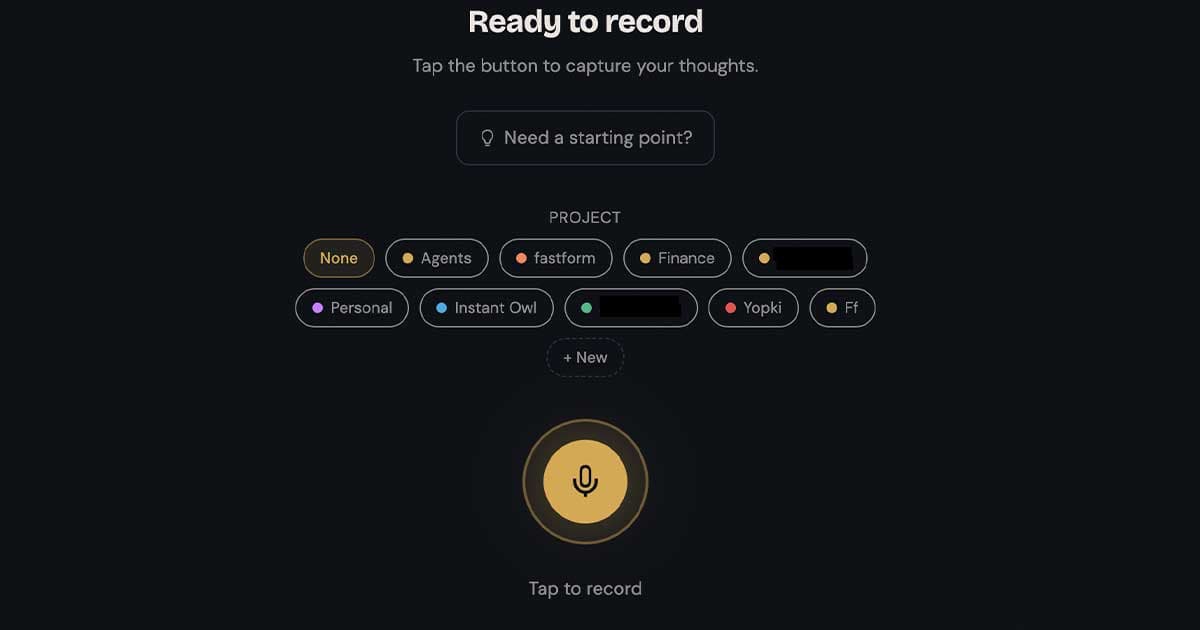
InstantOwl is a voice-first capture tool. When a thought or task interrupts you, speaking it takes seconds, protecting the 10 to 20 minute refocus cost Walker describes for every interruption you do not offload right away. What InstantOwl adds beyond a plain recorder is turning a messy spoken dump into organized notes you can actually find again later, which is where paper capture and old voice memos tend to fail. InstantOwl is currently free to use.
We do not claim to fix task initiation, time blindness, body doubling, or motivation, and no tool honestly can. If you need help starting a task, try the two-minute launch rule or a timer. If you need a body double, look for a service built for that. Use the full menu above honestly, and use InstantOwl for the one job it is actually built for: catching a thought before it is gone.
What about medication and therapy?
This post covers tactics and tools, not treatment, and makes no claim to fix or cure ADHD. Many people manage ADHD with medication, therapy, or both, alongside tactics like the ones above, and whether that combination is right is a conversation for a doctor or therapist, not a blog post. If tactics alone are not enough and you are not currently working with a clinician, that is worth raising with one.
Related reading
- ADHD brain dump: the capture method behind the externalize-everything tactic above, for a mind that moves faster than it can write.
- ADHD note-taking apps: where captured thoughts and re-entry notes actually live once they are out of your head.
- ADHD-friendly calendars: tools built around making time visible, for the time blindness mechanism above.
- ADHD apps: a broader menu of tools mapped to these same tactics.
- InstantOwl: talk instead of typing, and let the sorting happen after you capture.
Frequently asked questions
Why is productivity so hard with ADHD?
Productivity is hard with ADHD because the ADHD brain runs on interest, novelty, and urgency rather than importance or deadlines, according to Dr. William Dodson writing in ADDitude, and because dopamine pathway differences make distant rewards register weakly, per research cited by the ADDA (Volkow et al., 2011). It is a wiring difference, not a discipline problem, so advice built for a different wiring often backfires.
What is the best productivity method for ADHD?
There is no single best productivity method for ADHD, because no system works for every ADHD brain. What recurs across expert sources and community experience is externalizing everything (capture inboxes, visual lists, notes-to-self), shrinking the start of a task instead of forcing discipline, making time visible with timers instead of trusting an internal clock, and borrowing focus through body doubling. Treat these as a menu to test, not a program to follow exactly.
Does the two-minute rule work for ADHD?
It depends which two-minute rule you mean, since two different rules share the name. David Allen's original GTD rule, finish anything under two minutes immediately, tends to fail for ADHD because of poor time estimation and a 10 to 20 minute cost to refocus afterward, per ADHD coach Linda Walker in ADDitude. A different rule, committing to start a bigger task for just two minutes to build momentum, tends to work better because it targets task initiation directly.
How do I stop forgetting tasks with ADHD?
Stop trusting working memory with anything you need later, and externalize it instead. That means a single capture inbox for interrupting thoughts, visual or color-coded lists you actually look at, and notes-to-self describing exactly where you left off so you have a re-entry point after getting derailed. This is the most consistently recommended tactic across ADHD coaches, clinicians, and community discussion, and it is the mechanism a voice-first capture tool like InstantOwl is built to support.

Written by
Jim BreeseJim Breese is the founder of InstantOwl. He's spent 15 years building companies, from an Airbnb host community he founded and exited to growth leadership at venture-backed SaaS startups. He built InstantOwl because his best ideas kept arriving mid-walk, out of order, and half-finished.
Stop losing good ideas.
InstantOwl turns a rambling voice note into a clean, organized document in moments. Just talk. We'll organize it.
 Try InstantOwl free