Voice to Text on Android: Gboard, Advanced Voice Typing, and the Fixes
By Jim Breese · · Updated

How do you use voice to text on Android?
Tap the microphone icon on the Gboard keyboard, in any app where you can type, on Android 7.0 or later. That single tap is the whole system: no separate app to install, no setup screen, just a mic button built into the keyboard you already have.
The exact steps, per Google's Gboard support page: install Gboard, open any app you can type in, such as Gmail or Keep, tap a text entry area, tap the Microphone icon at the top of the keyboard, then start talking once you see "Speak now." Tap the microphone again, or tap the keyboard icon, to switch back to typing.
Punctuation works by voice too. Say "period," "comma," "exclamation point," "question mark," "new line," or "new paragraph," and Gboard inserts the mark instead of the word. Google's own caveat matters here: "Punctuation might not be available in all languages," so this trick is not universal. Google is also specific that "some of these steps work only on Android 7.0 and up," and that "talk-to-text doesn't work with all languages," so an older phone or an unsupported language changes what is actually available to you.
Two more details are worth knowing before you start. To fix a single word, touch and hold it, tap the microphone icon, and speak the replacement, rather than retyping the whole sentence. And the first time you tap the mic, Android asks for microphone permission with three options: "While using the app," "Only this time," or "Don't allow." That choice matters more than it looks, and it is the root of the most common complaint covered later in this post.
The two-tier system nobody explains
Android actually runs two separate voice typing systems, and most guides only describe one of them. Standard Gboard voice typing, the mic-tap system above, works on any Android 7.0 or later phone. Advanced voice typing is a separate, more capable system available only on Pixel 6 and later devices, per Google's support documentation. Google's own Gboard help page routes Pixel owners to a second page for it, which is the clearest sign the two systems are meant to be understood separately rather than as one feature.
Turn Advanced voice typing on or off from inside any typing app: tap the text field, tap Settings on the keyboard, tap Voice typing, then toggle "Advanced voice typing features."
What it adds over the standard system, per Google: automatic punctuation as you speak instead of saying punctuation names out loud, emoji inserted by name, voice commands including "delete," "clear," "send," "next," and "stop," a microphone that stays active for continuous dictation, and the ability to keep typing by hand while the mic is still on.
Not every Pixel gets every feature. Google's device requirements, verbatim: "Fix it" needs "Pixel 8 or 8 Pro and later," detailed edits need "Pixel 8 and later devices," and voice commands with writing tools are "Pixel 9 (excluding 9a) and later devices only."
Language support is the real limit on Advanced voice typing. Per Google, "English, French, German, Italian, Japanese, and Spanish are supported by the advanced voice typing feature," six languages total, with automatic language detection on by default (turn it off at Settings, Voice typing, Auto-switch language, or switch manually with the Globe icon).
Privacy works the same way as everything else here: on-device by default. Google's support page states, "The text you speak stays on your device and isn't sent to Google servers except when you use the 'Fix it' or detailed edits features." Google's own troubleshooting notes add that voice models can take a few hours to download over Wi-Fi, and that a restart sometimes helps, that your Gboard language has to match a supported language, and that some Android 12 phones need an Android System Intelligence update before Advanced voice typing works at all.
Voice typing not working? Here's the actual fix
The single most common cause, per user reports in a large Android community thread, is a silently revoked microphone permission: tapping the mic produces "No permission to enable voice typing" with no other explanation on screen. The fix users report working, the top-voted comment in that thread: go to Settings, Apps, Gboard, Permissions, Microphone, set it to "Allow only while using the app," then clear Gboard's cache if the error persists.
That same thread surfaces several other known issues, all attributed to real user reports rather than official Google documentation. Voice typing can cut out mid-sentence, forcing a manual tap to re-enable it even though it appeared to still be listening. Some users report a double-typing bug, where turning the mic off re-types the same words a second time, or a text field quickly refills with a message that was already sent.
Several users in the thread also report an offline regression: voice typing that used to work without an internet connection now requires one. The newer Advanced voice typing mode does not show text on screen as you speak either, unlike the standard mode, which some users in the thread find disorienting after being used to seeing words appear live.
A few smaller complaints round out the thread. One user's repeated example was Gboard overcorrecting casual words, rewriting "cause" as "cuz" no matter how many times they removed it from suggestions. Multiple users also reported accent and dialect accuracy problems, including one who described the system misreading their own distinct speech pattern as an autistic person. None of these are officially documented bugs, but the volume and specificity of the reports make them worth knowing before you assume your phone alone is broken.
What Android voice typing can't do
Both tiers of Android voice typing are transcription tools, not writing tools: they turn your speech into text, and stop there. That is by design, and it is also the limit. Even a competitor's own listicle, one that ranks its own paid app in first place, concedes the point about Gboard specifically: it "creates a wall of text... no AI to fix grammar, remove filler words, or format your ideas."
That wall-of-text problem shows up the moment you talk for more than a sentence or two. A quick reminder or a search query works fine either way. A few rambling minutes about a project, an idea, or a plan for the week comes back as one unbroken block of run-on text, filler words included, with no structure imposed on any of it.
Punctuation is the other real gap. Standard voice typing requires you to say punctuation by name, and per Google, that "might not be available in all languages" to begin with. Advanced voice typing fixes punctuation automatically, but only inside its six supported languages, and only on a Pixel 6 or later. Outside those conditions, you are back to narrating commas out loud, or reading unpunctuated text after the fact.
When a dedicated tool is worth it
Android voice typing is built to fill a text field, not to think with you. That is the right tool for a text message, a search bar, or a quick email reply. It is the wrong tool the moment you are talking through something bigger than a sentence: a project idea, a plan for the week, a rambling worry you just need out of your head.
If what you want is better dictation, meaning cleaner text with fewer filler words across every app on your phone or computer rather than just Gboard's text fields, our full breakdown of dictation software compares the leading options, including Wispr Flow, which cleans up speech as you talk instead of transcribing it raw.
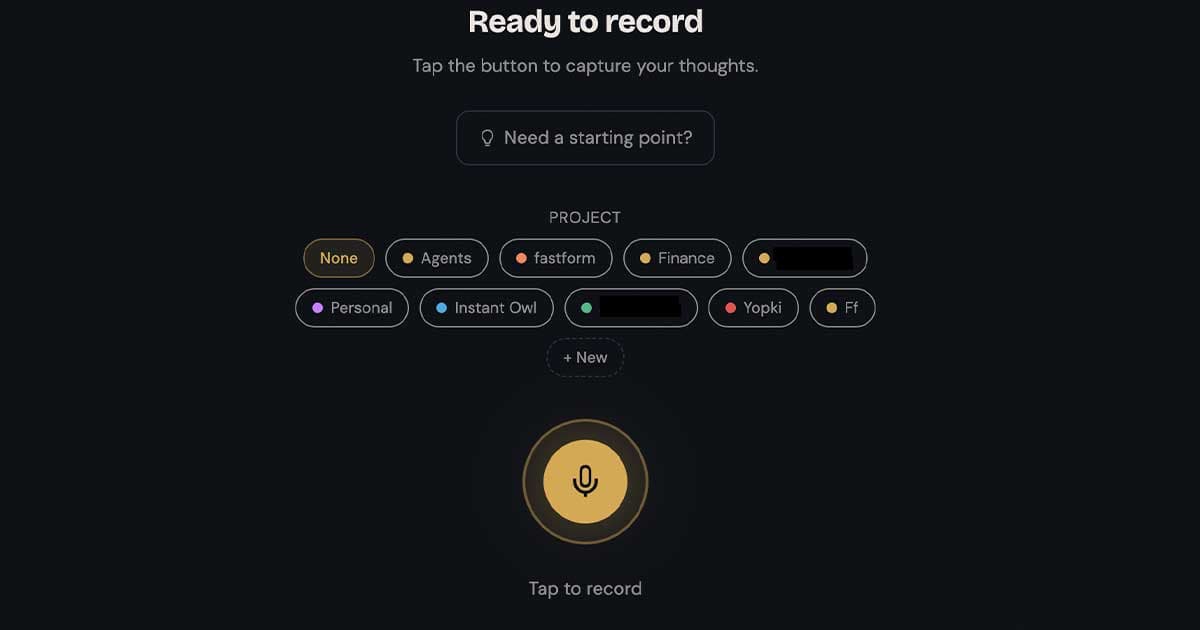
If what you actually have is a messy, unstructured train of thought rather than one sentence to drop into a text box, that is a different problem, and it is the one InstantOwl is built for. Full disclosure: InstantOwl is our product, and this blog belongs to it. Instead of handing you back a wall of transcribed text the way Gboard does, InstantOwl takes a rambling voice note and turns it into an organized document, a summary, or a task list. It is currently free to use.
Frequently asked questions
How do I turn on voice typing on Android?
Voice typing is built into Gboard by default on Android 7.0 and up: tap a text field in any app, tap the microphone icon at the top of the keyboard, and start speaking when you see Speak now, per Google's Gboard support page. Pixel 6 and later devices can also turn on Advanced voice typing from the keyboard's Settings menu, under Voice typing.
Why did my voice typing stop working?
The most common cause, per user reports in a large Android community thread, is a revoked microphone permission that shows as No permission to enable voice typing. Fix it in Settings, Apps, Gboard, Permissions, Microphone, by choosing Allow only while using the app, then clear Gboard's cache if the error continues.
Does Android voice typing work offline?
Standard and Advanced voice typing are both designed to process speech on your device, and Google states that Advanced voice typing keeps your speech on your device except when you use Fix it or detailed edits. However, users in a large Android community thread report an offline regression, where voice typing that once worked without internet now requires a connection.
What is Advanced voice typing?
Advanced voice typing is Google's more capable voice typing system, available only on Pixel 6 and later devices, per Google's support page. It adds automatic punctuation, emoji by name, voice commands like delete and send, and a microphone that stays active for continuous dictation, but it only supports English, French, German, Italian, Japanese, and Spanish.

Written by
Jim BreeseJim Breese is the founder of InstantOwl. He's spent 15 years building companies, from an Airbnb host community he founded and exited to growth leadership at venture-backed SaaS startups. He built InstantOwl because his best ideas kept arriving mid-walk, out of order, and half-finished.
Stop losing good ideas.
InstantOwl turns a rambling voice note into a clean, organized document in moments. Just talk. We'll organize it.
 Try InstantOwl free