Verbal Processing: Why Some of Us Think Out Loud (and How to Use It)
By Jim Breese · · Updated

What is a verbal processor?
A verbal processor is someone who works out their thoughts and feelings by talking, instead of sorting them out silently first and reporting a finished version. Psychologist Ilene S. Cohen, Ph.D., who teaches in the Department of Counseling at Barry University, calls this external processing: an external processor "thinks out loud," using speech itself to clarify and organize ideas as they arise, the way a chef tastes a dish while cooking it rather than after.
Cohen's counterpart is the internal processor, who sorts things out privately before speaking, closer to a slow cooker than a chef tasting as they go. Most people lean one way, and the everyday name for the external kind is simply thinking out loud.
One guardrail matters here. Even Cohen's definition is a therapeutic observation, not a standardized clinical category. "External processor" and "internal processor" are a self-knowledge lens, a way to understand how you already think, not a diagnosis. If you have seen the phrase "verbal processing disorder" in a search result, it is not a recognized diagnosis in any source we found. The style itself is not a disorder.
Writer Sam Dylan Finch, who writes about neurodivergence, describes external processing as using language, spoken, signed, or written in dialogue with others, to problem-solve and find clarity. He compares it to a toy box: an internal processor sorts the pieces in their head first, while an external processor has to spill the box out and handle the pieces in the open before they make sense.
What does verbal processing look like day to day?
It looks like not knowing what you think until you have said it out loud, then hearing your own answer as you finish the sentence. Leadership coach Sara Jeruss describes verbal processors as people who need to talk through information and emotions to make sense of them, and notes the habit is not tied to introversion or extroversion. You can be a quiet person by temperament and still need to talk to think.
Long emails and journal entries count too. Jeruss points out that processing does not require another person in the room. Writing at length, the way you might ramble in a text to a friend, is the same mechanism as talking out loud, just on a page instead of in the air.
A spoken idea from a verbal processor is often a draft, not a decision. Jeruss calls this "trying on" an idea: saying something out loud to see how it feels, without committing to it. Buffer's Hailley Griffis, who writes about workplace communication, describes announcing "I'm thinking out loud" specifically so a tentative idea does not get mistaken for a final one. ADHD coach Bobbi-Jo Molokken names the same pain point from the listener's side: the tentative idea gets treated as a settled decision, and that mismatch is where most of the friction lives.
Finch, who identifies as autistic and ADHD, puts it plainly: "Your processing style is morally neutral." Talking to think is not a flaw to manage. The problems that show up around it, like urgency or being misread as complaining, are separate from the style itself.
How do you work with a verbal-processing brain instead of against it?
Start by naming what you are doing. Griffis recommends simply announcing "I'm thinking out loud" before you start, so whoever is listening knows not to treat the next few minutes as final. Finch adds a second layer: name what you need before you unload on someone, since "can we talk?" is not automatic permission to process out loud at them.
When there is no one to talk to, or the thought is not ready for another person yet, solo channels work the same muscle. Finch lists letter writing, "campfire journaling" (a written dialogue with yourself), self-talk, and art as alternatives to a live conversation. Keeping a journal is one of those solo channels, and if you have wanted to but never known what to put down, here is how to start one when you don't know what to write. Several people in verbal-processor communities describe recording voice memos while driving for the same reason: the car is private, and the thought needs to come out now, not later.
For a faster version of a ramble, workplace coach Sarah Bedrick describes a compression drill some managers use with verbal processors: ask for a one-word answer first, then a one-phrase answer, then a full sentence. You can run the same drill on yourself after a long spoken tangent, to pull the actual point out of it.
Griffis also names a manual system a lot of external processors already use without calling it a system: record the conversation or the thought, get a written transcript, reread it later, and pull out the tasks and notes yourself. It works. It is also almost entirely manual, which is exactly where the next problem shows up.
The honest failure mode of solo voice capture
Recording yourself is easy. Doing anything with the recording afterward is where verbal processors say the system falls apart. In an ADHD community thread about coping with a verbal processor's habits, one self-described verbal processor explained why she stopped using a dictaphone: it "just meant extra tasks," on top of everything else she was already trying to keep track of.
Another person in the same discussion described her own habit of recording thoughts while driving this way: "I've never once gone back and listened to one of these recordings, but I like knowing they are there in case I say something worth remembering." That is the pattern in one sentence. The recording exists. It gets replayed almost never.
This is not a discipline problem. A raw recording asks you to do the same work twice: talk it out once to think, then sit down and listen to the whole thing again to extract anything useful. That second pass is the part that gets skipped, every time, because the thinking already happened the first time you said it.
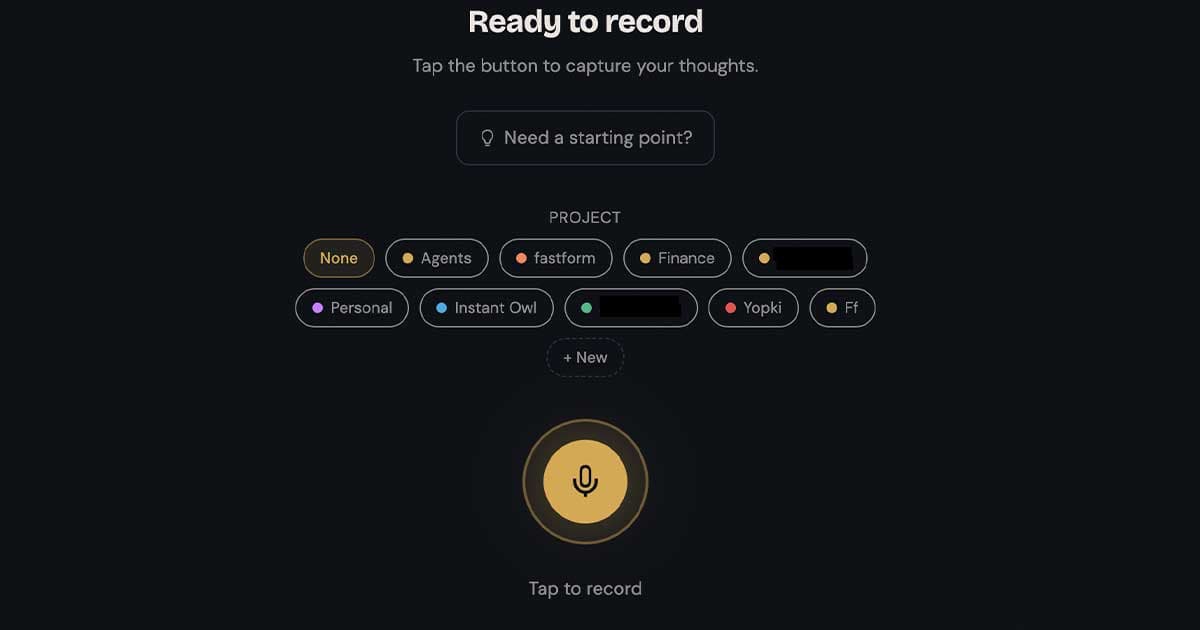
Full disclosure: InstantOwl is our product, and this is the exact gap it is built to close. You still talk it out the same way, but the recording comes back as an organized document instead of a wall of audio to relisten to: a structured summary, outline, or a dozen other formats, with any action items pulled out automatically.
No replay chore, because the organizing already happened. InstantOwl is currently free to use.
It is worth being honest about what this does not replace, too. An app does not talk back. A friend, a coach, or a therapist gives you responsive processing, questions and reactions in real time, that solo capture cannot. Coaches who run those conversations for a living face the mirror image of this, capturing what surfaced in a client session before it fades, which is its own habit (voice notes for coaches), and therapists carry the same between-session load with client confidentiality layered on top. Both belong in the toolkit: people for the conversation, a private capture habit for the thoughts that show up when nobody is around to hear them.
Is verbal processing an ADHD thing?
Not on its own, and it is not a symptom to fix. Verbal processing is a communication style, and plenty of people without ADHD are verbal processors. What shows up repeatedly in ADHD coaching conversations is a mechanism, not a diagnosis: ADHD coach Bobbi-Jo Molokken observes that many of her ADHD clients identify as external processors, and frames it as executive-function load. Organizing thoughts silently draws on working memory and planning, both of which take more effort in an ADHD brain, so talking does some of that organizing work instead.
Molokken's phrasing is worth repeating exactly, because it captures something clean about ADHD idea generation: "An ADHD strength is often idea generation; our struggle lies in organizing and carrying out the ideas." Finch, writing from his own autistic and ADHD experience, makes a related point without treating it as data: neurodivergence correlates with verbal processing for him personally, without meaning it prevents anyone from building the relational skills that make it work well with others.
None of this is a diagnostic claim, and it should not be read as one. If talking things out is tangled up with real anxiety or distress rather than just being how you think, a therapist is a reasonable processing partner, and several counseling practices describe exactly this as normal, unremarkable work.
If ADHD racing thoughts are the bigger piece of what you are dealing with, our guide to an ADHD brain dump covers fast, judgment-free capture for a mind that moves quickly, and our broader look at ADHD productivity covers what actually holds up beyond the standard advice.
The through-line
Every source here lands on the same idea from a different angle: knowing how you think is more useful than fighting how you think. Hailley Griffis puts it best: "The super power in this situation is not the systems themselves, but knowing yourself well enough to know what kind of processing works best for you." That applies whether the ideas show up in a meeting, in the shower, or during your own version of morning pages said out loud instead of written down.
If you already know you are a verbal processor, the work is not becoming someone who thinks quietly first. It is building a habit, and a channel, that catches the thinking without asking you to redo it later. Talk it out. Get something back you will actually use. That is the whole system, and it works whether the “something back” is a person, a notebook, or a recording that organizes itself.
Related reading
- ADHD brain dump: fast, judgment-free capture for a mind that moves quickly.
- What is a brain dump: why speaking is the fastest way to get a thought out of your head.
- Why you get ideas in the shower: another moment verbal processors lose their best thinking.
Frequently asked questions
What is a verbal processor?
A verbal processor is someone who works out their thoughts and feelings by talking through them, rather than sorting them out internally first. Psychologist Ilene S. Cohen, Ph.D. calls this external processing: thoughts get articulated as they arise, and speech is the tool that clarifies and organizes them, not just the way they get reported afterward.
Is verbal processing a sign of ADHD?
Not on its own. Verbal processing is a communication style, not a diagnosis, and plenty of people without ADHD are verbal processors. That said, ADHD coaches report that many of their ADHD clients identify as external processors, and one plausible mechanism is executive-function load: organizing thoughts silently takes more effort, so talking does the organizing instead.
What is the difference between verbal processing and internal processing?
A verbal (external) processor thinks out loud, articulating ideas as they arise and using the act of speaking to organize them. An internal processor sorts ideas out privately first and shares a more finished version later. Neither is better. They are two different routes to the same goal: clarity.
How do I stop losing track of what I say out loud?
You do not need to stop talking through your thoughts. You need somewhere for the talking to land. A recording that turns into organized notes you actually reread solves this better than a raw voice memo you never open again, which is the failure mode verbal processors describe most often.

Written by
Jim BreeseJim Breese is the founder of InstantOwl. He's spent 15 years building companies, from an Airbnb host community he founded and exited to growth leadership at venture-backed SaaS startups. He built InstantOwl because his best ideas kept arriving mid-walk, out of order, and half-finished.
Stop losing good ideas.
InstantOwl turns a rambling voice note into a clean, organized document in moments. Just talk. We'll organize it.
 Try InstantOwl free