Voice Notes for Coaches: The Client Support Channel and the Session-Notes Habit
By Jim Breese · · Updated
What does "voice notes for coaches" actually mean?
Voice notes for coaches means two separate jobs: sending short spoken support to clients between sessions, and capturing your own session notes and program ideas by voice after a call ends. Nearly every ranking guide, the Paperbell app roundup and the personal blogs about Voxer coaching among them, covers only the first job.
That gap is worth naming up front, because it means most of what a coach reads about voice note coaching solves someone else's problem. Sending voice support to clients is a real skill, and it's covered below. What almost nobody covers is the coach's own side: the session that just ended, the client context now living only in your head, and the notes that get thinner every week you skip them.
For the basics of what a voice note actually does, on iPhone, in WhatsApp, and the etiquette that comes with sending one, that guide covers ground this post won't repeat. This post covers what's specific to coaching: sending support between sessions, and capturing your own notes and ideas after.
How do coaches use voice notes to support clients between sessions?
Coaches send short voice messages through apps like Voxer or Marco Polo so clients get support between scheduled calls, without needing a synchronous meeting. It works because talking is faster than typing and lets clients respond on their own schedule instead of waiting for the next session.
Paperbell's roundup of coaching voice apps opens on the scenario every coach recognizes: a client texts at 9pm, stuck on something, and neither of you wants to book a call for it. A 90-second voice note answers the question that night instead of making the client wait until the next scheduled session, without turning every small stuck moment into a calendar event.
Coach Laura of Wholeheartedly runs this as a structured practice, not an open-ended chat. She checks messages twice a day in set hours, Monday through Thursday from 9:30 to 2:30, with notifications turned off the rest of the time. Messages stay in 3 to 4 minute chunks, and she keeps the channel strictly business, avoiding WhatsApp specifically because it would expose her personal number.
She's found voice quicker than typing out emails, and async support more sustainable and affordable to offer than hour-long calls. It also works well for clients with kids, who don't have to be screen-ready to send a message.
Coach Jodie Cook takes async further, building a coaching business around zero booked calls. She logs in every few days rather than checking constantly, deliberately delaying replies so her answers have time to form. She calls it microcoaching in async form, structured around a weekly check-in with three prompts: profession, obsession, decompression.
The same Paperbell roundup makes its strongest strategic point for coaches weighing whether to offer this at all: treat voice support like any other deliverable, scoped, named, and priced. That means a written response window clients can count on, pricing async support as its own add-on instead of folding it in for free, listing it in your booking software, and setting expectations on message length up front.
The two apps behind most of this are Voxer, a walkie-talkie style, push-to-talk app built for this kind of back-and-forth with a free tier plus paid Pro and Business plans, and Marco Polo, which works similarly for video and voice together with a free version and a paid Plus tier. Check current pricing directly before building a program around either; neither publishes a clear number on its own homepage.
InstantOwl isn't one of these apps and doesn't send anything to a client. It's built for what happens after the session ends, once the client has logged off and the voice thread has gone quiet for the day.
What happens to a coaching session after it ends?
After a session ends, or after a full day of async voice threads, a coach is left holding a head full of client context, action items, and follow-ups, with no built-in time to type any of it down before the next call starts. Notes get thin, or skipped, and continuity between sessions quietly erodes.
Every guide above solves the sending problem. None of them solves this one: a coach running back-to-back sessions, plus a full inbox of client voice messages, needs to capture selectively right after the conversation, the same habit that keeps any conversation from turning into an unusable wall of notes later (and the same debrief teachers lean on after a parent call).
The cost compounds fast. Skip the notes after one session and you're relying on memory for the next one. Skip it for a week of back-to-back clients and continuity is gone: you're re-asking things a client already told you, or missing a commitment they made two sessions ago. This is the real version of the "it's just another AI subscription" objection, not because the software matters, but because almost nobody keeps typing detailed notes by hand past week two of a full client roster.
The math is different from a single meeting, too. One missed follow-up after one call is a minor slip. A coach carrying 15 or 20 active clients, each with their own thread of commitments and context, is running that same risk on a loop, every week, for every client at once. A note system that works for two sessions has to keep working at week twelve, with a full roster, or it isn't really a system.
What should a coach's after-session voice debrief include?
A coach's after-session debrief should take 60 to 90 seconds and cover four things: what the client is working on, what they committed to, what to follow up on next time, and one personal detail worth remembering. Say it out loud right after the client logs off, before the next call starts.
Ramble is the right word for it. Nobody needs a polished recap, just a rundown of the session the way you'd describe it to a colleague, out of order, however it comes out. The four things above are the only structure that matters: client focus, commitment, next follow-up, and one personal detail, like a kid's recital or a move date, the kind of thing that makes a client feel remembered rather than processed.
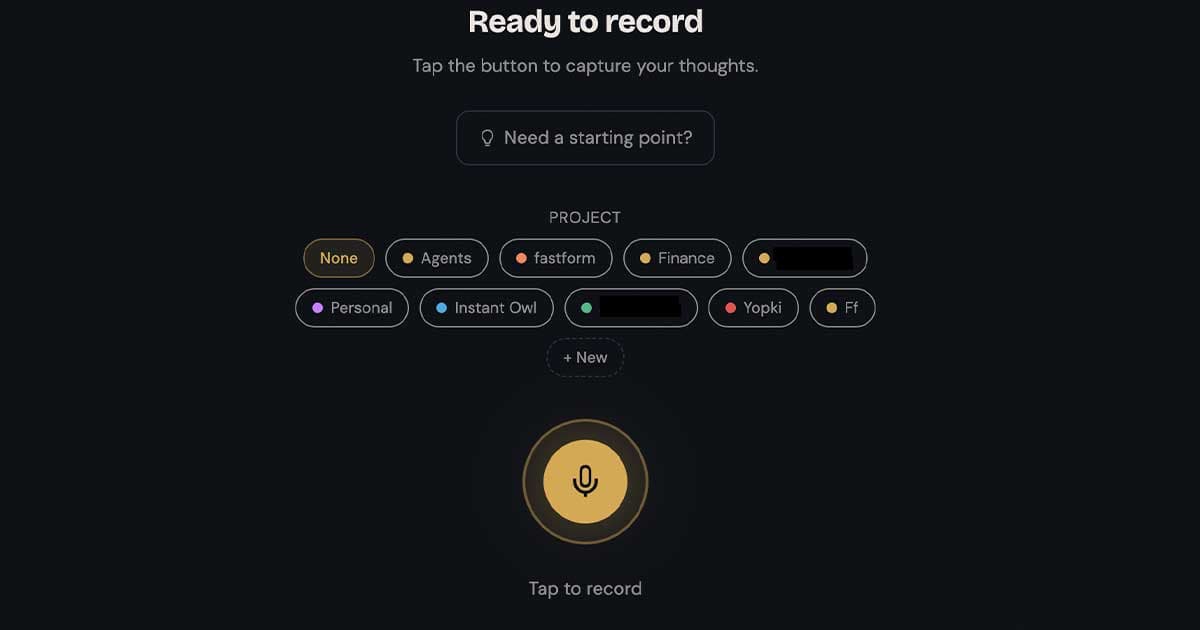
That's the exact ramble-in, organized-output-out gap InstantOwl is built to close. Full disclosure: InstantOwl is our product, and this blog belongs to it. Record the 60 to 90 second debrief the way described above, and it comes back as a clean Summary alongside a pulled-out Action Items list, instead of an audio file you'd have to relisten to before the next session.
Keeping every debrief in one place for everything you capture matters as much as the habit itself: a note buried in a random voice memo from three weeks ago is barely more useful than no note at all. The point isn't a fancier recording. It's being able to turn the ramble into a clean summary and actually find it again before the client's next session. InstantOwl is currently free to use.
How do coaches capture program and content ideas on the go?
Coaches capture program and content ideas the same way they capture session debriefs: by talking them out the moment they show up, usually walking or driving, instead of waiting to sit down at a laptop. A framework tweak or a content idea that arrives mid-walk rarely survives until you're back at a desk to type it.
A tweak to a coaching framework, a new angle for next week's newsletter, an idea for a program module: these show up between sessions and outside of them, on a walk, in the car, in the shower. Talking it through out loud, even messily, beats trying to hold the shape of it in your head until you're back at a laptop.
Where those ideas eventually live matters more than how fast you captured them. A second brain built around actionability, not just topic is one honest answer for a coach with a growing backlog of half-formed program ideas: some become next quarter's curriculum, most just sit in the archive, and both outcomes are fine as long as the idea got captured before it disappeared.
Related reading
- Voice notes: how to send them, keep them, and actually use them: the fundamentals this post builds on, including etiquette for the sending side.
- How to take meeting notes: the same capture-then-cleanup pattern, applied to any conversation, not just coaching sessions.
- How to capture ideas before they vanish: the system behind keeping every debrief and program idea in one place.
Frequently asked questions
What is voice note coaching?
Voice note coaching is asynchronous coaching delivered through short spoken messages instead of scheduled calls. A coach and client trade voice notes through an app like Voxer or Marco Polo between sessions, or in place of them entirely, so support can happen on the client's own schedule instead of requiring both people free at the same time.
What are the 5 C's of coaching?
The 5 C's of coaching are commonly listed as Clarity, Commitment, Confidence, Challenge, and Change, though the framework varies by source and there is no single universal definition. Most versions describe a coach helping a client get clear on a goal, commit to it, build confidence, take on the right challenge, and follow through to real change.
What is the 70/30 rule in coaching?
The 70/30 rule in coaching most often refers to a coach spending roughly 70 percent of a session listening and 30 percent guiding, through questions, reflections, and summaries rather than advice. A secondary use of the same ratio splits feedback into 70 percent positive reinforcement and 30 percent constructive correction.
How do coaches keep session notes?
Most coaches keep session notes by writing or talking through a quick recap right after a call: what the client is working on, what they committed to, and what to follow up on next time. The habit is easy to keep for the first few sessions and hardest to maintain once a full client roster and back-to-back calls fill the day.

Written by
Jim BreeseJim Breese is the founder of InstantOwl. He's spent 15 years building companies, from an Airbnb host community he founded and exited to growth leadership at venture-backed SaaS startups. He built InstantOwl because his best ideas kept arriving mid-walk, out of order, and half-finished.
Stop losing good ideas.
InstantOwl turns a rambling voice note into a clean, organized document in moments. Just talk. We'll organize it.
 Try InstantOwl free