How to Capture Ideas Before They Vanish (a System, Not a Tool List)
By Jim Breese · · Updated

How do you capture ideas?
You capture ideas by making the moment of capture take almost no effort, sending everything to one destination instead of scattering it across several, and reviewing that destination on a short, regular schedule. Skip any one part and the system breaks down.
Too much friction and you stop capturing. Too many destinations and you stop trusting where anything went. No review and captures just pile up unread, which is barely better than never writing them down at all.
That order matters more than which tool you pick. In a long discussion among people who capture ideas throughout the day, one comment summarized what everyone else in the thread had been circling around: the fix was never a better app, it was making capture take less effort than forgetting. Everything below builds on that single idea.
This is also why so many capture systems quietly fail. People blame the tool and switch apps, when the actual problem was that getting an idea safe required three steps: open an app, find the right note, and type. Three steps is often one too many.
Why do ideas vanish?
Ideas vanish because your mind can only hold so much unwritten, unspoken information at once, and whatever grabs your attention next crowds out anything you have not yet externalized. The idea does not get deleted so much as overwritten.
The moments people report losing ideas in are strikingly ordinary: walking somewhere, riding a bus, moving between two other tasks. None of these are dramatic interruptions. They are just enough of a new demand to bump an idea that was only ever held in your head.
An idea you have not written or said does more than risk being forgotten. Research on unfinished thoughts, known as the Zeigarnik effect, suggests they tend to stay active in memory rather than fade quietly, nagging at your attention right up until you externalize them or something else finally crowds them out.
The moments worst for capture are also the most common: driving, walking, cooking, mowing the lawn, a shoot with a camera in your hands, any point where your hands and eyes are already busy. Multiple people describing their own capture habits landed on the identical fix for exactly these moments, without comparing notes with each other: talk out loud into a phone.
Even people committed to fast capture admit there is a gap nothing fully closes. One person in that same discussion said outright that no solution covers every moment an idea could show up in: the shower, the middle of a run, the ten minutes before falling asleep. The honest goal is not perfect coverage. It is shrinking the gap, and talking shrinks it further than any other method, because speaking works in more places than typing does.
None of this is a character flaw. A racing, idea-a-minute mind loses more this way, not less, because it generates more candidates than a calmer mind does in the same stretch of time. The system above is not about willpower. It is about lowering the cost of capture until it is cheaper than losing the idea, for whichever mind you actually have.
What is the minimum viable note?
A minimum viable note needs four things: the topic, who it involves if anyone, what to do about it, and the date. Capture that much and future you can reconstruct the rest. Leave one out and the note is often unusable later, even though you technically wrote something down.
One person who had been taking rough notes like this for years put it plainly: they regretted it every single time one of those details went missing. Not the whole idea, just one field, like forgetting who a task was actually for.
The point is not documentation. It is just enough scaffolding that a note still means something a week later, once the context that made it obvious in the moment has faded from your head. If a blank page is the part that stops you, ready-made prompts instead of a blank page cover the same four fields with a structure already built.
Why does one destination beat four tools?
One destination beats four tools because the moment an idea has to cross between systems is a moment it can get lost, forgotten, or simply never looked at again. Consolidation is what makes a capture system trustworthy, not how sophisticated any single piece of it is.
One widely read guide to capturing ideas recommends a different specialized tool for each kind of input: one app for saved articles, another for book and article highlights, a third for podcast moments, a fourth for spontaneous voice notes recorded while driving. Each tool does its one job well.
That guide's own conclusion, though, is that the whole setup only works because everything eventually gets funneled into a single hub for review. That is the same principle covered above, arrived at independently, at a real cost: in that guide's case, roughly $150 a year across four subscriptions, plus the extra step of keeping them all synced into one place.
That is a genuinely workable system for someone who wants a dedicated tool per input type and does not mind maintaining the plumbing between them. It also proves the actual point: the destination is what matters, not the number of tools feeding it. Four tools that converge on one hub work. One tool that captures everything into that hub itself skips the plumbing entirely.
Neither route is wrong. A specialist stack rewards someone who already has strong habits around each input type and does not mind the subscriptions or the syncing. A single hub rewards someone who would otherwise never set the plumbing up in the first place, which describes most people who try a multi-tool system and quietly abandon half of it within a month.
How do you review what you captured?
Review what you captured on a short, recurring schedule, once a week for about five minutes is enough, and use recurrence as your filter for what deserves more time: an idea that keeps showing up is worth pursuing, one that appeared once and never again probably was not.
Novelist Joanna Penn describes something close to this as her actual method for choosing story ideas. Rather than judging an idea's quality the moment it arrives, she keeps recording everything and lets time do the sorting: the ideas that keep recurring across weeks or months are the ones that turn out to be worth developing.
This only works if there is an archive to look back through in the first place, which is the same reason capture and review are two separate steps rather than one pass. It is the same logic behind a full brain dump: get everything out first, decide what matters afterward, not while you are still emptying your head.
A five-minute weekly pass is enough to run the recurrence test. Reread what piled up, notice what keeps showing up in different words, and move only that into whatever more permanent system you actually act from.
If what you are collecting is less tasks to act on and more ideas, quotes, and observations worth keeping for years, that permanent home has a name and a long history: the commonplace book.
Where does voice fit into all this?
Voice fits into the hardest capture moments best, driving, walking, hands full, because talking works in more places than typing does. It turns the whole friction-destination-review system into something you can run one-handed, without stopping what you are doing.
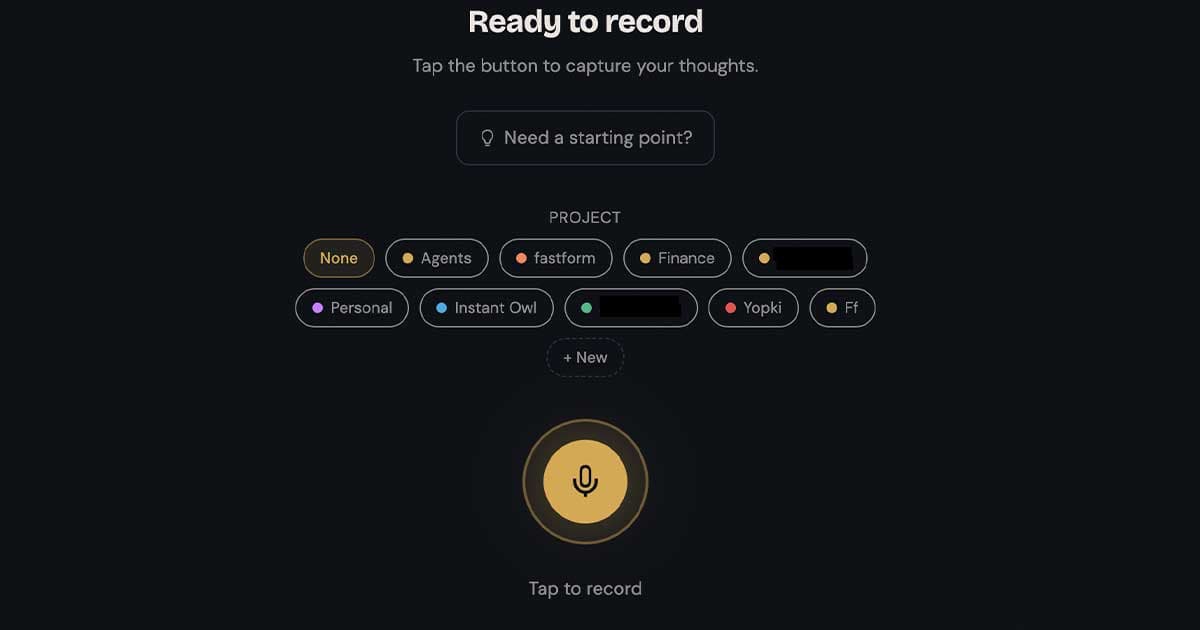
Full disclosure: this is the exact gap InstantOwl was built to close, and this blog belongs to it. You talk, and it turns the ramble into organized text in the same step, pulling out the topic, who it involves, what to do, and when, the same four fields covered above, automatically, instead of asking you to remember to include them mid-sentence while your hands are on the wheel. InstantOwl is currently free to use.
Speaking works as a capture method whether or not you ever use InstantOwl specifically. Our closer look at how people actually use voice notes covers the free options already built into your phone. And if everything you capture eventually feeds into a fully built second brain system like Notion or Obsidian, voice capture is the front door, not a replacement for whatever organizes things once they are in. If that system is specifically Notion, our voice to text in Notion guide covers what voice input exists there and what never did.
For a mind that generates ideas faster than it can type them out, why ADHD capture can't wait covers the same problem with an even shorter fuse: the gap between an idea showing up and it being safely captured has to be measured in seconds, not minutes.
Related reading
- What is a brain dump: the same capture-first, sort-later principle this whole system is built on.
- Voice notes: how to send them, keep them, and actually use them: what your phone can already do for free, and where it stops helping.
- The second brain method: where captured ideas go once you have a place to organize them long-term.
Frequently asked questions
How do I capture ideas quickly?
Use whatever method needs the least effort right where you are: talk, type, or jot a few words, and send it to one place you already check. Speed beats neatness. A rough, three-word note captured in two seconds beats a tidy one you never got around to writing.
What is the best way to record ideas?
There is no single best way, only the fastest one available to you in that moment. A notebook works if you carry it everywhere. A notes app works if your phone is already out. Voice works when your hands are busy, which is more often than people expect.
How do I capture ideas while driving?
Say it out loud. Talking is the only capture method that works hands-free and eyes-free, whether that means a voice memo app, a phone assistant, or a tool that also organizes what you said. Typing or writing while driving is not a method worth risking.
How do I organize captured ideas?
Organize on a separate pass, never while you capture. Once a week, review everything you collected and sort it into three piles: things to act on, things to keep, and things to drop. Most of what you captured will land in the last two piles, which is normal.

Written by
Jim BreeseJim Breese is the founder of InstantOwl. He's spent 15 years building companies, from an Airbnb host community he founded and exited to growth leadership at venture-backed SaaS startups. He built InstantOwl because his best ideas kept arriving mid-walk, out of order, and half-finished.
Stop losing good ideas.
InstantOwl turns a rambling voice note into a clean, organized document in moments. Just talk. We'll organize it.
 Try InstantOwl free