Voice Notes for Photographers: Freeing Your Shot Notes From the Card
By Jim Breese ·
What's wrong with your camera's built-in voice memo?
The voice memo built into your camera captures up to 60 seconds of audio, but it traps that audio as a separate file bolted to one photo, with no text and no way to search it. On a wedding, a shoot with 2,000 frames, or a two-week trip, that adds up to hundreds of clips you can only find by opening each photo and playing it back one at a time.
The spec is narrower than most photographers assume. On the Nikon D6, a voice memo maxes out at 60 seconds per photo, saved as its own WAV file named to match the image (DSC_nnnn.WAV), one memo per picture. Nikon's current mirrorless flagship, the Z9, works the same way, with the same 60-second cap confirmed in its menu guide. Neither manual mentions transcription, text, or search anywhere, because the feature was never built to produce any of the three.
That is fine for the rare shot where you just need a quick reminder played back on the camera itself later that day. It falls apart the moment you need to recall what you were thinking across an entire shoot. This is the same gap voice notes solve everywhere else: a spoken thought that stays useful only if it turns into something you can find again, not just something you recorded.
What do photographers actually want to remember?
Photographers want the per-frame context a camera can never log on its own: who was in the shot, what the light was doing, where it was taken, and, as one photographer put it on a DPReview forum thread, "the effect that I was wanting to achieve." Metadata records shutter speed and ISO. It has no field for intent.
That same photographer described coming home from a two-week trip with over 2,500 images and no way to recall the details weeks later. Two problems stacked on top of each other. First, a standalone voice recorder's clips would not line up with the photos automatically. Matching a recording back to the right frame looked, in his words, like "a large chore," and another poster in the thread went further, calling a synced timestamp outright impossible with an ordinary recorder. Second, even once you found the right clip, you still had to listen to it. He said outright that it would be nice to find an application that could transcribe a voice recording to a printed page, half joking that he was "dreaming."
That wish sits in an odd blind spot. Search for photography workflow advice and most of what ranks is post-shoot file management: backing up cards, culling in Photo Mechanic, syncing to Lightroom, mirroring drives to a RAID array. A well-known Fstoppers workflow piece walks through exactly that process end to end and never once touches what you were thinking on set. That content answers a real question. It just is not the question the DPReview photographer was asking, and it is not the one most working photographers ask either: not "how do I back up my files," but "how do I remember why I took this shot."
What are the three ways a raw voice memo fails you?
A raw voice memo fails a photographer in three specific ways: it stays trapped on one photo, it will not reconnect to a photo if it came from a separate recorder, and it is never searchable unless something transcribes it for you.
Trapped. The camera's own voice memo is a WAV file glued to a single RAW file on the card. It does not show up in your cataloging software as a note, a tag, or anything you can search. It is invisible everywhere except the camera itself.
Unmatched. A separate handheld recorder solves the 60-second limit, but its clips have no built-in link to your photo's timestamp or file number. Lining a batch of recordings back up to the right frames after the fact is manual, slow work, exactly the "large chore" described above.
Unsearchable. Whichever way you recorded it, the memo is still just audio. Finding the one clip where you mentioned a client's name, weeks later, means playing back recordings one by one until you hit the right one. Closing that gap means you need a way to turn the memo into searchable text instead of a folder of clips nobody has time to relisten to.
Here is how the three failure modes stack up against the alternatives:
| Trapped on one photo? | Reconnects to the photo automatically? | Searchable as text? | |
|---|---|---|---|
| Camera's built-in voice memo | Yes | Yes (one memo, one image) | No |
| Standalone handheld recorder | No | No, has to be matched by hand | No |
| Phone recording, transcribed | No | No, but findable by keyword instead | Yes |
The camera memo wins on automatic pairing and loses on everything else. A standalone recorder frees you from the 60-second cap but hands you a new chore: lining clips back up to the right frame. Talking into your phone and getting the recording transcribed gives up automatic pairing (you have to say which shot you mean, out loud) in exchange for the one thing neither camera option offers: text you can search.
What does a voice notes workflow that survives the shoot look like?
A workflow that survives the shoot means talking your shot notes into your phone as you go, the same way you'd hold the voice memo button on your camera, except what comes back is organized, searchable text instead of a trapped audio file. Say the location, the light, what the client asked for, and the effect you were going for, in your own words, while it's still fresh.
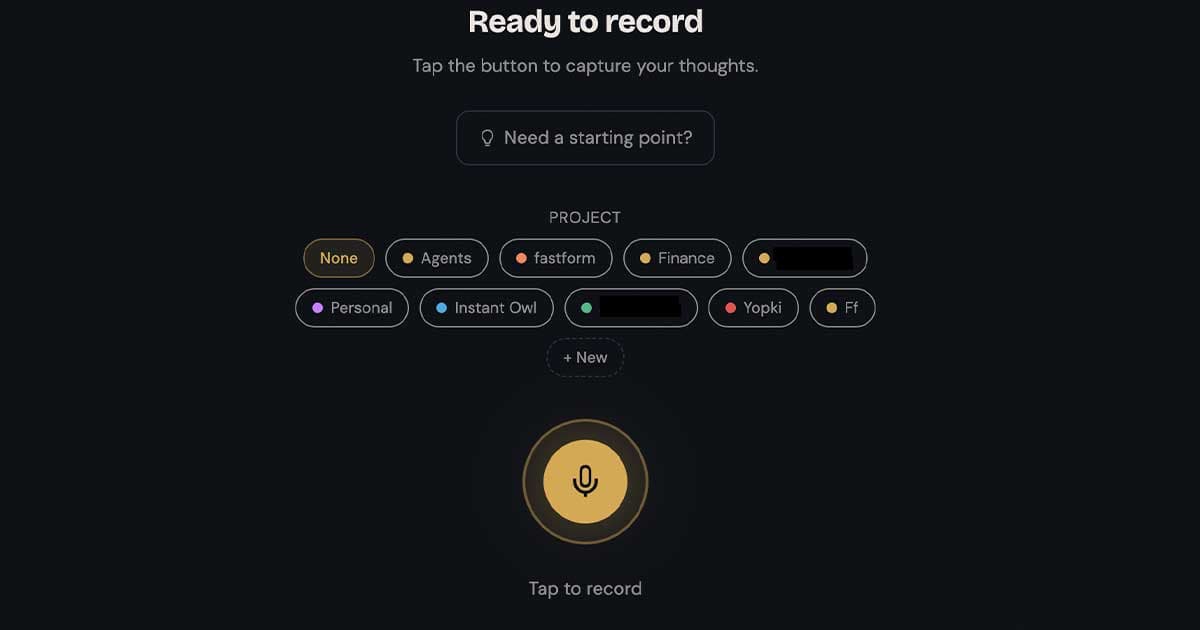
In full disclosure, this is exactly the gap InstantOwl was built for, and it is currently free to use. Talk through a shoot the way you already think about it (a stream of settings, subjects, and half-formed notes about a location you want to come back to at golden hour) and it comes back as a clean Summary you can skim later, or Action Items for the follow-ups a shoot always generates: send proofs, order a print, follow up on a location scouting lead. If a note needs to go straight to a client or an assistant, it can come back as an Email Draft instead of you retyping it from memory. Those are the three built-in output formats, nothing invented beyond what the product actually does today.
None of that requires changing how you already shoot. You still hold a button and talk, the same motion as triggering the camera's own voice memo. The difference shows up later: instead of a WAV file you can only open one at a time from the card, you get back text you can scan in seconds, search by a client's name or a location, and copy straight into an email or a shot list for next time.
This does not replace your camera's own voice memo for the rare one-off reminder played back on set. It replaces the bigger habit most photographers never had a good tool for: capturing ideas the moment they happen, without breaking your flow to write anything down, and getting them back in a form you can actually use.
How do you capture client briefs and ideas between shoots?
Client briefs and creative ideas between shoots both need somewhere to live that survives longer than a memory. Pre-shoot shot lists, a client's stated preferences, the "must-get" moments they mentioned on the phone: all of it is easiest to capture by talking it out the moment you hang up, instead of trying to reconstruct it from memory the morning of the shoot.
The same goes for ideas that show up between shoots and have nowhere to go. A composition you want to try, a location you drove past and want to come back to at a different time of day, a lighting setup you saw and want to test. No EXIF field holds intent, and no camera captures a thought you had on the drive home. A running voice journal for that kind of between-shoots thinking means the idea is still there, in your own words, the next time you're back on set with a few minutes to spare.
None of this needs a folder structure or a naming convention set up in advance. A client calls with a shot list for Saturday; you talk through what they said the moment you hang up, before it blurs into the next call. You pass a location on a Tuesday drive that would be perfect at sunset in October; you say so out loud, and it is there in October, not gone by Wednesday.
Related reading
- Voice notes: how to send them, keep them, and actually use them: the broader case for a spoken note over a typed one.
- How to transcribe voice memos: every path from a raw recording to searchable text.
- How to capture ideas before they vanish: the low-friction system behind on-shoot notes that actually get used.
Frequently asked questions
How do you put a voice memo in photos?
On Nikon cameras, you hold a button during or after shooting to record a short voice memo attached to that image. The memo is capped at 60 seconds, saved as a separate WAV file named to match the photo, and played back from the camera itself. It stays trapped on the card and is never transcribed or searchable.
What are the 5 C's of photography?
One common framing is Composition, Color, Contrast, Clarity, and Content, though the exact list varies by who is teaching it and some sources extend it further. Treat it as a rough checklist for evaluating a frame, not a fixed rule.
Can I transcribe a camera voice memo?
Not natively. Nikon's in-camera voice memo feature does not include transcription, so the recording stays audio-only unless you pull the WAV file off the card and run it through a separate voice-to-text tool.
How do photographers take notes on a shoot?
Most fall back on one of three habits: scribbling on a paper card or notebook between frames, talking into the camera's built-in voice memo feature, or talking into their phone. Paper and in-camera memos both work in the moment, but neither gives you searchable text afterward. A phone recording that gets transcribed does.

Written by
Jim BreeseJim Breese is the founder of InstantOwl. He's spent 15 years building companies, from an Airbnb host community he founded and exited to growth leadership at venture-backed SaaS startups. He built InstantOwl because his best ideas kept arriving mid-walk, out of order, and half-finished.
Stop losing good ideas.
InstantOwl turns a rambling voice note into a clean, organized document in moments. Just talk. We'll organize it.
 Try InstantOwl free