How to Transcribe Voice Memos (Free on iPhone 12+, and Every Other Path)
By Jim Breese · · Updated
Can you transcribe voice memos for free?
Yes. If you have an iPhone 12 or later, Voice Memos already transcribes your recordings automatically, in English (all variants), Spanish, Portuguese, Italian, French, German, Japanese, Korean, Simplified Chinese, and Traditional Chinese, per Apple's support guide. No app, no upload, no account, and that same hands-off transcription now reaches a FaceTime call, too.
This is a newer fact than most advice on this topic realizes. The most-upvoted answer for "how to transcribe voice memos" is a 2023 Reddit thread in r/iphone, 345 points and 189 comments, where the original poster asked: "Does Apple have anything that's free?" At the time, the honest answer was no. That thread predates the native transcript feature entirely, and its top recommendation, a free app called Aiko, now costs real money, which we get to below.
So the first question to answer for yourself is simple: what iPhone do you have? If it is a 12 or newer, skip the app store. If it is older, or you are not on iPhone at all, the rest of this post is for you.
How do you get the native transcript?
Open Voice Memos, tap the recording you want, and the transcript appears automatically if your iPhone is a 12 or later, per Apple's support guide. You do not need to turn anything on first.
To read it live while the recording plays, swipe up from the waveform. The current word highlights as it plays back, so you can follow along in real time. To read it after the fact, just open the recording and the transcript is already there, generated in the background.
Older recordings made before iOS 17 are not left behind. Apple transcribes them automatically the first time you open them, as long as they contain speech, per its support guide. There is nothing to trigger manually.
Copying the text is built in too. Open View Transcript, select the part you want, and tap Copy, or tap Copy Transcript to grab the whole thing at once. Paste it into Notes, Messages, an email, or anywhere else on your phone.
One more detail worth knowing: search in Voice Memos covers the words inside your transcripts, not just the titles of your recordings, per Apple. Tapping a search result jumps playback straight to that moment in the audio, which makes a backlog of old memos genuinely searchable for the first time.
If your iPhone is older than 12, or you're not on iPhone
Apple's transcription requires an iPhone 12 or later, so anyone on an iPhone 11 or earlier, or on Android, needs a different tool. Here is what the options actually cost and where they cap out, sourced to each company's own pages.
Notta. The free tool transcribes exactly one audio or video file, capped at 3 minutes, per Notta's own tool page. The transcript is delivered by email, and that link expires in 72 hours. Downloading the transcript as a file requires upgrading to Notta Pro, which runs $8.17 a month billed annually ($97.99 a year), per Notta's pricing page. There is a downgrade trap worth knowing before you commit to Pro for a big backlog: cancel later, and Notta's own FAQ states you can only view the first 3 minutes of each old transcript once you drop back to Free. For a fuller picture of how Notta's free tier and pricing hold up against a bigger name, our Notta vs Otter head-to-head checks both against their own pricing pages.
NoteGPT. Its landing page advertises fast processing and large file support, but the specific numbers shown (a 5GB file cap, a 20-file queue) belong to its $69-a-month Max plan, not the free tier, per NoteGPT's pricing page. Neither NoteGPT's pricing page nor its quota policy page publishes what a free account actually gets per month. If you try it, expect to hit an undisclosed ceiling rather than a stated one.
Aiko and similar Whisper-based apps. Aiko was the Reddit thread's consensus free pick in 2023, running transcription entirely on-device using OpenAI's Whisper model. Commenters in that same thread later tracked its price rising in stages, from free to roughly $10, then $16, then $18, then $22, landing at around $25 by the most recent comments. If you want an on-device, one-time-purchase option for a real backlog, apps like this are worth a look, but verify the current price before you buy, since it has moved before.
The common thread across all three: whatever you pick, get a finished memo into it first. The single most repeated stumble in that Reddit thread was people not realizing how to import an existing Voice Memos recording into a third-party app. The answer is the share sheet: open the memo in Voice Memos, tap Share, and pick the app you want to send it to.
Why do people resent these apps?
Because many of them ask for the same permission your phone already gives you for free. One of the more pointed comments in that 2023 thread put it plainly: third-party transcription apps "immediately ask for permission to use the built in speech recognition," which means paying a subscription "in order to use at least in part, a service that my phone has natively." A reply agreed, calling it "the dirty rotten truth of all of these 'wrapper apps.'"
We agree with that comment. If your iPhone is a 12 or later, try the native transcript first. It costs nothing, requires no permission grant to a third party, and does not send your recording anywhere. Only reach for an outside tool once you have confirmed the native option cannot cover your case, whether that is an older phone, a language Apple does not support, or a backlog you want processed all at once.
What actually solves the backlog problem?
A transcript, free or paid, still leaves you with the same problem you started with: a wall of text you have to read, sort, and act on yourself. The Reddit thread's original post said it best, without meaning to: "I have a whole bunch of voice memos that I would like to transcribe into text format." That is not a transcription problem. That is a pile problem.
Transcription is becoming a commodity fast. Apple ships it free on newer iPhones, and third-party apps mostly compete on price and file limits around a solved core feature. None of that changes what you get back: a wall of text with no structure, no task list, and no way to find the one thing you actually needed next week.
Say a voice memo to yourself is: "call the dentist, follow up with Sam, the Thursday deadline is stressing me out, look into that espresso machine." Every option above hands that back as one unbroken paragraph. None of them split it into a task list or file it anywhere useful.
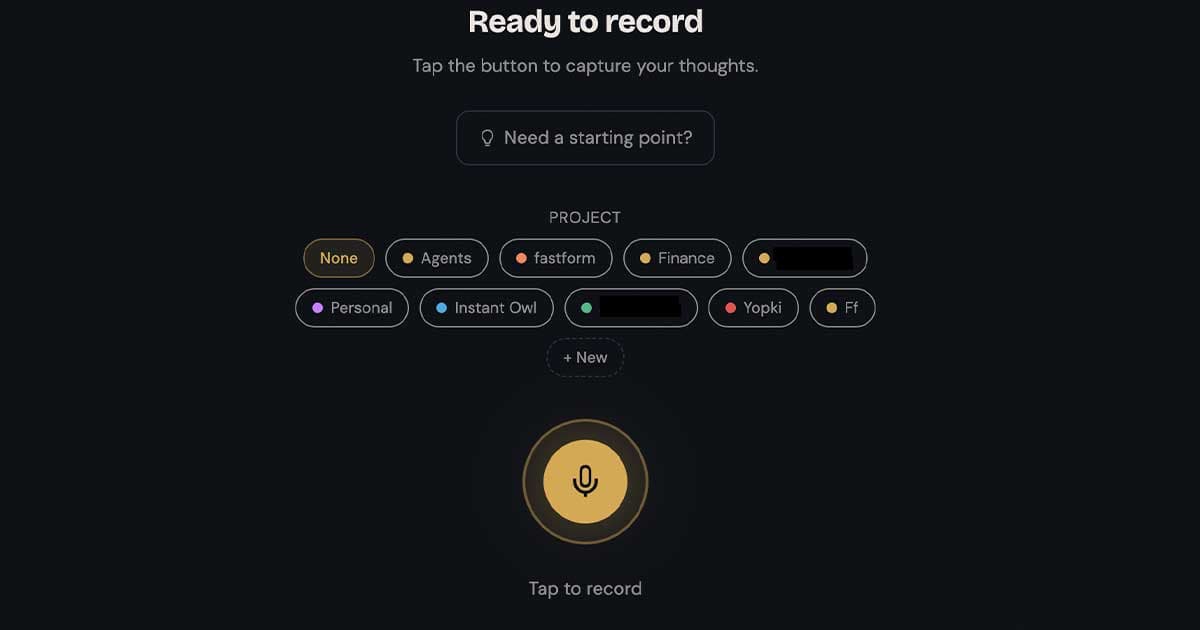
Full disclosure: InstantOwl is our product, and this is our blog. We built it because a transcript is where the work starts, not where it ends. A recording goes in, and organized output comes out: tasks pulled out, notes titled and filed by project, not a pile of raw text you still have to sort by hand. InstantOwl is currently free to use, and it is built for the exact backlog this post is about: not one memo to clean up, but a whole bunch of them.
If your memos already have real structure to them, our companion post on voice memos covers recording, organizing, and what to do with them beyond transcription alone. And if you want the fuller picture on every way to get spoken words into text, see our guide to voice notes to text and the broader roundup of audio transcription tools.
Related reading
- Voice memos: recording mechanics, use cases, and what happens after you capture one.
- Voice notes to text: every method for turning a voice note into text, free and paid, compared.
- Transcribe audio to text: the broader landscape of transcription tools and their fine print.
- InstantOwl: organized notes and tasks from one recording, currently free to use.
Frequently asked questions
How do I transcribe a voice memo on iPhone?
Open Voice Memos, pick a recording, and if your iPhone is a 12 or later, Apple transcribes it automatically. Swipe up from the waveform to view the transcript live while it plays, or open it after recording to read the full text, per Apple's support guide.
Can I transcribe voice memos on an older iPhone?
Not with Apple's built-in feature, since native transcription requires an iPhone 12 or later. Your options are a share-sheet app like Aiko or Scraibe for on-device processing, an upload tool like Notta or NoteGPT, or the two-device trick of playing the memo aloud into Notes dictation on a second device.
Is there a free voice memo transcriber?
Yes, and the best one is already on your phone: Voice Memos transcribes for free on iPhone 12 or later, no download required. Off that path, free tiers exist but are narrow, such as Notta's one free file capped at 3 minutes, delivered by an email link that expires in 72 hours.
How do I copy a Voice Memos transcript?
Open the recording, open View Transcript, then select the words you want and tap Copy for part of it, or tap Copy Transcript to copy the whole thing. Paste it anywhere else on your iPhone, per Apple's support guide.

Written by
Jim BreeseJim Breese is the founder of InstantOwl. He's spent 15 years building companies, from an Airbnb host community he founded and exited to growth leadership at venture-backed SaaS startups. He built InstantOwl because his best ideas kept arriving mid-walk, out of order, and half-finished.
Stop losing good ideas.
InstantOwl turns a rambling voice note into a clean, organized document in moments. Just talk. We'll organize it.
 Try InstantOwl free