How to Record and Transcribe FaceTime Calls (Audio Is Native Now)
By Jim Breese ·
Can you record a FaceTime call?
Yes, but the honest answer splits in two, and most guides get it wrong. One-to-one FaceTime audio calls now record and transcribe natively on iPhone, no extra app needed. FaceTime video calls still have no native recording feature at all, in the iOS 18 cycle or since.
Most pages ranking for "record and transcribe facetime" still say FaceTime cannot record audio in any form. That was true before iOS 18. It is not true anymore for one-to-one audio calls, and getting that distinction right is the reason this guide exists.
How do you record and transcribe a FaceTime audio call?
During a one-to-one FaceTime audio call, tap the more button, then tap Call Recording. Both people on the call hear a notice that the call is being recorded, per Apple's iPhone user guide. Tap stop, or just end the call, to finish.
The recording saves itself. Apple's guide states plainly: "Call recordings are automatically saved to a Call Recordings folder in the Notes app." No file management, no export step, no third-party app.
A transcript follows automatically in supported regions and languages. Apple's guide describes it directly: "In select regions and languages, you can view the transcript of a recorded call in the Notes app. The transcript may not be available immediately, you may see a message that the transcription is in progress." Each line names who said it: "In the transcript, the speaker of each statement is identified."
From the transcript in Notes, you can play audio starting from any sentence, search with Find in Transcript, add the transcript into a note or copy it elsewhere, and save the audio to Files or delete it. One warning worth repeating exactly, from Apple: "Deleting the audio recording also deletes the transcript." Keep that in mind before you clean up old recordings.
Apple also hedges accuracy directly, and it is worth taking at face value: "Verify the accuracy of a transcription before relying on it. It might not be a perfect representation of the conversation." Treat the transcript as a strong first draft, not a certified record.
Three limits matter before you rely on this feature. First, it covers one-to-one audio calls only, no group FaceTime and no video calls. Second, it is region and language gated; Apple points readers to its iOS and iPadOS Feature Availability page to check first. Third, the feature ships on by default, and you can turn it off in Settings > Apps > Phone > Audio Call Recording.
This mirrors what we cover in recording and transcribing a phone call: both are consent-by-design, both save the transcript automatically, and Apple's language in both places is nearly identical, right down to asking you to "make sure the other call participant is willing to be recorded" before you start.
Why can't you record a FaceTime video call the same way?
Because Apple never built a native recording feature for FaceTime video calls, on any current iOS version. The audio-call recording feature lives inside the Phone-adjacent call tools; FaceTime video has its own, separate more menu, and Call Recording is not on it.
That gap has stood since iOS 18 first added native audio call recording, through every iOS release since. If a page tells you video call recording is coming, or already exists, treat that claim skeptically until Apple's own support pages say so.
The workaround is screen recording, which works, but comes with a real caveat: it does not reliably capture the other person's voice.
How do you screen record a FaceTime video call?
On iPhone, swipe down from the top-right corner to open Control Center, then touch and hold the Screen Recording button (a plain tap starts recording with no microphone). Tap Microphone to turn it on, tap Start Recording, and wait for the three-second countdown, per Apple's screen recording guide.
That long-press step is easy to miss and changes the entire recording. A plain tap on the Screen Recording button starts recording with no audio at all. You have to touch and hold first, then tap Microphone, or you get a silent video. Recordings save automatically to Photos, under Collections > Media Types > Screen Recordings.
Here is the part almost nobody flags clearly: even with the microphone turned on, iPhone screen recordings of FaceTime calls often come out with no call audio, or only your own voice. Apple's own guide only goes as far as warning that "some apps might not allow you to record their content," without naming FaceTime specifically.
Real users confirm this is a known, recurring problem, not a one-off glitch. One person on Apple's own support community wrote: "The microphone was turned on... but there's no sound at all until the very end when I hung up the facetime call... Sometimes the screen recordings have sound, sometimes they don't." Another poster on Reddit's r/applehelp described trying to preserve a FaceTime call with a family member in hospice, hoping to keep a recording of hearing them say "I love you," only to play it back with no sound at all.
That is the honest reason to test your setup before a call that matters, not after. Record a 30-second test call with a friend first, and confirm you can hear both voices back, before you rely on an iPhone screen recording for anything you cannot redo.
What is the reliable way to screen record a FaceTime video call?
Use a Mac. Open the Screenshot app with Shift, Command, and 5, or use QuickTime Player's File > New Screen Recording, choose a microphone in Options, and put the FaceTime call on your Mac's speakers so the other person's voice plays out loud into the room, per Apple's Mac screen recording guide.
This works because of how Mac screen recording actually captures audio. Apple states it plainly: "To record your voice or other audio with the screen recording, choose a microphone." There is no built-in system-audio option, so the other person's voice gets picked up acoustically, playing out of your speakers and into whichever microphone you selected.
Quality follows from that setup. Record somewhere quiet, keep the call volume reasonably loud and clear, and use a decent external microphone if you have one, since the Mac's built-in mic is picking up the room, not a clean audio feed.
The output file lands automatically. Apple's guide names the exact convention: "When saving your recording automatically, your Mac uses the name 'Screen Recording [date] at [time].mov'." That .mov file is what you upload for a transcript in the next section.
What are Live Captions, and can you keep them after the call?
Yes, and this is the closest thing to a free, native transcript for a FaceTime video call. During a video call, tap the screen, tap more, then tap Live Captions to see the spoken conversation transcribed in real time, with each line showing who is speaking, per Apple's Live Captions guide.
By default, captions disappear the moment the call ends. There is one setting that changes that entirely, and almost no other guide covers it: Keep Call Captions. Go to Settings > Accessibility > Live Captions before your call and choose how long captions stick around.
The two options behave completely differently, per Apple's Live Captions setup guide. "1 Minute" clears everything right after the call, and you cannot copy, screenshot, or screen record the transcription at all. "1 Hour" saves captions for up to an hour after the call ends, and lets you copy, screenshot, or screen record them.
Choosing "1 Hour" also builds consent directly into the feature. Apple describes it exactly: "When you choose 1 Hour, all call participants hear a brief audio announcement ('This call is being transcribed') at the start of the call." If you pause or downgrade the setting mid-call, everyone hears "This call is no longer being transcribed" instead.
To pull the text out, tap more, then Copy Captions, and paste it into Notes or Messages. Set Keep Call Captions to 1 Hour before you dial, not after; the setting only helps if it is already on when the call starts.
One caveat Apple states directly: "The accuracy of Live Captions may vary and shouldn't be relied upon in high-risk or emergency situations." Treat captions the same way as any automatic transcript: useful, not certified.
How do you transcribe a FaceTime recording once you have the file?
Upload it to a transcription tool that accepts video files directly, no conversion step needed. InstantOwl, our product, accepts .mov and .mp4 files up to 150MB, so a Mac screen recording or an iPhone screen recording from Photos both upload as-is and come back as an organized transcript.
That matters because a raw call recording is not the same thing as a usable one. A transcript alone is still a wall of text; what you actually want after a family call or a work FaceTime is the few decisions and follow-ups buried inside it, not every filler word repeated back to you.
InstantOwl turns that .mov or .mp4 into a transcript plus organized output: a summary, extracted tasks, or a clean note, depending on what you need from the call. Full disclosure: this is our product, and it is currently free to use.
Is it legal to record a FaceTime call?
It depends on where you and the other person are. Some states only require one person on the call, meaning you, to consent. Others require every participant to agree, known as all-party or two-party consent. Justia's fifty-state survey lays out which rule applies where, and it is worth reading before you record anyone else.
This is not legal advice, just a reason to check first. FaceTime's own native features do some of this work for you: both the audio call recording feature and Live Captions set to 1 Hour play an audible notice to every participant, so nobody on the call can claim they were not told.
Screen recording is different, and this is the part that puts the responsibility fully on you. Neither iPhone nor Mac plays any announcement when you start a screen recording, native or otherwise. If you screen record a FaceTime call, telling the other person is entirely your job, not the software's.
Recording FaceTime, the honest summary
Audio calls, one-to-one, are solved: native recording, an automatic notice to both callers, and a speaker-labeled transcript in Notes. Video calls are not solved natively; the real fix is a Mac screen recording with a chosen microphone, uploaded to a transcription tool afterward.
Live Captions with Keep Call Captions set to 1 Hour is worth turning on before any video call you might want notes from later, even as a backup to screen recording. It costs nothing, announces itself to everyone, and gives you a copyable transcript for free.
If you already make a habit of keeping voice notes for yourself after important calls, the same idea applies here: a 60-second spoken recap right after you hang up often gets you further than a full transcript, with none of the consent questions a recorded call raises. If your call already lives as a video file in another format, our guide on turning a screen recording into text covers the upload path.
For text-based calls instead of FaceTime, the same consent-by-design pattern shows up in how WhatsApp handles voice message transcripts, off by default and visible only to the person who turns them on.
Frequently asked questions
Can you record a FaceTime call?
It depends on the call type. One-to-one FaceTime audio calls record natively on iPhone, with an automatic transcript saved to Notes. FaceTime video calls have no native recording feature, so the workaround is screen recording, which carries its own reliability problems for call audio.
Does FaceTime transcribe calls?
Yes, for one-to-one audio calls: a speaker-labeled transcript saves to the Notes app automatically after you record. For video calls, FaceTime has no saved transcript, but Live Captions can display and, with one setting changed, let you copy captions for up to an hour after the call ends.
Why does my FaceTime screen recording have no sound?
Apple's screen recording tool does not guarantee call audio, and real users report FaceTime recordings coming out silent even with the microphone turned on. Apple's own documentation only says some apps might not allow audio to be recorded, without naming FaceTime specifically. A Mac screen recording with a chosen microphone is the more reliable route.
Is it legal to record a FaceTime call?
It depends on your state or country, since some require only one person to consent and others require everyone on the call to agree; this is not legal advice, so check Justia's fifty-state survey for your state. FaceTime's own recording features are consent-by-design and announce themselves to every participant.

Written by
Jim BreeseJim Breese is the founder of InstantOwl. He's spent 15 years building companies, from an Airbnb host community he founded and exited to growth leadership at venture-backed SaaS startups. He built InstantOwl because his best ideas kept arriving mid-walk, out of order, and half-finished.
Stop losing good ideas.
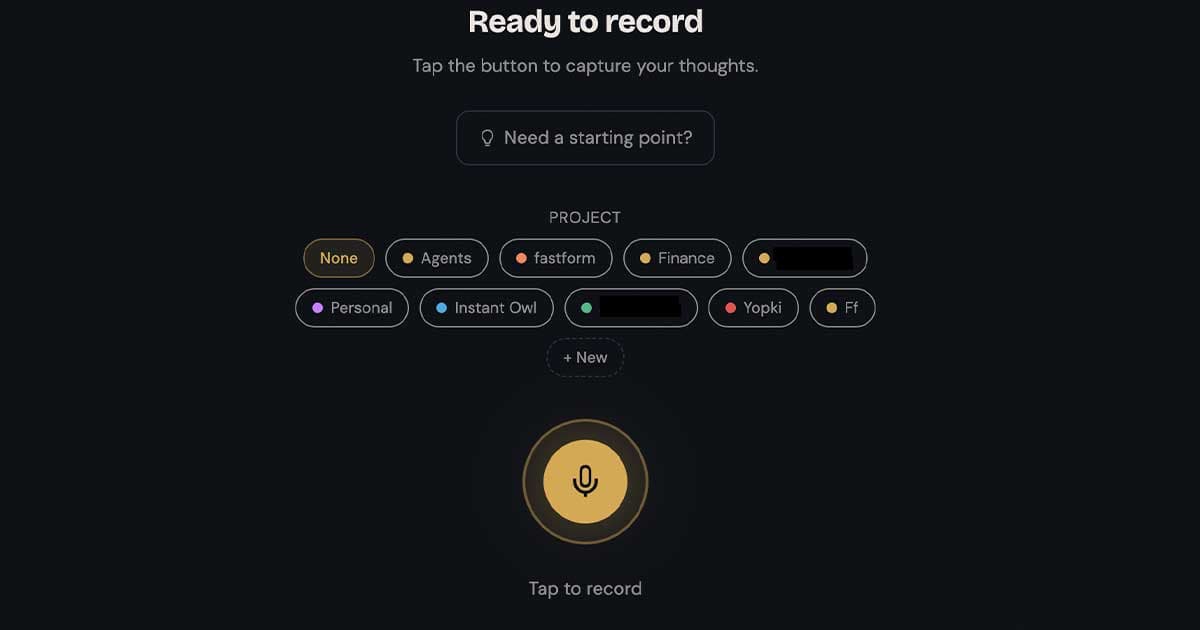
InstantOwl turns a rambling voice note into a clean, organized document in moments. Just talk. We'll organize it.
 Try InstantOwl free