MOV to Text: Transcribing QuickTime and Mac Screen Recordings
By Jim Breese ·

Where do .mov files come from?
Most .mov files on a Mac come from one place: screen recordings. Apple's own support page names the exact file it creates when you record your screen with the Screenshot toolbar or QuickTime Player: "Screen Recording [date] at [time].mov," per Apple's guide. You can open it in QuickTime Player, iMovie, or any app that edits or views video.
That screen recording is a QuickTime movie, typically with an H.264 video track and an AAC audio track. QuickTime Player recordings work the same way whether you're capturing your screen, a movie clip, or an iPhone tethered to a Mac.
iPhone camera video commonly arrives as .mov too, though that origin comes from a converter site rather than Apple itself. MOV "was designed for Apple's QuickTime Movie Player" and is "often the default format for iPhones and iPads," per Zamzar's format page. Treat it as common knowledge, not an Apple-published fact.
One thing a .mov file is not, despite the confusion: an iPhone screen recording. iOS screen recordings are widely reported as .mp4, and neither Apple's screen recording doc nor its codec doc names .mov for that case. If you're troubleshooting an iPhone screen recording specifically, rather than a Mac one, look for an .mp4 file instead.
One codec wrinkle explains why some tools stumble on newer iPhone .mov files. iOS 11 and later capture video in HEVC by default, a more efficient but less universally supported codec than H.264, per Apple's own documentation of iPhone video formats. You can switch to "Most Compatible" in Settings > Camera > Formats for broader compatibility. The audio track stays AAC either way, which is why transcription tools rarely care about any of this: they only ever read the audio.
Can Microsoft Word transcribe a .mov file?
No. Microsoft's support page states the supported format list verbatim: "Transcribe currently supports .wav, .mp4, .m4a, .mp3 formats," per Microsoft's page. MOV is not on it.
This is the detail most guides for this keyword skip. Word Transcribe is the most common "free because you already pay for Microsoft 365" path, and it handles .mp4 files without issue, up to 300 uploaded minutes a month, or 30,000 with a Copilot license, per the same page. A .mov file dropped into Word for the web simply will not upload.
Zamzar's free MOV to TXT converter has its own ceiling, and it's the tightest one in this post: 50MB per file, per its own page. For video, that's often just a couple of minutes of footage before the free tier stops you.
Two ways around either limit exist: convert the file first, covered below, or pick a tool that takes .mov directly, covered next.
Which tools transcribe .mov files directly?
Several tools accept .mov without any conversion step. Word Transcribe is the one exception worth keeping in the same table, since knowing what it can't do is half the point of this post.
| Tool | Free tier | File cap | Exports |
|---|---|---|---|
| Word Transcribe (Microsoft 365) | Included with M365, 300 min/mo (30,000 with Copilot) | Not published | Does not accept .mov |
| TurboScribe | 3 files/day, 30 min each, no card | 10 hours / 5GB on Unlimited ($10/mo billed yearly, $20/mo monthly) | PDF, DOCX, SRT, VTT, CSV, TXT |
| ElevenLabs | 10,000 credits/mo, recurring, signup required | No size or duration limit stated | TXT, DOCX, PDF, JSON, SRT, VTT, HTML |
| Happy Scribe | 10 minutes, one time | No file size limit stated | TXT, DOCX, PDF, SRT, VTT |
| go-transcribe | Free trial, pricing not published | No strict limit; recommends under 4GB | Word, PDF, SRT, VTT, Avid DS |
| any2text | 15 minutes free, then $0.035/min or $19.99/mo for 3,000 min | No max length stated | DOCX, XLSX, SRT, TXT |
| converter.app | Free, no signup | Not stated; files auto-delete after 120 minutes | TXT only |
| InstantOwl | Currently free to use | 150MB | Organized note, not a raw transcript |
ElevenLabs names MOV explicitly, alongside MP4, AVI, and MKV, on its own page: "Upload MOV, AVI, and MKV video alongside your MP4s, plus MP3, WAV, M4A, AAC, FLAC, and OGG audio," per ElevenLabs' page. Its free tier is 10,000 credits a month, recurring rather than a one-time allowance, though ElevenLabs does not publish how many minutes a credit buys.
TurboScribe lists MOV directly in its format list alongside MP3, M4A, MP4, AAC, and WAV, per its site. Its free tier gives 3 transcripts a day at 30 minutes each with no card required; its Unlimited plan removes that cap for $10 a month billed yearly.
Happy Scribe's dedicated MOV page treats the format as one of 45 or more it supports, with imports directly from YouTube, TikTok, Vimeo, Dropbox, and Google Drive, per its page. go-transcribe and any2text both accept .mov the same way they accept MP4, with no strict size limit stated by either. converter.app is the one free option in this table that outputs plain text only, so it's a poor fit if subtitles are the goal.
How do you convert a MOV file before transcribing it?
If a tool rejects your .mov file, whether it's over a size cap or the format simply isn't accepted, extracting just the audio track turns it into a small, universally accepted file. ffmpeg is a free, open-source command-line tool built for exactly this.
ffmpeg -i input.mov -vn output.mp3
The -vn flag disables video entirely. Per ffmpeg's own documentation, it "disables video recording i.e. automatic selection or mapping of any video stream." What's left is the audio track alone, ready for any audio tool, including Word Transcribe's .mp3 support.
To skip re-encoding and keep the original audio quality, copy the audio stream directly to an .m4a file instead:
ffmpeg -i input.mov -vn -c:a copy output.m4a
Either version solves the size problem too, not just the format problem. A .mov file over a tool's cap, like Zamzar's 50MB limit, is almost entirely video data. The audio track alone is usually a small fraction of that size, with no loss to transcription accuracy, since only the audio ever gets read.
ffmpeg has no graphical interface; it installs through a package manager (Homebrew on a Mac: brew install ffmpeg) or a direct download from ffmpeg.org, and every command runs in Terminal. If that's more setup than you want for one file, skip straight to a tool that accepts .mov natively in the table above. Once you have an extracted .mp3 or .m4a, our MP3 to text guide maps that exact file to more tools.
How do you convert MOV to SRT?
Five tools that accept .mov directly also export SRT subtitles: TurboScribe, ElevenLabs, Happy Scribe, go-transcribe, and any2text. Three routes are text-only and can't produce subtitles: converter.app, Zamzar's MOV to TXT tool, and Word Transcribe, which doesn't accept .mov at all.
The distinction matters because a plain text transcript can't become subtitles without re-timing every line by hand. If captions are the actual goal, start with a tool that exports SRT or WebVTT rather than converting a TXT file after the fact.
go-transcribe's editor makes the format choice explicit: select Export, then choose SubRip (.srt) or WebVTT (.vtt) from a dropdown, per its page. any2text adds subtitle customization on top of the export itself: 1 to 5 lines per subtitle, up to 100 characters per line, and automatic or manual speaker detection, per its page.
Can you text a .MOV file?
Yes, and Apple does not publish an official size limit for sending video over iMessage. Third parties commonly cite a figure around 100MB for iMessage attachments, and roughly 1 to 3.5MB for the MMS fallback that kicks in when iMessage isn't available, though neither number comes from an Apple support page.
Messages compresses large videos automatically before sending, which can visibly degrade quality. For a video too large or too important to compress, Apple's documented workaround is a shared iCloud link instead of a direct attachment.
If your real question was turning a .MOV into text rather than sending it, the routes above already cover that: a native tool from the table, or the ffmpeg fallback if your only option is a tool that rejects the format.
Where does InstantOwl fit?
Full disclosure: InstantOwl is our product, and this is our blog.
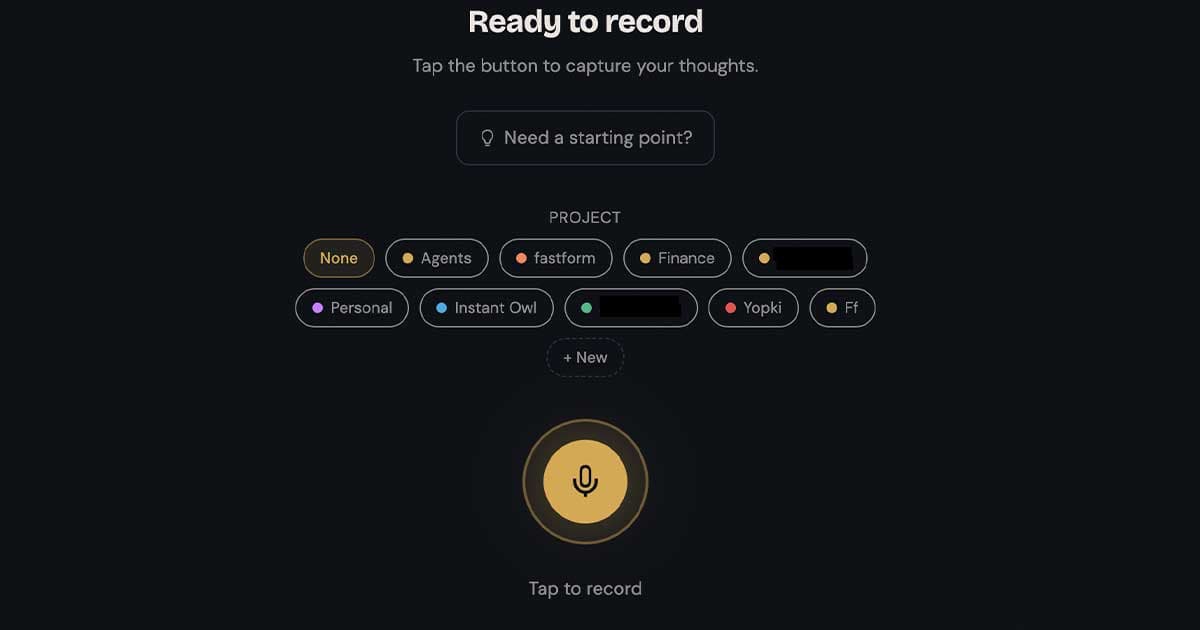
InstantOwl accepts .mov files natively, up to 150MB, per its own upload docs. If the file is a video, InstantOwl processes the audio track for transcription, so nothing about it being video rather than plain audio changes what happens next.
The fit is narrow and deliberate: a Mac screen recording where you talked through an idea out loud, or a phone video that's really just your own voice with a camera running. Upload it, and InstantOwl runs its usual pipeline, transcript, an AI-generated title, an organized output document, extracted tags, and any tasks it finds, instead of handing back a wall of transcript text to sort through yourself.
If your file is one of many someone else recorded, our wider video to text guide covers the tool landscape beyond InstantOwl, and if it's already plain audio, our transcription guide covers that path too.
It's the wrong fit if subtitles are the goal. InstantOwl doesn't export SRT or VTT files; use one of the tools in the table above instead. InstantOwl is currently free to use.
Related reading
- Video to text: the full guide to turning any video file into text, beyond MOV specifically.
- MP3 to text: where an extracted MOV audio track goes next.
- Transcribe audio to text: every real transcription option, priced and compared.
Frequently asked questions
How do I transcribe a MOV file?
Use a tool that accepts .mov natively, such as TurboScribe, ElevenLabs, Happy Scribe, or InstantOwl for your own recordings. If the tool you already have, like Microsoft Word's Transcribe, does not accept .mov, extract the audio with ffmpeg first (ffmpeg -i input.mov -vn output.mp3), then upload the resulting audio file instead.
Can Microsoft Word transcribe MOV?
No. Microsoft's own support page lists the supported formats verbatim as .wav, .mp4, .m4a, and .mp3. MOV is not on that list, so a .mov file needs converting to one of those formats, or extracting to audio only, before Word's Transcribe feature will accept it.
How do I convert MOV to SRT?
Use a tool with SRT in its export list, such as TurboScribe, ElevenLabs, Happy Scribe, go-transcribe, or any2text, all of which accept .mov directly and export SubRip subtitle files. Tools that output plain text only, like converter.app or Word Transcribe, cannot produce subtitles.
Are Mac screen recordings MOV files?
Yes. Apple's own support page states that a Mac screen recording saves automatically as Screen Recording [date] at [time].mov, playable in QuickTime Player, iMovie, or any app that edits or views video. This applies to Mac screen recordings specifically, not iPhone screen recordings, which are not confirmed as .mov by Apple.

Written by
Jim BreeseJim Breese is the founder of InstantOwl. He's spent 15 years building companies, from an Airbnb host community he founded and exited to growth leadership at venture-backed SaaS startups. He built InstantOwl because his best ideas kept arriving mid-walk, out of order, and half-finished.
Stop losing good ideas.
InstantOwl turns a rambling voice note into a clean, organized document in moments. Just talk. We'll organize it.
 Try InstantOwl free