How to Record and Transcribe Phone Calls: iPhone, Pixel, and the Consent Question First
By Jim Breese · · Updated
Is it legal to record a phone call?
It depends on where you and the other person are. Some states only require one person on the call to consent, meaning you alone. Others require every participant to agree, which is called all-party or two-party consent. Justia's fifty-state survey lays out which rule applies where, and it is worth reading before you record anyone else.
This is not legal advice, just a reason to check before you hit record. Cross-state calls add a wrinkle: one commenter in an online VOIP forum pointed out that if you are calling someone in another state, it is worth checking their state's law too, not just your own.
Here is the part almost nobody notices: your phone has already made this decision easier for you. Both iPhone and Pixel are consent-by-design. Apple's own guide tells you to check feature availability and "make sure the other call participant is willing to be recorded" before you start. Once you do start, iPhone plays an audio notice that both people on the call can hear.
Google does the same thing, twice. Per Google's support page, "When you start recording, both parties are notified with a disclosure that the call is being recorded. When you stop recording, both parties are notified with a disclosure that the call is no longer being recorded." Google adds plainly: "It's up to you to follow all laws on recording phone conversations."
The announcement is not an inconvenience. It is the feature doing your disclosure for you. Neither Apple nor Google lets you skip it, which is the strongest argument that recording someone without their knowledge was never the intended use case for either phone.
How do you record and transcribe a call on iPhone?
During a call in the Phone app, tap the in-call controls, then tap Call Recording. Both call participants hear an audio notice that the call is being recorded, per Apple's support guide. Tap stop to end it, or just hang up.
iPhone automatically saves the recording to a Call Recordings folder in the Notes app. Spoken words in supported languages are transcribed automatically, with the speaker of each statement identified, the same automatic transcription iPhone now brings to a recorded FaceTime call. Apple's guide notes that the transcript may not be available immediately and may show a message that transcription is in progress.
Apple's own accuracy disclaimer is worth repeating exactly: "Verify the accuracy of a transcription before relying on it. It might not be a perfect representation of the conversation." If Apple Intelligence is turned on, you can also get a summary of the call. Call Recording is on by default; turn it off in Settings > Apps > Phone > Call Recording.
Two caveats build real trust here because most guides skip them. First, call recording is not available everywhere: Apple's guide lists it as unavailable in Azerbaijan, Bahrain, Egypt, the European Union, Iran, Iraq, Jordan, Kuwait, Morocco, Nigeria, Oman, Pakistan, Qatar, Russia, Saudi Arabia, South Africa, Turkey, the United Arab Emirates, and Yemen. That means the entire EU has no native call recording on iPhone. Second, deleting the audio recording also deletes the transcript, so do not delete one if you still need the other.
How do you record a call on a Pixel phone?
Pixel Call Recording is audio only, and it is built into the Phone by Google app on Pixel 6 and later running Android 14 or later, or Android 9 and later on non-Pixel phones. During a call, tap Call Assist, then Call Recording. Tap again to stop.
Per Google's Call Recording support page, both parties are notified when recording starts and again when it stops, the same disclosure Apple uses. Unlike iPhone, Pixel lets you set automatic recording for calls from unknown numbers or from selected contacts, but the disclosure still plays every time, even when recording turns on automatically.
Recordings stay on the device. Google's page states that calls "aren't saved or backed up off-device," and deleting a call log entry deletes its recording with it. Call recording is "widely available, but not in all countries or regions." Google's legal framing matches Apple's tone: "It's up to you to follow all laws on recording phone conversations. Use call recording responsibly and turn it on only when needed."
What is Pixel Call Notes, and how is it different from Call Recording?
Call Notes is transcription, and it only runs on Pixel 9 and later, excluding the A-series models, which is a narrower device list than Call Recording's. Nobody ranking for this keyword separates the two features cleanly, and they are genuinely different products.
Per Google's Call Notes support page, the feature requires a SIM card of the country or region it is used in, and it only works in specific places: Australia, Canada, Ireland, the UK, and the US for English, Japan for Japanese, and India for Hindi and English on Pixel 10. Call summaries are English only, everywhere.
Turn it on in Phone app settings, then during a call tap Call Assist, then Call Notes. The output is a full transcript plus a summary covering topics covered, dates, times, and places, and next steps. Google states plainly that "participants are notified" when you activate it on a call, and that "your call contents are stored on your device and aren't shared with Google," running on an on-device Gemini model. You can delete individual notes, delete everything, or set an auto-deletion interval.
What if you need every call recorded automatically?
Native recording was not built for record-everything use cases, and one exchange in an online VOIP forum captures why. A real estate salesperson asked how to automatically record and transcribe every call from their iPhone into a searchable database. Someone asked if iPhones already record all calls. The salesperson's answer was blunt: "Yes it does, but it's not automatic and it announces it every time which makes it basically useless to me."
The community's answer was to move the calls off the native dialer entirely. The top-voted recommendation was a VOIP PBX like 3CX: port your number to a VOIP provider, make every call through the PBX app, and recording and transcription happen server-side automatically. Business phone services came up too: OpenPhone, Dialpad, GoToConnect, and Grasshopper, though one commenter noted Grasshopper is cheaper "but no auto transcription."
This route has real costs. You may need to port your number, replace your native dialer with a softphone app, and accept that you might lose iMessage on that number. Some VOIP providers also play their own recording notice to both parties, so the disclosure requirement does not disappear, it just moves to a different app.
Worth saying plainly: the fully automatic, silent iPhone call recorder that salesperson wanted does not exist, by design. One participant in the same thread summed it up: "AFAIK there's no solution to the question." Another described almost paying for an app that claimed to do it and simply did not deliver. If an app promises silent, automatic call recording on a stock iPhone, be skeptical of it.
Does hardware like PLAUD record calls without an announcement?
Yes, and this is the sharpest contrast in this whole guide. PLAUD's Note ($159) and Note Pro ($189) record phone calls through a Vibration Conduction Sensor pressed against the back of the phone, held in place by a MagSafe case. It picks up both sides of the conversation, needs no app permissions and no carrier support, and plays no announcement of its own. Headphones cannot be used during call recording, and PLAUD's NotePin and NotePin S cannot record calls at all; PLAUD's own workaround for those is speakerphone.
Recorded or imported audio gets transcribed and summarized inside the PLAUD app, against a free quota of 300 minutes a month, with paid plans starting at $8.33 a month billed annually.
One forum commenter who uses this exact setup for calls confirmed the mechanism directly: "You mentioned Plaud, and that works great. You do not need to talk on speakerphone... The flat one is the one you want, not the notepin." Another commenter in the same thread panned the broader category of generic Bluetooth and MagSafe recorders as a group, writing "I have honestly yet to find a decent device for this purpose. Every last one I have tried has been awful in some way," and separately, "In my experience they aren't great" about MagSafe two-microphone recorders generally.
Say this plainly: because no disclosure plays on the hardware side, using a device like this to record a call puts the entire legal and ethical burden on you. Nothing in the product does your disclosure job the way iPhone's audio notice or Google's on-start-and-stop alerts do.
Already have a call recorded? How do you transcribe it?
If you already have the audio, whether from a legally recorded call or an old voicemail export, TurboScribe and HappyScribe both handle single files without hardware. TurboScribe's free tier gives three transcripts a day for files up to 30 minutes with no card required; its Unlimited plan is $10 a month billed yearly (or $20 month to month) for files up to 10 hours or 5GB, powered by Whisper with speaker recognition included.
HappyScribe gives ten free minutes once, and its own fine print claims "up to 96% accuracy on clear audio" for the AI tier, with its human transcription tier closer to 99%.
Set your expectations before you upload a phone call specifically: phone audio is compressed and often crosstalk-heavy, exactly the conditions where AI transcription accuracy drops. A flat 99% accuracy claim on any tool, for any audio, is marketing, not a guarantee for your specific recording.
Is there a way to get call notes without recording the other person?
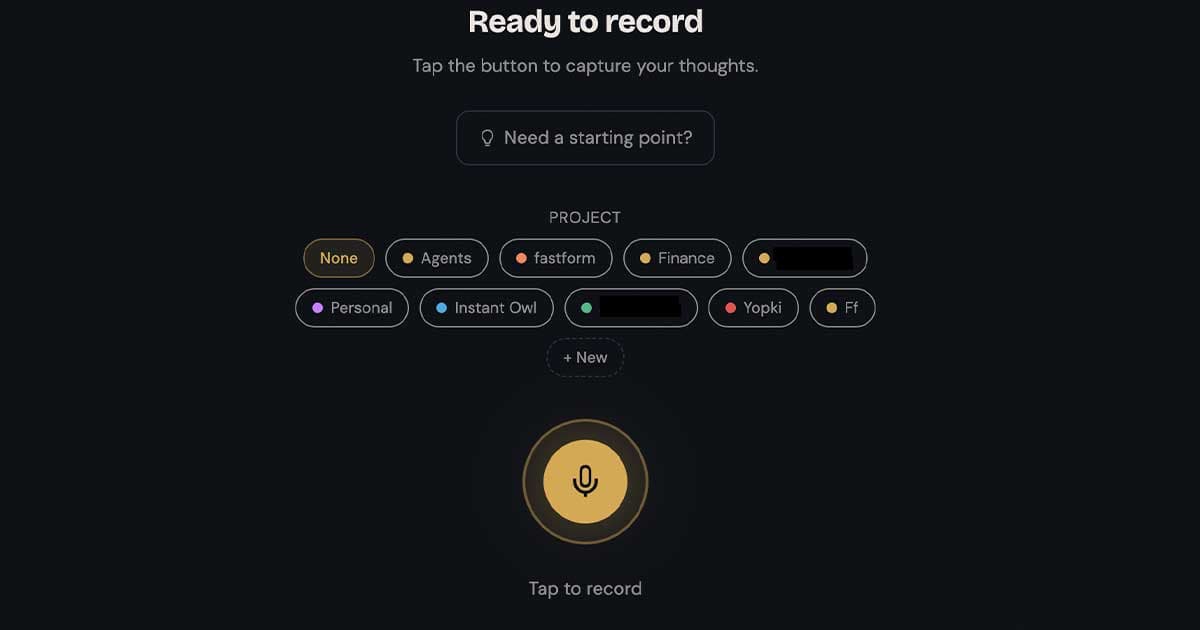
Yes: stop recording the call and record yourself instead, right after you hang up. Talk for sixty seconds about what was agreed, the numbers that came up, and the next steps while it is still fresh. InstantOwl, our product, turns that into an organized note with the details pulled out for you.
This sidesteps the entire question this guide starts with. There is no announcement to play, no consent to secure, and no state law to check, because you are the only person being recorded. It also skips the two features you would otherwise need: recording software and a transcript, since you are talking through what mattered instead of capturing every word of the call itself. That consent-free lane is the same one our guide to voice notes for family caregivers is built around, where the calls in question are usually a doctor's office.
This fits the same problem covered in meeting notes: people who record entire conversations often just need the decisions and the actions, not a verbatim transcript. It is also the exact habit we recommend for voice notes for sales, where the call itself matters less than what you do with it thirty seconds later. If you already keep voice notes for yourself, a post-call debrief is the same habit pointed at a different moment in your day. InstantOwl is currently free to use.
Frequently asked questions
Is it legal to record a phone call?
It depends on your state or country. Some require only one party to consent, others require everyone on the call to agree, and this is not legal advice: check Justia's fifty-state survey for your state before you record anyone else.
How do I record a call on iPhone?
During a call, tap the call controls, tap Call Recording, and both people on the call hear an audio notice that it started. The recording and its transcript save automatically to a Call Recordings folder in the Notes app.
Why does my phone announce the recording?
Apple and Google both build the disclosure into the feature itself: iPhone plays an audio notice to both callers, and Pixel notifies both parties when recording starts and again when it stops, so consent is not something you have to remember to ask for separately.
Can I record calls without the other person knowing?
Not with the built-in tools: both iPhone and Pixel announce the recording by design, and whether silent recording is even legal depends on your state. The consent-free option is recording your own debrief after you hang up instead of recording the other person.

Written by
Jim BreeseJim Breese is the founder of InstantOwl. He's spent 15 years building companies, from an Airbnb host community he founded and exited to growth leadership at venture-backed SaaS startups. He built InstantOwl because his best ideas kept arriving mid-walk, out of order, and half-finished.
Stop losing good ideas.
InstantOwl turns a rambling voice note into a clean, organized document in moments. Just talk. We'll organize it.
 Try InstantOwl free