The Best Note-Taking Apps in 2026 (Prices Verified This Week)
By Jim Breese · · Updated

What is the best note-taking app?
There is no single best note-taking app, because the app that wins depends on who is using it. Students and Microsoft-shop professionals get the most out of OneNote. People who want their notes as local files, immune to any one company's future pricing decisions, land on Obsidian or Joplin. Apple users do fine with what is already on their phone. Daily-life scraps, grocery lists, and quick reminders belong in Google Keep.
This roundup is built the way the actual demand is shaped: by use case, not a single ranked list. It also carries a freshness advantage the incumbent listicle does not. The most-cited ranking post for this search was last updated in December 2025, and two of its printed prices have already drifted since then. Every number below was checked against the official pricing page on 2026-07-16, the day this was written.
That incumbent post is not lazy work. Its author says the ranking is based on testing "over 50 different note apps," scored on core function quality, capture speed rivaling pen and paper, cross-device access with offline support, and value for money. Those are reasonable criteria, and worth naming because one of them, capture speed, is the exact criterion this post argues nobody actually finishes testing. Capture speed rivaling pen and paper is a typing benchmark in every ranking post we found. None of them time how fast you can just talk.
The corrections that matter
The December 2025 update to the leading "best note-taking apps" post gets most of its facts right, but carries two provable errors and a fair one. Naming them is not a takedown; it is the reason to verify prices on the date you actually need them, since even a recently updated post can drift within a couple of months.
Notion's Plus plan is printed there as $12 per user per month. Notion's own pricing page, checked live today, lists Plus at $10 per member per month and Business at $20, not the $24 also printed. Obsidian is still described as requiring a $50 per user per year commercial license to use it for work. Obsidian's own license page says the app is now free for personal, commercial, and nonprofit use, and that the $50 fee is an optional supporter tier, not a requirement.
One thing that post gets right deserves equal billing: its Evernote numbers check out. Free plan limits (50 notes, 1 notebook, 1 device) and its rounded $15 and $25 monthly prices both match Evernote's official pricing data today. Not every incumbent figure is stale, and it would be dishonest to imply otherwise.
What actual users recommend, not a ranked list
A 2024 r/productivity thread that asked specifically about students, professionals, and daily life is a better map of real opinion than any single-author ranking, because 95 people weighed in with their own experience. The top comment, at 16 points, backs Joplin: "free and open source, and works great." A second commenter in the same thread cites the reason people leave Evernote for it: Evernote "makes every note proprietary and it is very difficult to transfer it to another file type."
The second-most-upvoted answer, at 13 points, is OneNote, praised for its Microsoft 365 integration with the Planner and To Do apps, the pick that commenter uses for student and professional note-taking while pairing it with Google Keep "like Post-It notes" for grocery lists. A separate commenter adds that OneNote "can sync across all my devices, and has all the features, and absolutely free."
Obsidian earns 8 points from a commenter who pairs it with the reference manager Zotero "for everything," and picks up smaller mentions as "a mapping of your brain" and a developer favorite. A Google Keep plus Google Docs combo gets 6 points for being "free, cross platform/device, and infinitely flexible." Notion draws a split verdict: loved by a few for dashboards and templates ("Notion for literally everything"), and dinged by others as "too complex for note taking but great for self or work wikis."
Evernote sentiment in the thread is organically negative, independent of any pricing complaint. One commenter says they "avoided Evernote bc the best features are behind a paywall." Another writes, "Evernote sucks. Should be best but is buggy and expensive with lots of unnecessary bells and whistles. I quit Evernote this year." The single strongly pro-Evernote comment in the thread sits at negative 3 points, the lowest score of any comment cited here.
Apple Notes gets a smaller but genuine endorsement at 2 points: "has improved so much over the years that I use it exclusively now." Bear picks up a one-word, 2-point nod from another commenter.
One pattern in that same thread is worth naming plainly. At least 8 low-scoring comments push a single app, Amplenote, in near-identical marketing language, and one of those commenters admits outright that the recommendation comes "from my experience working for them and using the app itself." We have excluded those comments from the verdicts above because a paid endorsement is not a user verdict. It is also the clearest argument for reading community recommendations by their score and their wording, not just their existence.
Verified pricing quick-reference
Every figure below was checked against the app's own pricing page on 2026-07-16.
| App | Free plan | Paid plans |
|---|---|---|
| Evernote | 50 notes, 1 notebook, 1 device, 1GB storage | Starter $14.99/mo or $99/yr; Advanced $24.99/mo or $249.99/yr |
| OneNote | Free app on every platform | Premium features via Microsoft 365 Personal, $9.99/mo |
| Bear | Local notes on Mac, iPhone, iPad | Pro $2.99/mo or $29.99/yr |
| Apple Notes | Free | No paid tier |
| Google Keep | Free | No paid tier |
| Notion | Free plan for individuals | Plus $10/member/mo; Business $20/member/mo |
| Obsidian | Free for personal and commercial use | Optional add-ons: Sync $4/user/mo, Publish $8/site/mo |
Evernote's exact dollar figures come from the pricing page's own embedded data, not the visible page text, since the page renders its prices with JavaScript. They match Evernote's rounded numbers elsewhere on the same site, so treat them as confirmed rather than estimated.
Line these plans up side by side and Evernote's free tier is the outlier, not the norm. Obsidian is free with no notebook or device cap at all, even for commercial use. Notion's free plan has no notebook limit either, just a 5MB per-file cap and 7-day page history. Apple Notes and Google Keep charge nothing regardless of how many notes you keep. Evernote is the only app on this list that caps free users at a specific note count, 50, and a single device, which is the detail its Reddit critics are actually reacting to. How those caps and Evernote's paid tiers stack up against Notion specifically is covered in our Evernote vs Notion breakdown.
The criterion nobody ranks: voice capture
No ranking post in this category treats speaking as a first-class way to create a note, and that gap is worth naming directly. Apple Notes will transcribe a recording into text, but only on iPhone 12 or later and only in 10 supported languages, per Apple's support guide. Microsoft's own OneNote page lists voice transcription for note capture as a feature. Google Keep lets you record a voice memo inside a note, but its current help pages make no promise about automatic transcription. Notion, Obsidian, and Bear have no built-in voice capture at all.
Where voice does exist across this list, it is a feature bolted onto a typing-first app, not the point of the app. Apple's transcription only turns a recording into text; it does not title the note, extract a task, or file it anywhere. Nothing here treats a spoken ramble as something to be organized automatically, the same way a typed note gets a title and a notebook.
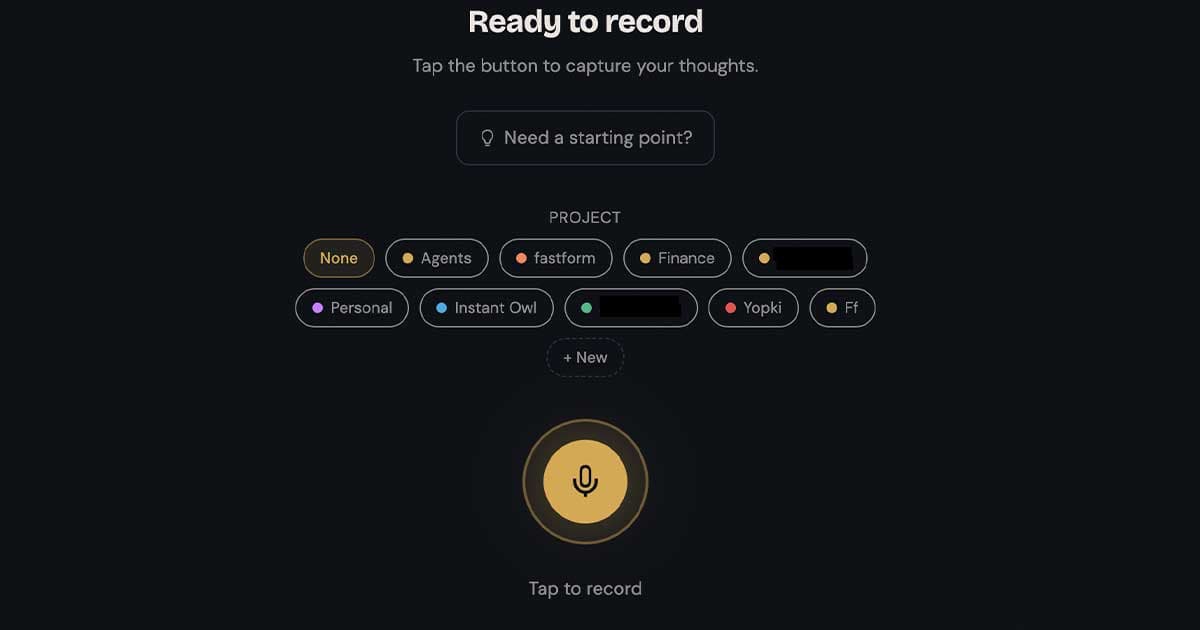
That leaves a real gap for anyone whose fastest way to get a thought down is saying it out loud, not typing it. This is our own product's lane, disclosed plainly: InstantOwl is built around talking as the primary input. You record a thought the way you would say it out loud to a friend, and it comes back as an organized, titled note rather than a raw transcript you still have to clean up and file yourself. It is currently free to use.
This is not a claim that voice replaces typing for everyone. If you are the kind of note-taker this whole roundup describes, someone for whom a racing mind loses thoughts faster than a keyboard can catch them, see our ADHD note-taking app picks and our wider voice notes app comparison for the honest tradeoffs across that category, InstantOwl included.
How do you choose the right note-taking app?
Choose by the use case the thread above actually maps, not by star rating or feature count. Students and Microsoft-shop professionals get the most mileage from OneNote, especially with Planner and To Do already in the same ecosystem. Professionals who want their notes as portable, future-proof files rather than a subscription they might lose access to should look at Obsidian or Joplin, both free for that use today.
Daily-life capture, the grocery lists and quick reminders that do not need a system, belongs in Google Keep or Apple Notes, whichever is already on your phone. If your real question is whether to stay in the built-in app or move up to a full workspace, our Apple Notes vs Notion comparison walks that exact line. Apple users who have outgrown Apple Notes and want Markdown, wide export formats, and note encryption for $2.99 a month should look at Bear before paying for anything heavier, though it stays limited to Mac, iPhone, and iPad only. If your notes are handwritten on an iPad with a stylus, that is a different category entirely, and our Notability vs GoodNotes comparison covers the two apps that dominate it.
If your note-taking struggles less with which app and more with which method to use inside it, our note-taking methods comparison covers Cornell, Outlining, Mapping, and four others side by side.
If none of that matches how you actually capture thoughts, and typing itself is the bottleneck rather than the app, a wider look at brain dump apps covers capture tools built around speed instead of structure, and InstantOwl is one option in that category built specifically around talking instead of typing.
Related reading
- ADHD note-taking apps: honest picks for a mind that loses thoughts before it can type them.
- Voice notes apps compared: the wider voice-first category, by job rather than by rank.
- Brain dump apps compared: capture tools for getting a thought out fast, typing or otherwise.
- Note-taking methods compared: Cornell, Outlining, Mapping, Charting, Sentence, Boxing, and a seventh for when writing cannot keep up.
- InstantOwl: talk instead of type, and get back an organized note.
Frequently asked questions
What is the best free note-taking app?
There is no single best free note-taking app, but the strongest free options are Joplin, completely free and open source, OneNote, free on every platform with premium features gated behind Microsoft 365, and Apple Notes and Google Keep, both free and already installed on their respective phones. Evernote's free plan is the most limited of the group, capped at 50 notes on 1 device.
Is Evernote still worth it?
Evernote is worth it if you need unlimited notes and devices and are willing to pay for them: its free plan caps out at 50 notes, 1 notebook, and 1 device, and its paid Starter and Advanced plans run $14.99 and $24.99 a month. Community sentiment on Reddit is organically negative, with users calling it buggy and paywalled compared to free alternatives like Joplin and OneNote.
What note app do students use?
On a 2024 r/productivity thread asking specifically about students, professionals, and daily life, OneNote drew the strongest student endorsement for its Microsoft 365 integration with Planner and To Do, followed by Obsidian for students who prefer local files, and Google Keep paired alongside either one for quick to-dos and grocery lists.
Is there a note app you can talk to?
Yes, but built-in voice features are limited. Apple Notes transcribes recordings into text on iPhone 12 and later in 10 languages, and Microsoft's OneNote page lists voice transcription for note capture. None of the major note apps treats speaking as the primary way to create a note. InstantOwl is built around that gap: you talk, and it turns the recording into an organized, titled note, currently free to use.

Written by
Jim BreeseJim Breese is the founder of InstantOwl. He's spent 15 years building companies, from an Airbnb host community he founded and exited to growth leadership at venture-backed SaaS startups. He built InstantOwl because his best ideas kept arriving mid-walk, out of order, and half-finished.
Stop losing good ideas.
InstantOwl turns a rambling voice note into a clean, organized document in moments. Just talk. We'll organize it.
 Try InstantOwl free