Evernote vs Notion in 2026: Fresh Prices, Stale Comparisons
By Jim Breese ·

Evernote vs Notion: the short answer
Evernote is a notes archive: capture something once, find it later with search. Notion is a workspace builder: pages made of blocks that become databases, wikis, and project trackers. Pick Evernote for quick capture and powerful search with almost no setup. Pick Notion if you want to build a structured system and do not mind assembling it yourself.
The prices below are current as of this week, read directly from Evernote's own pricing page and Notion's own pricing page. That distinction matters more than it sounds. Every ranking comparison we checked while researching this piece, including one updated as recently as June 2026, still prints at least one number Evernote has since retired. This one does not.
What does Evernote cost right now?
Evernote's free plan caps out fast: 50 notes, 1 notebook, 1 connected device, and 1GB of monthly uploads, per Evernote's compare-plans page. Every price below is billed annually unless the table says otherwise.
| Plan | Price | What you get |
|---|---|---|
| Free | $0 | 50 notes, 1 notebook, 1 device, 1GB monthly uploads, 1GB max note size, 20 tags, 5 spaces, 200 attachments |
| Starter | $8.25/month billed annually ($99/year) | 1,000 notes, 20 notebooks, 3 devices, 5GB storage, 100 tags, 1,000 attachments |
| Advanced | $20.83/month billed annually ($249.99/year) | Unlimited notes, notebooks, attachments, devices, and storage (safeguard limits apply) |
| Enterprise | Custom, 10+ seats | SSO, SCIM, 20GB monthly uploads plus 2GB per user, custom limits |
Evernote's free tier is not as bare as the price alone suggests. It includes Tasks, a built-in Calendar, the Web Clipper, image and document search, offline mode, and PDF annotation, all at $0. Evernote's own comparison grid even lists its AI features (AI Assistant, Semantic Search, AI Transcribe, AI Edit, and AI Cleanup) as available on every plan, including Free. The real limit on Free is volume, 50 notes on 1 device, not missing features.
One more detail worth knowing before a migration: Evernote's free tier lets you export notes and notebooks as PDFs, straight from its own feature list. That matters later, when we get to what moving to Notion actually involves.
What does Notion cost right now?
Notion's model starts differently: pages built out of blocks, and any list of blocks can become a database viewed as a table, board, calendar, or gallery. There is no separate notebook concept to learn. Everything is one flexible building material.
| Plan | Price | What you get |
|---|---|---|
| Free | $0 | Databases, Notion Calendar, 5MB per file upload, 7-day page history |
| Plus | $10/member/month billed annually | Unlimited file uploads, unlimited collaborative blocks |
| Business | $20/member/month billed annually | Notion Agent, AI Meeting Notes, SAML SSO |
| Enterprise | Custom | Advanced admin controls, negotiated |
Per Notion's pricing page, yearly billing on either paid plan saves up to 20 percent. Unlike Evernote's free plan, Notion's free plan is essentially unlimited on notes and blocks for an individual account, held back only by the 5MB per-file upload cap and 7-day page history. It is the sharpest free-tier contrast in this whole comparison: Evernote free stops at 50 notes, Notion free does not stop at a note count at all.
Offline access is where Notion's story got more interesting this year. Per Notion's help center, all workspace members on all plans, including Free, can now use pages offline, but only in the desktop or mobile apps, not a web browser. On Free, you turn on "Available offline" for one page at a time. On paid plans, recently visited and favorited pages download automatically too.
There is a real limit worth knowing before you rely on it. Only the first 50 rows of a database's first view download for offline use, and embeds from other apps, AI blocks, Forms, and Buttons do not work offline at all. You also cannot share a page or edit its permissions while offline.
Why do so many Evernote vs Notion comparisons get the price wrong?
Because Evernote's plan lineup changed, and most published comparisons have not caught up. Evernote used to sell Personal and Professional tiers. Both are gone. The current lineup, Free, Starter, Advanced, and Enterprise, replaced them, and the free plan's upload cap grew from 250MB a month to 1GB.
We found this gap directly while researching this piece. One comparison updated as recently as June 2026 still lists Evernote's retired tier names, long after Evernote stopped selling them. A separate, older comparison still cites the old free-tier upload cap, which has not been accurate for some time. Neither guide is being dishonest. Pricing pages change quietly and often, and keeping a published comparison current every time a vendor adjusts a number is easy to fall behind on.
That gap is exactly why we read Evernote's own pricing page directly this week instead of trusting an existing writeup, ours included from any earlier pass. Buying decisions deserve this week's numbers, not last year's. If you are reading any other Evernote pricing comparison, including this one months from now, check the date it claims to have verified pricing, and check Evernote's own page directly if that date looks old.
What does moving from Evernote to Notion actually involve?
Less button-click, more redesign. Evernote's free tier confirms one export path today: notes and notebooks as PDFs, right from its own feature list. A PDF preserves how a note looked, but it is not an editable Notion page. You would still retype or reformat the content once it lands in Notion.
We did not verify a dedicated Evernote export format built specifically for moving into another app during this research, so we are not claiming more than what Evernote's own page confirms today. If a full, editable export matters to your migration plan, check Evernote's own export documentation directly before you plan around it.
The bigger work is structural, not technical. Evernote organizes around notebooks, notes, and tags. Notion organizes around blocks and databases, where any list can become a table, board, or calendar. Moving between the two means re-deciding how your information is organized, not just relocating files. A notebook does not map cleanly onto a database. You choose what each note becomes on the other side.
Realistically, migrate the way you would move houses, not the way you would forward an email. Pick your most-used notebooks first, decide what each one becomes in Notion, a database, a page, or a section inside a bigger page, and move those before touching notes you have not opened in a year. The old notes staying behind in Evernote, on whichever plan still holds them, cost you nothing you were not already paying.
Which one should you actually pick?
If you are the person who dumps things into an app and finds them later by typing a search term, Evernote fits better. According to one comparison guide, Evernote's search supports 14 operators in total, and its capture tools, document and image scanning, sketching, and audio recording, all work the moment you open the app. Notion's search is comparatively shallow, and a database has to exist before you can add anything structured to it.
If you are the person who wants a system, tables that link to other tables, a project tracker next to a wiki next to a calendar, Notion is built for that in a way Evernote was never designed to be. The tradeoff shows up quickly. A review of why people leave Notion, published in December 2025, found the real cost is maintenance, not a missing feature: "Opening complex databases with dozens of columns and large Kanban boards takes ages at times," especially in the mobile app.
If a racing, scattered mind is why you are shopping for either tool, the deciding factor is rarely the feature list. Our guide to note-taking apps for a scattered mind covers what actually matters when setup time competes with capture speed, something both Evernote and Notion ask you to spend before either one pays you back.
Want the fuller field beyond just these two? Our roundup of note-taking apps and our breakdown of the second brain method both cover where systems like Notion's tend to succeed, or quietly stall.
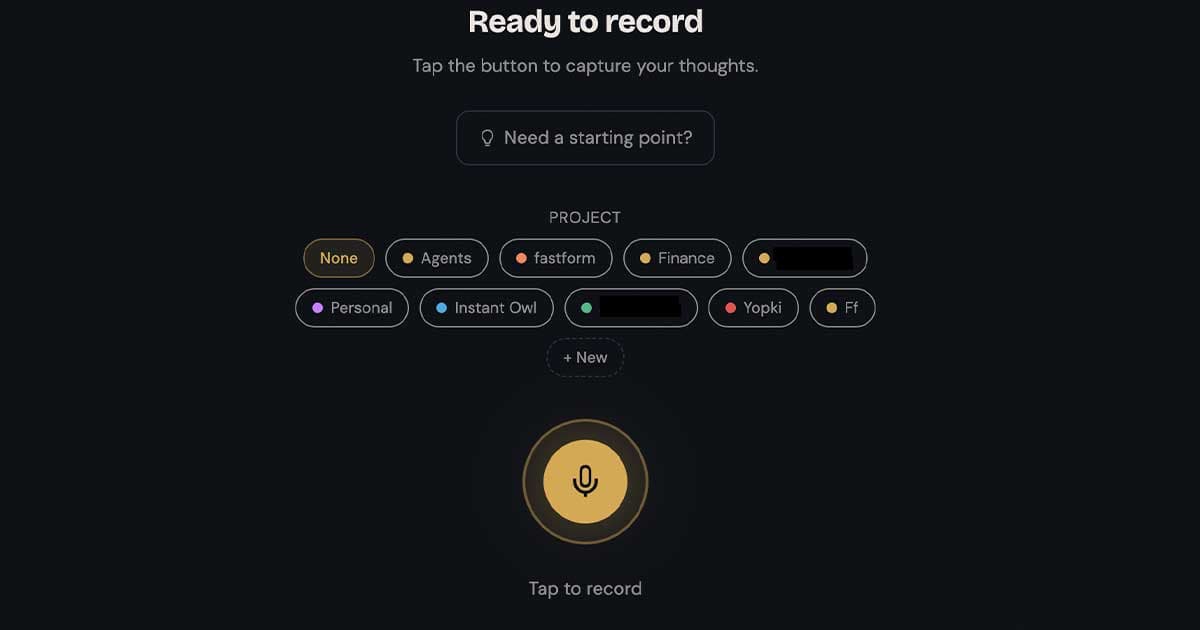
Full disclosure: InstantOwl is our product, and this is our blog. Neither Evernote nor Notion solves the step before either one opens, getting a fast-moving thought out of your head in the first place. Evernote assumes you already typed or clipped something. Notion assumes you already built somewhere for it to go. InstantOwl is voice-first capture that hands back organized text you can paste into either one, whichever you actually use. It does not compete with your notebooks or your databases. It solves what happens before you have opened either app. InstantOwl is currently free to use.
Related reading
- Note-taking apps compared: a fuller list if Evernote and Notion both feel like the wrong shape for your notes.
- The second brain method: CODE and PARA explained, and where second-brain systems break down before app choice even matters.
- The best note-taking apps for ADHD: what matters when capture speed competes with setup time.
- InstantOwl: voice-first capture that feeds either Evernote or Notion, currently free to use.
Frequently asked questions
Is Notion a good replacement for Evernote?
Not directly. Evernote is built around fast capture and deep search, while Notion is built around blocks and databases. If you want tables, boards, and calendars, Notion is the better replacement. If you rely on Evernote's search syntax or one-tap scan-and-capture habits, moving to Notion means rebuilding that workflow, not swapping it in.
Does anyone still use Evernote?
Yes. Bending Spoons acquired Evernote in January 2023 and had shipped 30 improvements to the app by mid-2024, according to a review published that August. Evernote's current pricing page, with its newer Starter and Advanced tiers and AI features listed on every plan, shows active development, not a stalled product.
What does Evernote's free plan include now?
Evernote's free plan allows up to 50 notes in 1 notebook, on 1 connected device, with 1GB of monthly uploads and a 1GB maximum note size, per Evernote's own compare-plans page. It also includes Tasks, Calendar, Web Clipper, image and document search, offline mode, and PDF annotation, all at no cost.
What are the disadvantages of Notion?
Notion's own users report a real maintenance tax: complex databases with many columns and large boards slow down, especially in the mobile app, and keeping the system organized takes ongoing time. Offline support is also limited to the desktop and mobile apps, not the browser, and only the first 50 rows of a database download for offline use.

Written by
Jim BreeseJim Breese is the founder of InstantOwl. He's spent 15 years building companies, from an Airbnb host community he founded and exited to growth leadership at venture-backed SaaS startups. He built InstantOwl because his best ideas kept arriving mid-walk, out of order, and half-finished.
Stop losing good ideas.
InstantOwl turns a rambling voice note into a clean, organized document in moments. Just talk. We'll organize it.
 Try InstantOwl free