The Second Brain Method: CODE, PARA, and Where Systems Die
By Jim Breese · · Updated
What is a second brain?
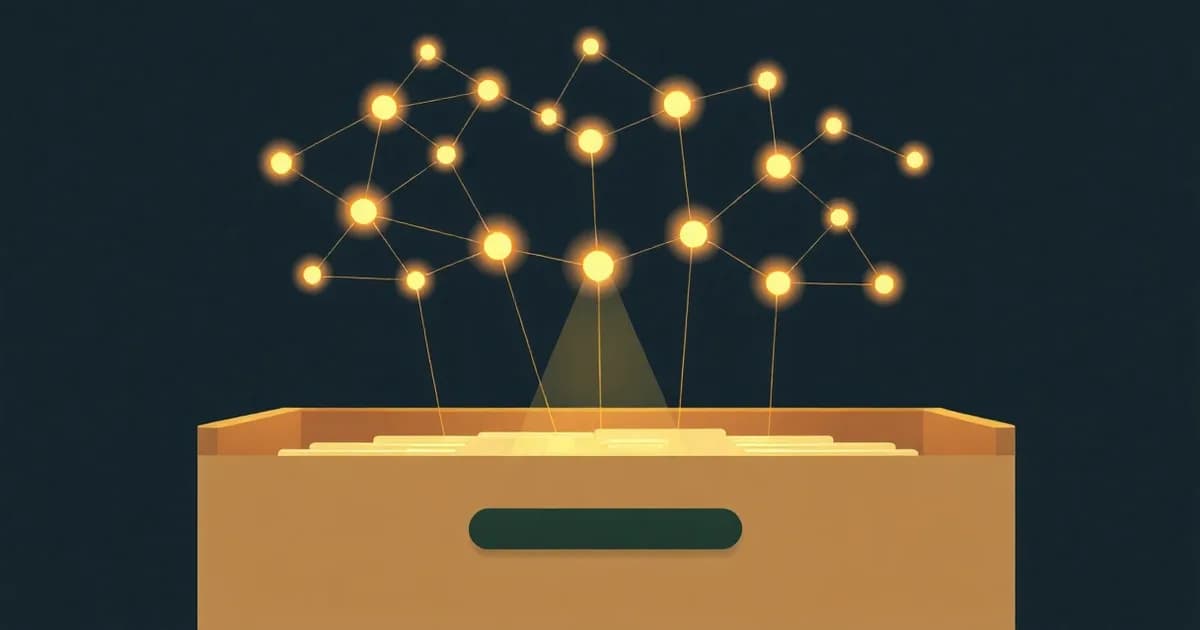
A second brain is "an external, centralized, digital repository for the things you learn and the resources from which they come," a definition from productivity expert Tiago Forte, creator of the Building a Second Brain method. The point is not a bigger to-do list. It is to hold information outside your head so your brain is free to do the one thing only a brain can do. The idea long predates apps: a commonplace book was doing the same job on paper centuries ago, collecting what its keeper gathered from reading and life to use again later.
Forte puts the reasoning in one line: "our brains are for having ideas, not storing them." A second brain exists to take storage off your plate so your working memory stays open for actual thinking.
Forte also frames what a second brain should feel like day to day. He describes it as "a factory not a warehouse": a warehouse just holds things, but a factory takes raw material in and turns it into something you use. A second brain that only stores information without ever producing anything is not doing its job, in his framing.
Forte spent over a decade researching personal knowledge management before publishing Building a Second Brain, and followed it with a second book, The PARA Method. Everything below (CODE, PARA, progressive summarization) is his terminology, not a generic industry standard, so it is attributed to him throughout.
The CODE method: Capture, Organize, Distill, Express
CODE is Tiago Forte's four-step framework for what to actually do with the information you take in: Capture, Organize, Distill, Express. Each letter is a stage, and each stage has its own rule from Forte's own writing.
Capture means saving anything that "resonates with you on an intuitive level," in Forte's phrase. His guideline is to think like a curator, not an archivist: keep only what resonates, and use a capture tool you will actually reach for in the moment, rather than the technically best one you avoid.
Organize means sorting by actionability, not by subject. Forte's rule is to ask three questions of anything you capture: what project is this for, which area of responsibility does it belong to, which resource might it feed later. He recommends starting from a clean slate rather than importing an old folder structure. This is also where PARA, covered next, does the actual sorting.
Distill means compressing a note down to something your future self can scan in seconds. Forte calls this designing notes "with your future self in mind," and describes a technique he named progressive summarization: multiple summarization passes over time, each one leaving a lighter layer of detail on top of the last, so a note can be reviewed "in seconds to decide if it's useful for the task at hand." Forte's guidance is to distill opportunistically, a little at a time, not all at once. Progressive summarization is one structured way to take notes; the classic systems like Cornell and Outline solve the same problem on paper.
Express means turning stored knowledge into something tangible: a document, a post, a plan, a finished piece of work. Forte's advice here is not to just keep consuming; break work into small reusable units he calls Intermediate Packets, and share the result before it feels finished, since in his words "there is no such thing as a finished product."
The PARA method: Projects, Areas, Resources, Archive
PARA is Tiago Forte's answer to the Organize step of CODE: four categories, sorted by actionability rather than topic. Forte defines them this way.
- Projects: short-term efforts with a specific goal and an end date, like "launch the new website" or "plan the June trip."
- Areas: long-term responsibilities you maintain indefinitely, with no fixed end date, like health, finances, or a role at work.
- Resources: topics of ongoing interest you are collecting for future use, without an active project attached yet.
- Archive: anything inactive from the other three categories, kept but out of the way.
The logic behind PARA is that a piece of information's usefulness depends on what you are doing with it, not what it is about. A single article about running could sit in a Project (training for a specific race), an Area (general health), or a Resource (something you might use someday), depending entirely on your current situation. Forte's system asks you to re-sort by actionability as your life changes, rather than filing once by topic and leaving it there.
Second brain apps: does Notion or Obsidian matter more than the habit?
The second brain method is deliberately tool-agnostic: Forte built CODE and PARA to work in any app, and he sells an official Notion template and a course called The AI Second Brain, which is itself proof the method does not require one specific tool. The two apps that show up most often in second brain discussions are Obsidian and Notion.
Obsidian stores notes as local markdown files: "Obsidian stores notes privately on your device, so you can access them quickly, even offline," and uses open file formats so you are never locked into one company's system. It supports linking notes to each other with backlinks and a visual graph of how your notes connect, the same linking model the Zettelkasten method is built on. The core app is free for all purposes, including personal, commercial, and non-profit use. Paid add-ons exist for people who want them, per Obsidian's pricing page: Sync at $4 per user per month billed annually, and Publish at $8 per site per month billed annually.
Notion takes a different shape: a flexible workspace of pages and databases rather than plain text files, with apps for web, desktop, and mobile. Its free plan for individuals is $0 and includes databases that can organize hundreds or thousands of items, plus a trial of Notion AI, with limits of 5MB per file upload and 7-day page history. Paid plans start at Plus, $10 per member per month on Notion's pricing page, which removes the upload cap and adds unlimited collaborative blocks.
Some apps that turn up when you search "second brain" have nothing to do with Forte's method at all; they borrowed the phrase as a product name for an unrelated tool. If you are looking for the actual CODE and PARA system, Obsidian and Notion are the two apps most associated with it, and either works. Our Notion vs Obsidian breakdown weighs the data-ownership tradeoff between them, and what Notion actually is walks through its blocks-and-databases model if you have never used it. The deciding factor is not which app has more features. It is whether you reliably put things into it.
Where second brains die
Second brains do not usually fail because CODE or PARA is flawed. They fail at the first letter of CODE: Capture. Getting an idea down before it vanishes is the whole game, and if getting a thought into your system means opening an app, finding the right note, and typing it out, the thought is often gone before you finish deciding where it should go.
This is the exact problem covered in what is a brain dump: getting a thought out of your head as fast as possible, before it evaporates, matters more than which organizing system waits on the other side. Forte's own Capture rule, keep what resonates, assumes you can act on that resonance the moment it happens. In practice, resonant thoughts show up while driving, walking, in the shower, or mid-task, exactly when typing is hardest.
For a mind that generates ideas faster than it can type them, this gap is even sharper. The ADHD brain dump problem is the same capture-speed issue, just with a shorter fuse: the thought needs catching in seconds, not minutes. A beautifully organized PARA structure with nothing captured into it is not a working second brain. It is an empty warehouse waiting for a factory that never opens.
The capture layer: where InstantOwl fits
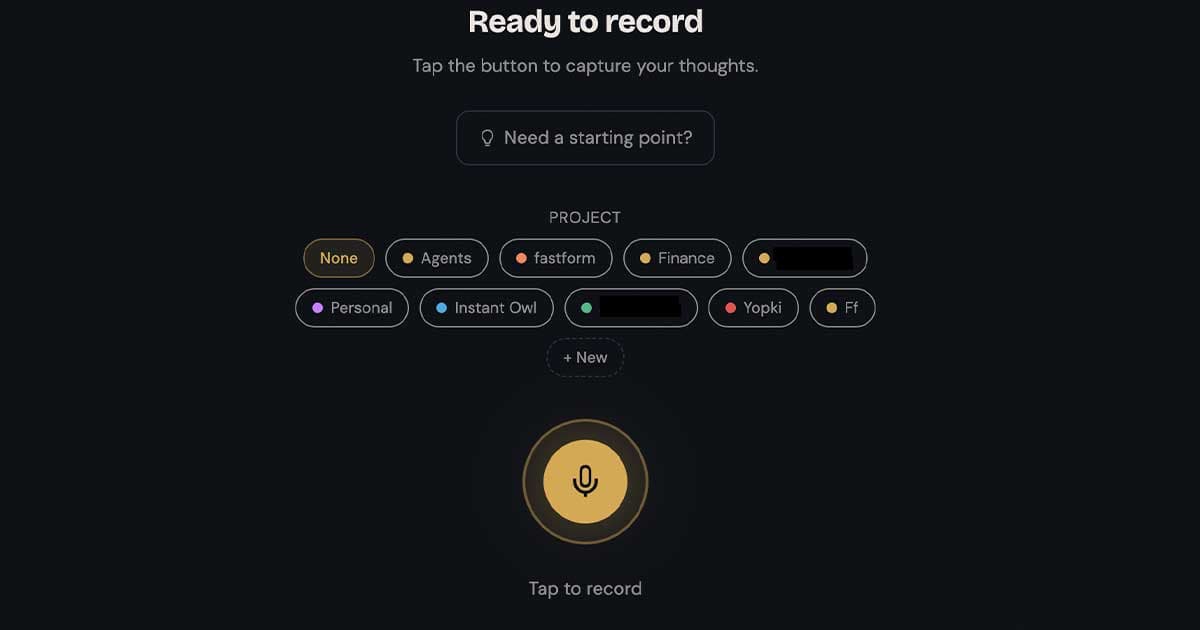
Full disclosure: InstantOwl is our product, and this blog belongs to it. InstantOwl is not a second brain, and it does not try to be one. It does not sort your notes into PARA, it does not do progressive summarization, and it is not built to replace Obsidian, Notion, or whatever system already holds your Areas and Resources. It is built for the one step that breaks most second brains before they start: Capture.
The idea is simple. You talk instead of type, InstantOwl turns the recording into organized, readable text, and that text becomes the raw material your actual Organize and Distill steps work on, whichever app you keep them in. It does not replace your second brain. It feeds it.
That matters because Forte's Capture guideline, save what resonates, works only if capturing takes no more effort than the thought itself. Speaking is faster than typing for most people and works in moments typing does not: walking, driving, mid-task. InstantOwl is currently free to use, and it is meant to sit in front of whatever Organize system you already trust, not ask you to replace it.
Whatever you are building, an Obsidian vault, a Notion workspace, or a stack of paper notebooks, CODE only starts working once something actually gets captured. That first step is worth taking seriously, because everything else in the method depends on it.
Related reading
- What is a brain dump: why speaking is the fastest way to get a thought out of your head, the same problem that breaks most second brains at the capture step.
- ADHD brain dump: why capture speed matters most for a racing mind, and what happens when a system cannot keep up.
- Brainstorming: Alex Osborn's rules for generating ideas, and why solo capture avoids the failure modes group brainstorming runs into.
Frequently asked questions
What is the second brain method?
The second brain method, created by productivity expert Tiago Forte in his book Building a Second Brain, is CODE: Capture what resonates, Organize it by actionability using PARA, Distill it into a short summary, and Express it as a finished product. It treats notes as raw material for future work, not just an archive.
What is the PARA method?
PARA is Tiago Forte's system for organizing information by actionability instead of by topic. It has four categories: Projects (short-term efforts with a goal and a deadline), Areas (long-term responsibilities you maintain, like health or finance), Resources (topics of ongoing interest), and Archive (anything inactive from the other three).
What is the best second brain app?
There is no single best app, because the second brain method Tiago Forte created is built to work with any tool. Obsidian stores notes as local markdown files and is free for personal and commercial use, with paid add-ons for sync and publishing. Notion's free plan works too, with paid plans starting at $10 per member per month. The app matters less than whether you actually capture and revisit your notes.
Is building a second brain worth it?
Yes, if you actually feed it. Tiago Forte's own case is that a second brain reduces stress and helps you find things in seconds instead of searching your memory. The method usually fails not because PARA or CODE is wrong, but because capturing a thought takes too much effort in the moment, so nothing goes in and there is nothing left to organize.

Written by
Jim BreeseJim Breese is the founder of InstantOwl. He's spent 15 years building companies, from an Airbnb host community he founded and exited to growth leadership at venture-backed SaaS startups. He built InstantOwl because his best ideas kept arriving mid-walk, out of order, and half-finished.
Stop losing good ideas.
InstantOwl turns a rambling voice note into a clean, organized document in moments. Just talk. We'll organize it.
 Try InstantOwl free