What Is Notion, Literally? (Blocks, Databases, and the Overwhelm Trap)
By Jim Breese · · Updated

What is Notion?
Notion is a workspace app where every page is built from blocks, small pieces like text, checkboxes, tables, and images, and any list of information can become a database you view as a table, board, calendar, or gallery. That is the literal answer, and almost nobody who explains Notion actually starts there.
Instead, people reach for analogies, because a blocks-and-databases app does not map cleanly onto anything most people have used before. In a Reddit thread titled simply "what is notion," the top-voted answer, from user RedShiftRunner, calls it a "productivity multi-tool" used as "a second brain, a journal, organizer, calendar, to-do list, planner, project management tool, study aide, and I'm sure hundreds of other use cases."
Other users in that same thread reach for a different comparison. Commenter iNanieke describes running a "personal wiki" for recipes with an automated grocery list, tutorials, and class notes. Another, pelotonwifehusband, pictures Notion as "the Google docs or Microsoft Office Suite... crossed with a personal Wiki generator." Every one of these descriptions is an analogy, not a definition, because Notion genuinely does not have a single job the way a calendar app or a notes app does.
The building blocks underneath all of it are simple even when the results look complicated. A page holds blocks. A collection of similar items (books, tasks, contacts) becomes a database. A database has views: the same rows shown as a table, a calendar, a kanban board, or a visual gallery. Templates are just pre-built arrangements of blocks and databases someone else assembled first.
Notion has existed long enough to earn all those competing analogies. It was founded in 2013 by Ivan Zhao, Chris Prucha, Jessica Lam, Simon Last, and Toby Schachman, per The Good Trade's history of the company, built from the start around blocks and databases that could be reconfigured into different views rather than a fixed notes format. That design choice, structure you assemble yourself instead of structure the app hands you, is exactly why it earns so many different nicknames and why none of them is quite right on its own.
What is Notion used for?
Notion is used for whatever a person or team decides to build inside it: notes, project boards, team wikis, and personal life dashboards are the four most common shapes. Because blocks and databases are generic building material, the same underlying tool ends up running a company's product roadmap and one person's recipe box.
The honest use map, drawn from how actual users describe their own setups, includes a "second brain" of scattered notes and ideas, task lists and project boards with deadlines, a shared wiki teams write and search together, and personal databases for things like books read, workouts logged, or a household inventory. One Reddit commenter in the same thread uses it purely to track a to-be-read list; another runs a lab notebook, protocols, and finances out of it. The through-line is structure: if you can imagine it as rows with properties, Notion can hold it.
Notion runs on the platforms you would expect. It works in a web browser (Safari, Chrome, and Edge are supported, Internet Explorer is not), as a desktop app on macOS and Windows, and as a mobile app on iOS and Android, per Notion's own help pages. There is no single "Notion device," which is part of why it fits both a company's shared laptop fleet and one person's phone.
Worth noting plainly: Notion's own homepage has drifted away from that individual user. As of this writing, notion.com leads with "The AI workspace that works for you" and "Where teams and agents Think together," organized around Docs, a team Knowledge Base, Projects, Calendar and Mail, Notion AI, custom AI agents, AI Meeting Notes, and Enterprise Search, all pitched to companies, not life organizers. The page states Notion is "trusted by 98% of the Forbes Cloud 100," used by "62% of Fortune 100" and "over 50% of Y Combinator companies," and has "over 100M users worldwide."
None of that is false, and none of it is aimed at someone who typed "what is notion" because they want to get their life organized. If you are that person, know going in that Notion's front door is currently built for your employer's IT department, not for you, even though the free individual plan underneath still works exactly the way it always has.
What does Notion cost?
Notion has a genuinely usable free plan and two paid tiers built for teams, not individuals. The Free plan costs $0 and includes databases able to "organize hundreds or thousands of items," Notion Calendar, and a trial of Notion AI, capped at 5MB per file upload and 7 days of page history, per Notion's pricing page.
Paid plans exist mainly for collaboration, not for solo use. Plus costs $10 per member monthly and removes the upload cap entirely. Business costs $20 per member monthly and adds Notion Agent, AI Meeting Notes, and SAML single sign-on. Enterprise pricing is custom. Yearly billing on any paid tier saves up to 20 percent. For one person keeping personal notes and databases, the Free plan is the entire relevant price list.
The overwhelm trap
The most consistent thing anyone says about learning Notion is a warning, not a compliment. RedShiftRunner's top-voted Reddit answer, right after calling Notion a productivity multi-tool, adds this unprompted: "It's extremely easy to get overwhelmed at first when you start using Notion. My recommendation is to first identify your specific use case/needs and don't focus on making it aesthetically perfect." The original poster confirms it in real time, replying the same morning: "I was browsing it this morning and got quite overwhelmed by the amount of stuff to get used to."
The timeline other users report is not short. One commenter in that thread writes plainly, "It has taken about a year for me to really catch on to all the power of Notion." Another describes Notion as "very versatile but has a steep learning curve."
Even people who love the tool confirm this from the other side. Emily McGowan, Editorial Director at The Good Trade, calls Notion "an operating system for your brain" in her guide to the app, and after years of daily use still writes: "it's not as simple as downloading the app and voila! Suddenly you're organized. Notion is as only as useful and interesting as you make it, kind of like an old school planner."
She admits she "voraciously sought out YouTubers, bloggers, and templates to optimize all the things," and that it took her "over two years and multiple trial-and-error templates" to land on a system that stuck.
That pattern, a fan of the product needing two-plus years to get comfortable, is the honest cost of Notion's flexibility. The same blank-page freedom that lets Notion become anything also means nothing is set up for you, and setting up a system can quietly turn into its own procrastination project. Productivity blog Productive has described this directly as a "risk of over-customization reducing efficiency," and frames Notion as "too robust for simple note-taking" for exactly this reason. If plain jotting is most of what you do, our side-by-side of Apple Notes and Notion covers where the simpler tool honestly wins.
Start with one template for one specific use case, resist making it look perfect, and add structure only once you feel the lack of it. That is the advice Notion's own users give each other, and it holds up.
Who Notion is not for
Notion is not the right fit for two kinds of people: those who want their notes stored as local files instead of in the cloud, and those whose thoughts move faster than any setup process can keep up with. Both are honest mismatches, not failures on the user's part.
If local file ownership matters to you, plain markdown files on your own device with no cloud dependency, a tool like Obsidian is the better starting point. Our Notion vs Obsidian comparison covers that tradeoff, including verified pricing for both, in more depth.
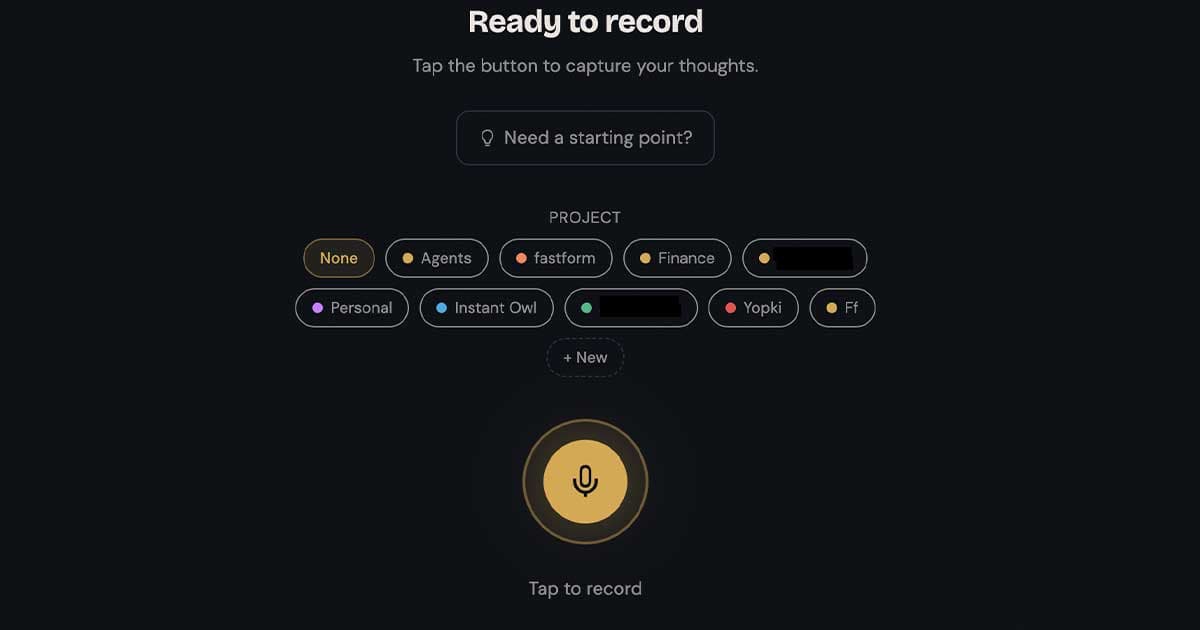
Full disclosure: InstantOwl is our product, and this blog belongs to it. Notion organizes what you already know and have decided to write down; it assumes you are ready to build a system and choose a template. InstantOwl is built for the opposite moment, when a thought is still a ramble in your head and needs to get out before it disappears, with no template to pick and no database to design first. If setting up a workspace feels like a second job before you have even started, InstantOwl is currently free to use for that first, unstructured step.
Related reading
- Notion vs Obsidian: the real divide between the two, verified pricing, and the setup trap they both share.
- The best note-taking apps: simpler options if a full workspace app is more than you need.
- What is a brain dump: why getting a thought out fast matters more than where it lands.
Frequently asked questions
Is Notion free?
Yes. Notion's Free plan costs $0 and includes databases that can organize hundreds or thousands of items, Notion Calendar, and a trial of Notion AI, limited to 5MB per file upload and 7 days of page history. Paid plans start at Plus for $10 per member monthly, per Notion's own pricing page.
What is Notion best used for?
Notion is best used for anything you would otherwise track in a spreadsheet plus a document plus a to-do list: project boards, team wikis, personal databases like a reading list or a habit tracker, and notes that need to link to each other. It is less suited to fast, single-purpose note capture.
Is Notion hard to learn?
Notion has a real learning curve. The top-voted answer in a Reddit thread asking what Notion is warns it is extremely easy to get overwhelmed at first, one user says it took about a year to catch on to its full power, and a longtime fan writer at The Good Trade says it took her over two years of trial and error to land a system that stuck.
Do I need Notion if I just want notes?
No. If you just want to jot down notes, Notion's blocks-and-databases model is more structure than you need. Simpler dedicated tools like Apple Notes, Google Keep, or Obsidian get you writing faster with far less setup; see our note-taking apps comparison for the full list.

Written by
Jim BreeseJim Breese is the founder of InstantOwl. He's spent 15 years building companies, from an Airbnb host community he founded and exited to growth leadership at venture-backed SaaS startups. He built InstantOwl because his best ideas kept arriving mid-walk, out of order, and half-finished.
Stop losing good ideas.
InstantOwl turns a rambling voice note into a clean, organized document in moments. Just talk. We'll organize it.
 Try InstantOwl free