Notion vs Obsidian: Data Ownership, Real Pricing, and the Trap Both Share
By Jim Breese · · Updated

Which should you pick, Notion or Obsidian?
Notion is the better pick if you want databases, collaboration, and structure built for teams. Obsidian is the better pick if you want your notes stored as local files, linked together, and fast. That is not just our take. A top-voted commenter in r/ObsidianMD summed up the entire divide in one line: "Notion's is more data-driven, while Obsidian is text-based." The same comment adds that Notion is also better for collaboration, while Obsidian is built around taking notes and linking them.
That split holds up outside marketing pages, in the words of people who have actually switched. A user considering leaving Notion for Obsidian opened one popular thread by describing Notion as something that "often lags, has many bugs, and generally doesn't run as smoothly as I would like," especially on his phone. That is the frustration Obsidian is built to answer: a local app with no server round-trip standing between you and your notes.
Neither app is trying to do the other one's job better. Notion is a workspace with databases at its core. Obsidian is a text editor with links and a graph on top, which is why it is a favorite home for linking-heavy systems like the Zettelkasten method. Match the choice to what you are actually building, not to which app has more features on paper.
What's the real divider between Notion and Obsidian?
The bigger divide is not features. It is who owns your files. Obsidian stores notes as local markdown files on your own device. Per Obsidian's own site, the app "stores notes privately on your device, so you can access them quickly" and "uses open file formats, so you're never locked in." Notion stores notes in the cloud, inside its own database format, accessed through a Notion account. Obsidian is not the only local-first option either; if plain files matter to you but Obsidian itself does not click, our look at Obsidian against Logseq covers its closest rival, and why that rival's database transition complicates the plain-text pitch.
In the same r/ObsidianMD thread, one commenter distilled why that difference matters more than any feature list: "I'm using both and I gotta say, Notion's UI is much better. But I prefer obsidian because it's free and I own my files." The reply underneath, at 16 points, put it even more plainly: "'I own my files' is the entire argument for me."
Data ownership shows up practically at export time. A team-docs comparison of the two tools warns that exporting a Notion workspace to markdown "loses formatting; database relations and hierarchies flatten." Obsidian skips that problem, since its files are already plain markdown you can open in any text editor, copy, or back up yourself, with no export step required.
One claim we will not make here: whether Notion currently works offline. The two ranking comparisons we checked for this piece disagree with each other, and neither cites current documentation to back its claim. If offline access is a deciding factor for you, check Notion's own help pages directly rather than trust a comparison article, ours included. What we can verify is the underlying architecture: Obsidian's local-first design versus Notion's cloud-native one. That difference should drive your decision more than any single feature.
What do Notion and Obsidian actually cost?
| App | Plan | Price | What it includes |
|---|---|---|---|
| Notion | Free | $0 | Databases, Notion Calendar, 5MB per file upload, 7-day page history |
| Notion | Plus | $10/member/month | Unlimited file uploads, unlimited collaborative blocks |
| Obsidian | Core app | Free, personal and commercial use | Local markdown files, backlinks, graph view |
| Obsidian | Sync | $4/user/month billed annually ($5 monthly) | Encrypted sync across devices, version history |
| Obsidian | Publish | $8/site/month billed annually ($10 monthly) | Publish a vault as a public website |
Per Notion's pricing page, yearly billing saves up to 20 percent on either paid plan. Per Obsidian's pricing page, Sync and Publish are the only two paid add-ons; the core app carries no seat price at all.
Two of the most-read comparison guides for this exact search get Obsidian's pricing wrong today. One states Obsidian's commercial license is a required $50 per user per year. Per Obsidian's license page, that fee is now an optional supporter tier, not a requirement to use the app commercially.
A second comparison lists Obsidian Sync at a flat $8 a month. Per Obsidian's own pricing page, Sync is $4 a month billed annually, or $5 billed monthly, not $8 under either billing cycle. Check a tool's own pricing page before you plan a budget around a ranking guide's summary of it.
One more clarification worth making, since real users get it wrong too: Notion's free plan does not cap the total number of blocks for an individual account. The block limit only applies to collaborative team workspaces, not personal, single-user use.
What's the setup trap both apps share?
Obsidian's own community warns new users against the same trap that slows Notion down: over-customization. The top comment in that r/ObsidianMD thread doubles as advice to switchers: "I'd recommend not overdoing it with plug-ins when you start with Obsidian." Later in the same thread, a commenter described setting up one AI plugin: "I just set this up last night took about 3 hours." Obsidian ships with thousands of community plugins available, and each one is a small decision that can eat an afternoon before you write a single real note.
Notion has the same trap, and its own comparison guides admit it. One ranking page for agency-management software, with no reason to flatter Obsidian, concedes there is a real "risk of over-customization reducing efficiency" inside Notion itself, driven by the same relational databases and templates that make it powerful in the first place. Building the perfect workspace before you have captured a single real note is procrastination wearing a productivity costume, and it happens on both sides of this comparison.
This tax falls hardest on the person who can least afford it: someone who needs to capture a thought the moment it shows up, not three hours from now once a plugin or a database schema is configured. If your note-taking app itself becomes the project, our note on picking a note-taking app for a scattered mind covers what actually matters when setup time competes with capture speed.
Where does each app fall short, honestly?
Even inside Obsidian's own community, users concede specific things Notion does better. Multiple separate commenters in that r/ObsidianMD thread wrote versions of "I prefer Notion's UI," and one went as far as writing custom CSS to make Obsidian look more like it.
Obsidian's mobile experience gets the same honest treatment from its own users. One commenter admitted she "begrudgingly" uses Obsidian's mobile app just to reach her notes, blaming her own plugin overload and customization for a slow vault startup and multi-second delays switching between notes. Not everyone hits this: another commenter in the same thread reported a 400-file vault running "not unresponsive at all" on a Pixel Fold, which suggests the mobile slowdown tracks with plugin count, not with Obsidian's mobile app on its own.
Notion's users report the mirror complaint about speed, just at a different scale. Independent commenters in the same thread described Notion becoming "too slow" as databases grew, with one writing plainly: "Notion was too slow, the databases loaded slow." Another, a professional writer, said she "found Notion to become too slow" and disliked that there was "no real way to backup" her work inside it. Neither app stays uniformly fast forever. Notion slows through database size and scale; Obsidian slows through plugin count. Users are honest about both.
It is also common to run both at once, not as a compromise but as a deliberate split. One academic commenter in the thread uses Obsidian for reading notes and finding connections between concepts, and Notion for habit tracking, project status, and a shared trip-planning page with a partner. Another described migrating notes to Obsidian for safety while keeping Notion "for databases/kanban." Whichever one you land on, or both, the same problem shows up before either app is even open: getting the thought out of your head in the first place.
What neither app solves: the capture gap
Notion and Obsidian both assume you already have something typed, or about to be typed, in front of you. Neither one solves getting a fast-moving thought out of your head before it disappears. That step happens before you open either app, and it still means stopping to type. See what a brain dump actually is for why talking beats typing at that exact moment.
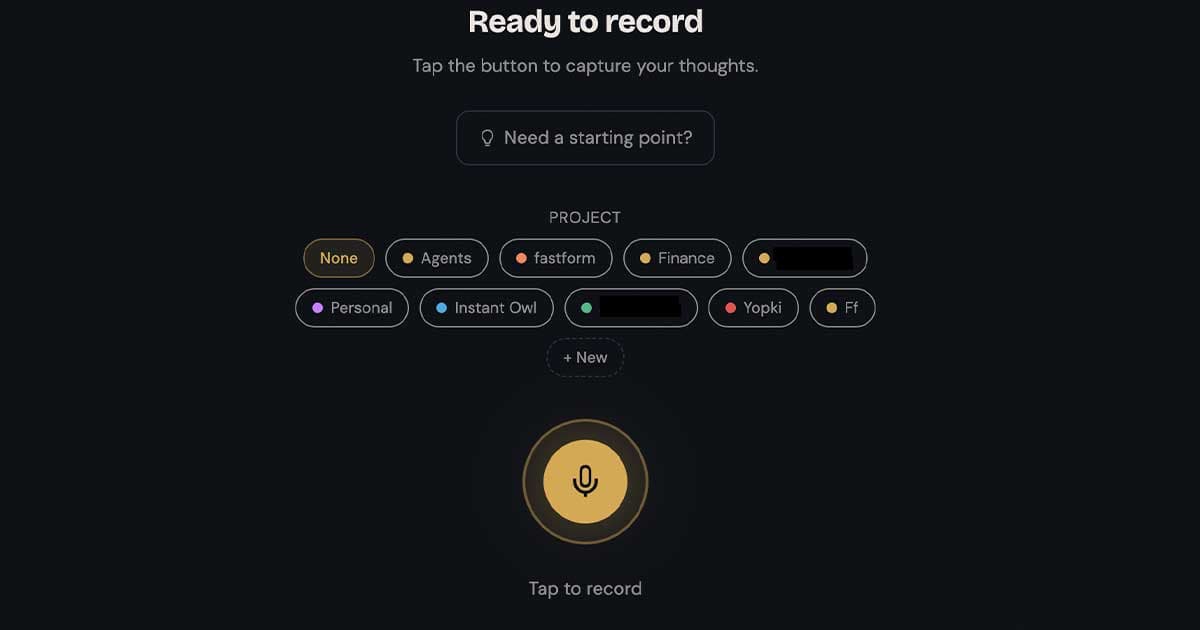
Full disclosure: InstantOwl is our product, and this is our blog. InstantOwl is voice-first capture that feeds either system: talk through a messy idea, and it comes back organized enough to paste into a Notion database or drop straight into an Obsidian note, whichever one you actually use.
It is not trying to replace whichever second brain method you have already built, and it does not compete with either app for where your notes live afterward. It solves the step before that, getting the thought captured before you have opened a note-taking app at all. InstantOwl is currently free to use.
Related reading
- Note-taking apps compared: a fuller list of tools if Notion and Obsidian both feel like the wrong shape for your notes.
- The second brain method: CODE and PARA explained, and where most second-brain systems break down before app choice even matters.
- What is a brain dump: why talking beats typing when a thought needs to get out fast, whichever app it lands in afterward.
- InstantOwl: voice-first capture that feeds either Notion or Obsidian, currently free to use.
Frequently asked questions
Is Obsidian better than Notion?
Neither is better outright. Obsidian wins for local file ownership, linking notes together, and speed. Notion wins for databases, collaboration, and getting a shared workspace running fast. Long-time users of both, including many in the r/ObsidianMD community, say the honest answer is to match the tool to the job, and plenty use both at once.
Is Obsidian really free?
Yes. Per Obsidian's own license page, Obsidian is free for all purposes, including personal, commercial, and non-profit use. The $50 per year commercial license that older comparison guides describe as required is now an optional supporter tier, not a requirement to use Obsidian for paid work.
Can Notion work offline?
We did not verify Notion's current offline behavior well enough to state it either way, and the comparison guides we checked disagree with each other on it. Check Notion's own help documentation directly if offline access is a deciding factor for you.
Which is better for a second brain?
Obsidian is the more common pick for a second brain built on the CODE and PARA methods, since local markdown files and backlinks match how those methods link and organize ideas. Notion works too if your system leans on databases and relations more than freeform linking. That is a workflow choice, not a rule.

Written by
Jim BreeseJim Breese is the founder of InstantOwl. He's spent 15 years building companies, from an Airbnb host community he founded and exited to growth leadership at venture-backed SaaS startups. He built InstantOwl because his best ideas kept arriving mid-walk, out of order, and half-finished.
Stop losing good ideas.
InstantOwl turns a rambling voice note into a clean, organized document in moments. Just talk. We'll organize it.
 Try InstantOwl free