How to Transcribe an Interview: Consent, Conventions, and the Real Costs
By Jim Breese · · Updated
How do you transcribe an interview?
There are three real paths: transcribe it yourself, run it through an AI tool, or pay a human transcription service. Which one is right depends on how accurate the transcript needs to be, what you can spend, and what rules govern the data itself, not personal preference alone.
Doing it yourself costs time, not money, and doubles as a first pass through your material, but it is slow and hard on your body at volume. AI tools run free to about $10 a month and get you most of the way there, with a cleanup pass still required afterward. Human services cost $0.80 to $3 a minute and earn that price when the transcript must be publish-ready, the audio has heavy crosstalk, or a compliance rule demands it.
Before any of that, one question comes first: who is allowed to hear this recording, and where is it allowed to go once it leaves your device.
What do you need to check before you hit record?
Settle consent and data policy before you transcribe a single word, not after. This is not legal advice, and rules vary by jurisdiction and institution, but the pattern researchers and journalists describe is consistent: know who has to agree to being recorded, and know exactly where the recording will travel once it leaves your hands.
For journalists, the baseline is the same one covered in our meetings posts: check what your jurisdiction requires before you record a conversation, since some places require every party on the recording to be informed and to agree, and getting that wrong carries real consequences. Ask before you press record, not after the interview is already on your device.
For researchers, the stakes are higher because an ethics board is watching. One researcher, writing about getting Otter.ai approved for interview transcription, described the pattern that satisfied their review board: "we said we'd remove the sound files and transcripts from the Otter servers as soon as the transcription was complete. So, upload, run Otter, download everything, all in one go." Minimizing how long the data sits on someone else's servers was the whole argument. Cost pressure shapes the same choice from the other direction; our Otter vs Rev pricing comparison runs the numbers for exactly this upload-and-transcribe workflow.
Data residency adds another layer for some researchers. One EU-based researcher described their university requiring a transcription service that "doesn't transfer data outside of the EU, as per GDPR," and struggling to get anything approved under that constraint. Another researcher expected their ethics board to reject a preferred AI tool and default to "institution-licensed Word" instead, despite liking a different tool's formatting better. A third uses Microsoft Teams for exactly this reason: it is "provided by my institute" and already tied to their university email.
The safe default researchers describe again and again is the same: use whatever transcription tool your institution already licenses, ask before you improvise with a free tool, and treat "upload, transcribe, download, delete" as the pattern to copy when a cloud tool is approved at all.
What are verbatim, intelligent verbatim, and edited transcripts?
Pick a transcription convention before you start, not after, because switching conventions partway through means redoing earlier work. Transcription service SpeakWrite and research software company MAXQDA describe the same three core types, with MAXQDA adding a fourth for a specific case.
Verbatim captures every word and sound, including filler words, laughter, stammering, and pauses, per both sources. It is slower to produce but preserves tone and hesitation as data, which matters when how someone said something is part of what you are studying. Intelligent verbatim strips out fillers, repeated words, and off-topic asides while keeping every substantive word intact, per MAXQDA's description; both sources call it the most common convention, and it is the right default for most interviews.
Edited transcripts go further, correcting grammar and incomplete sentences for readability, the choice for publication-ready quotes, though MAXQDA warns it risks altering "the interviewee's voice." MAXQDA also names a fourth, rarer type: phonetic transcription, which notes pronunciation using special symbols, used for dialect or accent analysis rather than general research.
Decide the convention up front, per MAXQDA's advice, because a study analyzing tone or hesitation needs verbatim from the first interview onward, not a late switch once you realize edited transcripts erased the detail you needed.
Should you transcribe the interview yourself?
Yes, if the interviews are few and transcribing doubles as your first analysis pass, but budget real time and protect your body if the volume is high. Transcribing an interview yourself takes about four times the length of the audio, according to SpeakWrite's own guide, the same roughly four minutes of work per minute of audio that Wirecutter cites, crediting Rev and other sources.
Typing the interview yourself has a real upside beyond saving money. One researcher, describing their own manual process with a foot pedal, put it this way: "this first exposure to my data is critical for kickstarting my thoughts about analyzing it." Another researcher only transcribes the interviews that matter most in full, adding tone and emotion in brackets as she goes, and bookmarks the audio for the rest rather than transcribing everything.
That upside has a real cost at volume, and it deserves a kind, honest accounting rather than a warning label. One researcher transcribing 30 interviews of 60 to 90 minutes each described the toll plainly: it took five months, caused repetitive stress injuries, and burned through three hired transcriptionists along the way. "Complete hell," in their words. Another researcher put it just as directly: "I destroyed my wrists for awhile." If you are staring down that much audio, that cost is worth weighing before you commit to doing it all by hand.
Can AI transcribe an interview well enough?
Often yes for a first draft, for free to about $10 a month, but plan on a cleanup pass. Microsoft's Word Transcribe feature, included with a Microsoft 365 subscription, allows 300 minutes of uploaded audio a month and works in Word for the web, per Microsoft's support page, a cap researchers in the same thread describe burning through quickly on a couple of two-hour interviews.
TurboScribe offers a free tier of 3 files a day at 30 minutes each, with an Unlimited plan at $10 a month billed yearly for files up to 10 hours, per its site. Researchers in the same discussion also reported paying Otter.ai anywhere from about $5 to $15 a month, with one on a roughly $100-a-year student plan, though those figures are individual users' own reported prices rather than a published rate card.
The cleanup cost is real and worth planning for. One researcher described AI mislabeling speakers in a two-person conversation as "upwards of 8 different people." Another reported domain-specific words getting mangled by homophones: research on Hmong people came back transcribed as "among, monk, mom, or monkey," every time. AI transcription gets you a fast, cheap first draft; a careful listen-through afterward is not optional.
If the interview isn't the only audio you need to deal with, our broader audio-to-text guide covers the same tools against a wider set of jobs, and if the recording is specifically saved as an mp3 file, the mp3-to-text walkthrough maps that same tool landscape to that exact format.
When is a human transcription service worth the cost?
Pay for a human transcription service when the output has to be publish-ready, the audio has heavy crosstalk, or a compliance rule requires it, since that is where the accuracy and formatting earn the $0.80 to $3 a minute price. Rev charges $1.99 a minute for human transcription with 99%-plus accuracy guaranteed. If you also edit the recordings for publication, our Rev vs Descript breakdown weighs Rev's per-minute service against an editor with transcription built in.
GoTranscript, Wirecutter's current top pick, runs about $1.20 a minute at its five-day turnaround for a normal-sized order, dropping toward roughly $1.02 a minute only on orders over 10,000 minutes, while the fastest six-to-twelve-hour turnaround runs $2.75 a minute, per Wirecutter's testing. Scribie's own published human rate is $0.80 a minute, the cheapest human option here, and Wirecutter found human transcription typically runs $1 to $3 a minute across the market.
The most detailed guide ranking for this exact topic never prints a single price anywhere on its page, funneling every reader toward a quote request instead. It also walks through five transcription steps without once raising consent or where the audio ends up, the questions this post puts first. Printing real prices and putting data handling before technique is the gap human-service guides tend to leave open.
Where does InstantOwl fit in this?
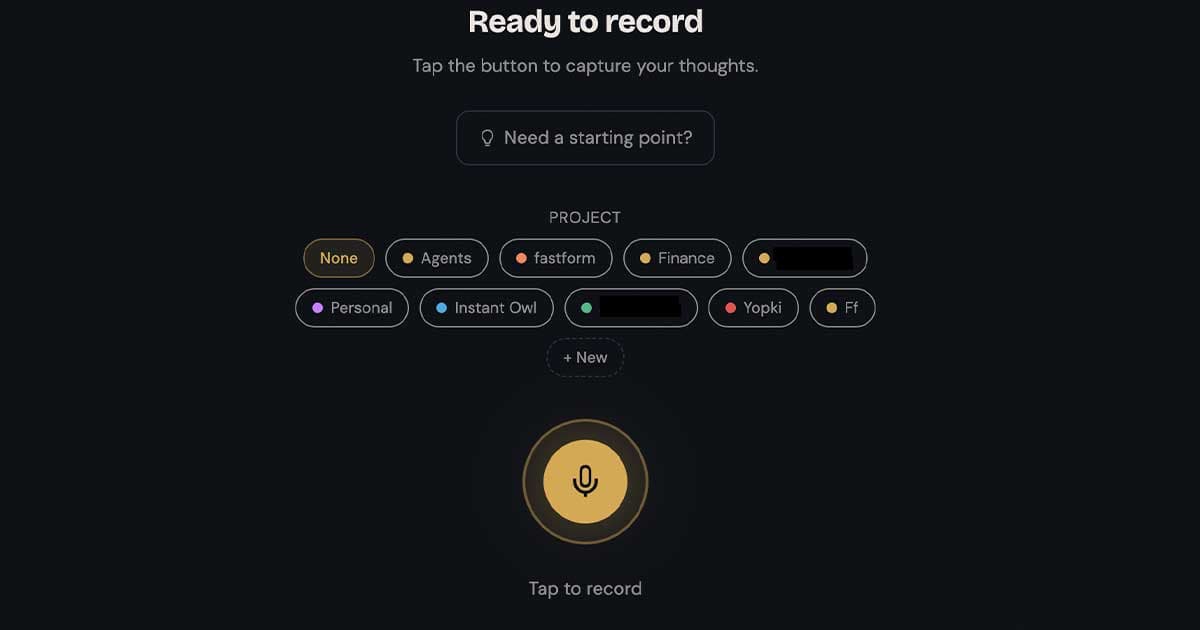
Full disclosure: InstantOwl is our product. An interview transcript is someone else's words, and that is not InstantOwl's job. Our lane is the debrief you record afterward, in your own voice, the same pattern our meeting notes guide covers for meetings. InstantOwl is currently free to use.
Frequently asked questions
How long does it take to transcribe an interview?
About four times the length of the audio, per SpeakWrite's own guide: one hour of recording takes roughly four hours to type by hand. Wirecutter cites the same ratio, about four minutes of work per minute of audio, crediting Rev and other sources.
What is intelligent verbatim?
A transcript with fillers, false starts, and repeated words removed, leaving clean, readable sentences that keep every substantive word intact. MAXQDA describes it this way, and both MAXQDA and SpeakWrite call it the most common convention, the right default unless hesitation and tone are themselves part of what you are studying.
Can I use AI to transcribe research interviews?
Often, but check your ethics board first, since some reject specific tools and some require data to stay within a region under rules like GDPR. One researcher's approved pattern was upload, transcribe, download everything, then delete the audio from the vendor's servers immediately, minimizing how long it sat elsewhere. Institution-licensed tools like Word or Teams are the safer default when approval is uncertain.
How much does interview transcription cost?
Human services run about $0.80 to $3 a minute: Scribie's own published rate is the cheapest at $0.80, Rev charges $1.99 for its human tier, and GoTranscript's tiers run $1.20 to $2.75 depending on turnaround, per Wirecutter's testing. AI transcription is far cheaper, with free tiers for short files and roughly $10 a month for unlimited use.
Frequently asked questions
How long does it take to transcribe an interview?
Generally about four times the length of the audio, according to transcription service SpeakWrite's own guide: one hour of recording takes roughly four hours to type. Wirecutter cites the same rough ratio, about four minutes of work per minute of audio, crediting Rev and other sources, so the estimate holds up across independent guides.
What is intelligent verbatim?
Intelligent verbatim is a transcript with the filler words, false starts, and repeated words removed, leaving readable, accurate sentences. Research software company MAXQDA describes it as excluding filler words, non-standard words, repeated phrases, off-topic asides, and general noise, while keeping every substantive word the speaker said. It is the most common convention and the right default for most interviews.
Can I use AI to transcribe research interviews?
Often yes, but check with your ethics board first, since some will not approve it and some require data to stay within a specific region. One researcher described getting approval by uploading, transcribing, downloading everything, and deleting the audio from the vendor's servers in one sitting, to minimize how long the data sat on someone else's hardware. Institution-licensed tools like Microsoft 365 or Teams are the safer default when in doubt.
How much does interview transcription cost?
Human transcription services run roughly $0.80 to $3 a minute of audio. Scribie's own published human rate is $0.80 a minute, Rev charges $1.99 a minute for its human tier, and GoTranscript's turnaround tiers run $1.20 to $2.75 a minute depending on speed, per Wirecutter's testing. AI transcription is far cheaper, often free for short files and about $10 a month for unlimited use.

Written by
Jim BreeseJim Breese is the founder of InstantOwl. He's spent 15 years building companies, from an Airbnb host community he founded and exited to growth leadership at venture-backed SaaS startups. He built InstantOwl because his best ideas kept arriving mid-walk, out of order, and half-finished.
Stop losing good ideas.
InstantOwl turns a rambling voice note into a clean, organized document in moments. Just talk. We'll organize it.
 Try InstantOwl free