Rev vs Descript: Buy a Transcript or Buy the Whole Workbench
By Jim Breese ·

Rev vs Descript: which one should you buy?
Buy Rev if what you want back is a finished transcript. Buy Descript if what you want back is an edited piece of audio or video. That single distinction, a transcript versus a workbench, is the whole decision, and most comparison pages skip straight past it into an accuracy scoreboard instead.
Rev is a service: you hand it a file, it hands back a transcript, human or AI, priced per minute or by seat. It does not edit anything. Descript is software: you buy monthly media hours, and transcription is only the first step, the interface you use to cut, caption, and export the finished piece. Rev never asks what you plan to do with the transcript. Descript assumes you are about to do something with it.
Neither model is wrong. A journalist with 15 hours of interview tape to get into text fast wants Rev. A podcaster turning that same tape into a finished episode wants Descript. The rest of this post prices both accurately, current as of today, and works through real cost examples so the choice is arithmetic, not guesswork.
What does Rev cost today?
Rev sells transcripts two ways: pay per minute, or subscribe by seat. Human transcription costs $1.99 a minute, with 99%-plus accuracy claimed and a 12-hour turnaround, or faster with rush service. AI transcription costs $0.25 a minute, with 95%-plus accuracy claimed, delivered in five minutes or less. Both rates come from Rev's services page.
Rev's subscriptions live on a separate page and no longer show per-minute rates at all. Rev's pricing page lists a free tier of 45 AI minutes a month, then Essentials at $29.99 a seat monthly or $25.49 a seat billed annually for 5,000 AI minutes a month, then Pro at $59.99 a seat monthly or $47.99 a seat billed annually for 10,000 verbatim AI minutes a month across 37-plus languages. An Unlimited tier is custom-priced. Subscribers also get a discount on human transcription: 3% monthly or 10% annually on Essentials, 5% monthly or 15% annually on Pro.
Rev's own accuracy claims are marketing numbers, not independent measurements. An independent counterweight exists: Wirecutter's own testing measured Rev's human tier at 98% accurate and its AI tier at 96.7%, both close to Rev's claims but not identical to them.
One naming trap worth clearing up before you shop: Rev also runs Rev AI, a separate developer-facing speech-to-text API brand under the same company, positioned as "The World's Most Accurate Speech-To-Text API" for engineers building products, not for someone transcribing a file by hand. Consumer pricing above is entirely from rev.com; Rev AI is a different product with its own API pricing.
What does Descript cost today?
Descript prices by media minutes and AI credits, not by the minute of transcription. Descript's pricing page lists a free plan at $0 for one person, 60 media minutes a month (one hour), 100 one-time AI credits, watermarked exports, and 5GB of storage.
Paid tiers scale up from there. Hobbyist costs $24 a month or $16 a month billed annually, for 600 media minutes a month (10 hours), 400 AI credits a month, watermark-free 1080p export, and 100GB of storage. Creator, Descript's most popular tier, costs $35 a month or $24 a month billed annually, for 1,800 media minutes a month (30 hours), 800 AI credits, and 4K export. Business costs $65 a month or $50 a month billed annually, for 2,400 media minutes a month (40 hours), 1,500 AI credits, and priority support with an SLA. Enterprise is custom-priced.
Transcription itself is described as "up to 95% accuracy" on Descript's transcription page, a vendor claim with no independent test attached. That page also makes clear what Descript actually sells: "Descript combines AI transcription, video editing, captions, translation, and AI voice synthesis, all in one intuitive workspace." Transcription is the front door, not the product.
Here is the catch worth flagging plainly: Descript's current pricing and transcription pages describe AI transcription only. There is no human transcription tier anywhere on Descript's site today. Some older comparison articles still cite a "White Glove" human add-on at roughly $2 a minute; that service is not verifiable on Descript's current site, and should not be treated as something you can still buy.
Who actually buys which, and why?
Rev's own product tells you who it is for: a service you send a file to and get a transcript back, nothing to install, nothing to edit inside. Descript's tells you the opposite: software you sit inside for hours, editing a project rather than requesting a deliverable.
A thread in Reddit's r/editors, from a professional video editor with 15 hours of interview footage to get through, makes the split concrete. One editor described Rev this way: "Rev is the only place I EVER used to transcribe shows for broadcast. It's pricy, but worth every penny." A second editor summed up Descript in one line: "Descript is great." Neither treated the two as competitors for the same job; they treated them as tools for two different jobs on the same project.
Software Advice's own review data backs up that split with numbers instead of anecdotes. Per its Descript-vs-Rev comparison page, reviewers use Descript for transcription 23% of the time, video editing 21%, and audio editing 18%. Rev's reviewers use it for transcription 25% of the time and closed captioning 14%, with no video- or audio-editing use case registering at all. That gap, editing showing up heavily in Descript's usage and not at all in Rev's, is the category difference in one stat.
A 60-minute interview, priced three ways
Take one real file: a 60-minute recorded interview. Here is what it costs under each option, with the arithmetic shown.
Rev human transcription: $1.99 a minute times 60 minutes equals $119.40, delivered within 12 hours, with a human checking the words.
Rev AI transcription, paid per minute: $0.25 a minute times 60 minutes equals $15.00, delivered in minutes, no human involved.
Descript, one month of the free plan: $0. Descript's free tier caps out at 60 media minutes a month, exactly enough to cover one 60-minute file and nothing left over that month.
Descript, one month of Hobbyist: $16 a month billed annually (or $24 monthly), for 600 media minutes a month, meaning a single 60-minute interview uses one tenth of that month's allowance, with editing tools included that Rev never offers.
That last point is the real comparison, not the sticker price. Rev's $15 AI charge buys a transcript and nothing else. Descript's $16 monthly charge buys a full month of editing capacity, of which one interview is a small fraction.
There is also a crossover point worth knowing if you transcribe often. Rev's Essentials subscription costs $25.49 a month billed annually. Divide that by the $0.25-a-minute pay-as-you-go AI rate and the break-even point is about 102 minutes a month, just under two hours. Transcribe less than that in a typical month, pay per minute. Transcribe more, the subscription is cheaper.
When do you actually need both?
Plenty of real workflows use Rev and Descript together, and there is nothing wrong with that: transcribe with one, produce with the other. A journalist or researcher who needs a publish-ready, human-checked transcript can order it from Rev, then import that transcript alongside the audio into a Descript project to cut a podcast excerpt or add captions.
The honest handoff runs in one direction only. Rev's transcript is a finished deliverable; it does not import into an editing timeline on its own. Descript's transcript is a working draft built to be edited inside Descript, not exported as a standalone, publish-ready document. Neither tool is trying to be the other, which is exactly why pairing them, rather than picking one to do both jobs, is often the right call for a project with both a transcription need and an editing need.
Where InstantOwl fits
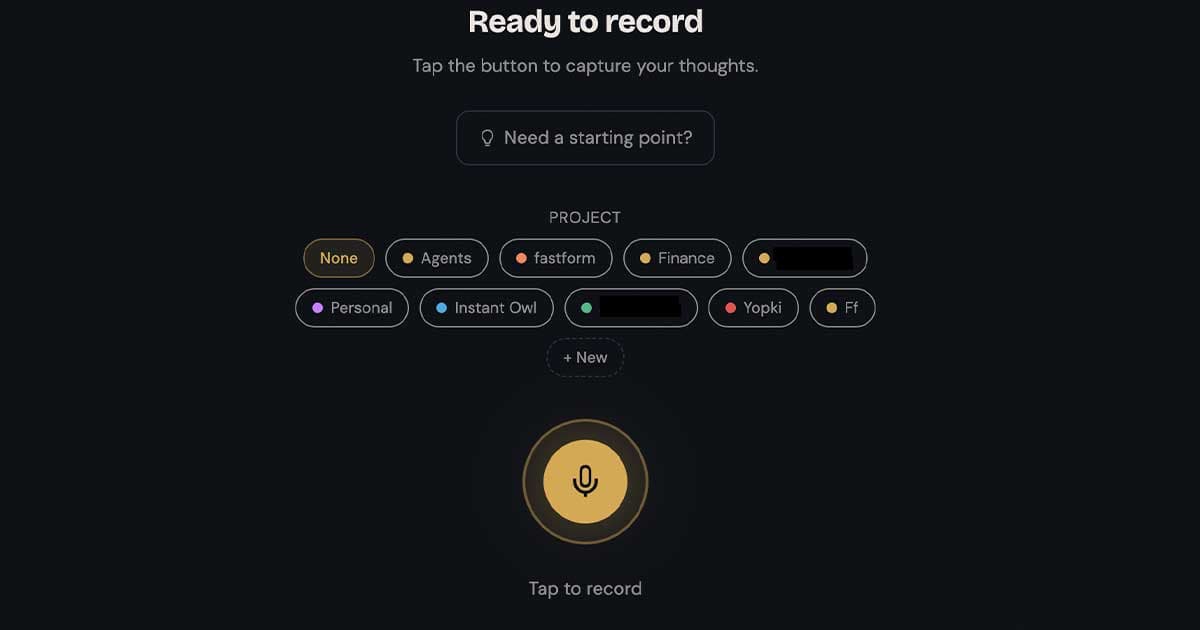
Full disclosure: InstantOwl is our product, and this is our blog. Neither Rev nor Descript is built for the audio Rev and Descript both assume you have: someone else's interview, meeting, or podcast. InstantOwl is built for a different file entirely, your own voice notes to yourself, turned into organized notes and tasks instead of a transcript or an editing project.
If the recording in front of you is an interview you need transcribed, our guide to transcribing an interview covers consent, conventions, and the real DIY, AI, and human-service costs in more depth than this post has room for. For transcription pricing across more vendors than just Rev and Descript, our transcription services pricing guide breaks down the market by rate and use case.
And if the file is not an interview at all but any audio you need turned into text, our how to transcribe audio to text guide walks through every free and paid path. InstantOwl is currently free to use.
Frequently asked questions
Is Rev worth it for transcription?
Yes, if what you want back is a finished transcript file and nothing else. Rev's human tier costs $1.99 a minute with a 12-hour turnaround, and its AI tier costs $0.25 a minute, both per rev.com/services/audio-transcription. It is not an editor, so if the transcript is a means to editing audio or video, you will still need a second tool.
Does Descript have human transcription?
Not currently. Descript's pricing and transcription pages describe only AI transcription, with accuracy described as up to 95%, per descript.com/transcription. Older comparison articles reference a White Glove human transcription add-on; that service does not appear anywhere on Descript's current site and should not be treated as available.
What does Rev cost per minute?
Rev's human transcription costs $1.99 a minute with 99%-plus accuracy claimed and a 12-hour turnaround. Rev's AI transcription costs $0.25 a minute with 95%-plus accuracy claimed, delivered in five minutes or less. Both rates are published on rev.com/services/audio-transcription; Rev's subscription plans, which include bundled AI minutes per seat, are priced separately on rev.com/pricing.
Which is better for interviews?
Rev, if the interview needs to be broadcast-grade or publish-ready and you want a human to check it. Descript, if the interview is one part of a podcast or video project you plan to edit afterward. Freelance editors on Reddit describe Rev as the broadcast-grade default and Descript as the editing tool, not the other way around.
Related reading
- How to transcribe an interview: consent, transcription conventions, and DIY, AI, and human-service costs in full.
- Transcription services in 2026: human vs AI pricing across the wider market, not just Rev and Descript.
- How to transcribe audio to text: every free and paid option for turning one file into text.
- InstantOwl: organized notes and tasks from one recording, currently free to use.
Frequently asked questions
Is Rev worth it for transcription?
Yes, if what you want back is a finished transcript file and nothing else. Rev's human tier costs $1.99 a minute with a 12-hour turnaround, and its AI tier costs $0.25 a minute, both per rev.com/services/audio-transcription. It is not an editor, so if the transcript is a means to editing audio or video, you will still need a second tool.
Does Descript have human transcription?
Not currently. Descript's pricing and transcription pages describe only AI transcription, with accuracy described as up to 95%, per descript.com/transcription. Older comparison articles reference a White Glove human transcription add-on; that service does not appear anywhere on Descript's current site and should not be treated as available.
What does Rev cost per minute?
Rev's human transcription costs $1.99 a minute with 99%-plus accuracy claimed and a 12-hour turnaround. Rev's AI transcription costs $0.25 a minute with 95%-plus accuracy claimed, delivered in five minutes or less. Both rates are published on rev.com/services/audio-transcription; Rev's subscription plans, which include bundled AI minutes per seat, are priced separately on rev.com/pricing.
Which is better for interviews?
Rev, if the interview needs to be broadcast-grade or publish-ready and you want a human to check it. Descript, if the interview is one part of a podcast or video project you plan to edit afterward. Freelance editors on Reddit describe Rev as the broadcast-grade default and Descript as the editing tool, not the other way around.

Written by
Jim BreeseJim Breese is the founder of InstantOwl. He's spent 15 years building companies, from an Airbnb host community he founded and exited to growth leadership at venture-backed SaaS startups. He built InstantOwl because his best ideas kept arriving mid-walk, out of order, and half-finished.
Stop losing good ideas.
InstantOwl turns a rambling voice note into a clean, organized document in moments. Just talk. We'll organize it.
 Try InstantOwl free