Apple Notes vs Notion: Different Speeds, Different Jobs (Use Both)
By Jim Breese ·

Apple Notes or Notion: which one should you use?
Neither wins outright, because they solve two different problems. Apple Notes opens in about a second, syncs free through iCloud, and asks nothing of you before you start typing or talking. Notion asks you to build something first, pages, databases, views, then rewards you with structure Apple Notes cannot match.
That is the real divide: capture speed versus system structure. Every ranking guide that actually tested both apps lands on the same conclusion, and it is not a winner. It is a hybrid: catch the thought in Apple Notes, then move the ones worth keeping into Notion once they prove they matter.
iOS 18 narrowed the gap more than most 2024-era comparisons admit. Apple Notes now records and transcribes audio inside a note on its own, no separate app required. It still cannot build you a database. Read on for what each app does today, verified pricing, why people actually leave Notion, and who should pick which.
What can Apple Notes do in 2026?
Apple Notes is a free, preinstalled app that captures fast and now records itself. On iOS 18 and iPadOS 18, you can record and transcribe audio within a note: on supported iPhones, a Transcript button shows the generated text, which you can search, copy, or add straight into the note. If Apple Intelligence is turned on, you can summarize that transcript too.
That audio feature is genuinely new ammunition for Apple Notes in this comparison. Most guides ranking it against Notion still describe a typing-only notes app. It is not one anymore: a rambling voice note now becomes searchable text inside the same app you already use for grocery lists.
Beyond audio, Apple Notes has quietly picked up real organizing tools. Note links, typed with ">>", connect related notes since iOS 17. Collapsible sections tuck detail under a heading in iOS 18. Tags and tag-driven Smart Folders sort notes automatically as you write them, though locked notes cannot carry tags. Search finds text inside scanned documents and photos, not just note titles.
What Apple Notes still cannot do matters just as much. There are no databases, no multiple views of the same information, and no backlink graph, only one-way links you type yourself. Sync assumes iCloud: Apple's own guidance is direct: "Many Notes features won't work with other email providers." For a single person capturing thoughts on an iPhone, none of that is a real limitation. For anyone building a structured system with linked records, it is the ceiling.
What does Notion cost, and how does it actually work?
Notion is a workspace built from blocks: small pieces like text, checkboxes, tables, and images that combine into a page. Any list of similar items becomes a database you can view as a table, board, calendar, or gallery, the feature Apple Notes has no equivalent for. It runs on the web, on desktop for macOS and Windows, and on mobile for iOS and Android.
Notion's Free plan costs $0 and includes databases, a 5MB per-file upload cap, and 7 days of page history. Paid plans are billed per member: Plus runs $10 per member monthly billed annually, and Business runs $20 per member monthly billed annually, adding Notion Agent, AI Meeting Notes, and SAML single sign-on. Yearly billing saves up to 20 percent on either paid tier; monthly billing runs higher, so treat these as the annual rate specifically.
Offline access is real now but limited. Notion's own help center confirms that all workspace members on every plan can use pages offline, but only through Notion's desktop or mobile apps, not a web browser. On the Free plan, offline access is manual: open a page, open the menu, and turn on "Available offline" yourself. Nothing downloads automatically.
Paid plans go further, automatically downloading recently visited and favorited pages so they are ready when you lose signal. Databases still cap at the first 50 rows of the first view for offline use, a real constraint for a databases-first app. Embeds, AI blocks, Forms, and Buttons do not work offline, and you cannot share a page or edit its permissions while disconnected. Edits sync automatically once you reconnect.
Why do people move away from Notion?
The two most common reasons are capture friction and maintenance overhead, not a missing feature. Tech writer Parth Shah described exactly why he left: "By the time I navigated to the right sub-page or clicked New, the original thought had usually lost its spark." A system built for structure can get in the way of the moment you actually need to write something down.
Shah's other complaint was the daily tax of upkeep: "I was spending a major chunk of my morning just managing the app," rather than using what was inside it. One competing note app's marketing page frames the same pattern more bluntly: people don't leave Notion because it lacks a feature, they leave because the overhead of maintaining their system exceeds the value it provides.
Shah also flagged Notion's mobile apps specifically. Opening a complex database with dozens of columns and a large Kanban board on a phone screen takes ages, because a layout built for a desktop monitor gets compressed onto a much smaller one. That is a real cost of the same structure that makes Notion powerful on a laptop.
Both sides of this comparison are honest about their own weak spot. Notion is genuinely overkill for jotting down a fast, personal thought, the exact moment Apple Notes wins. Apple Notes genuinely hits a ceiling once you need databases, multiple views of the same data, or a system several people build on together, the exact moment Notion wins.
The hybrid: capture in Apple Notes, build in Notion
The honest answer, repeated independently by people who actually use both apps daily, is not a winner. It is a workflow: capture fast in Apple Notes, then move whatever proves worth keeping into Notion on a schedule. Most captured notes never make that trip, and that is fine.
One writer who switched away from Notion for daily work, but kept it for structured projects, put his own cost plainly: he had spent "a ridiculous amount of time organising, tweaking, and reorganising" his workspace before he simplified. Raw ideas and messy notes now live in Apple Notes; only things like a publishing calendar or a trip plan graduate to Notion, where he still concedes Notion is the better tool for visualizing dense information.
A Notion-focused blog, one with every incentive to argue the opposite, lands on the identical recipe: use Apple Notes as your capture tool, then move the important notes into Notion on a schedule, daily, weekly, or whenever you feel overwhelmed. Its own framing of Apple Notes' edge: it is the "fastest way to catch a thought" on an iPhone, and it "usually feels dependable when you are offline." Its line about the alternative sticks: a note you never revisit is clutter.
Notice what both sides skip. They assume the thought is already typed by the time it lands in either app. That is the actual variable Shah's capture-friction complaint points at: the thought dies while you navigate the system, not because the system is bad. This is the same problem a proper capture system built around speed instead of habit has to solve first, before Apple Notes or Notion ever enters the picture.
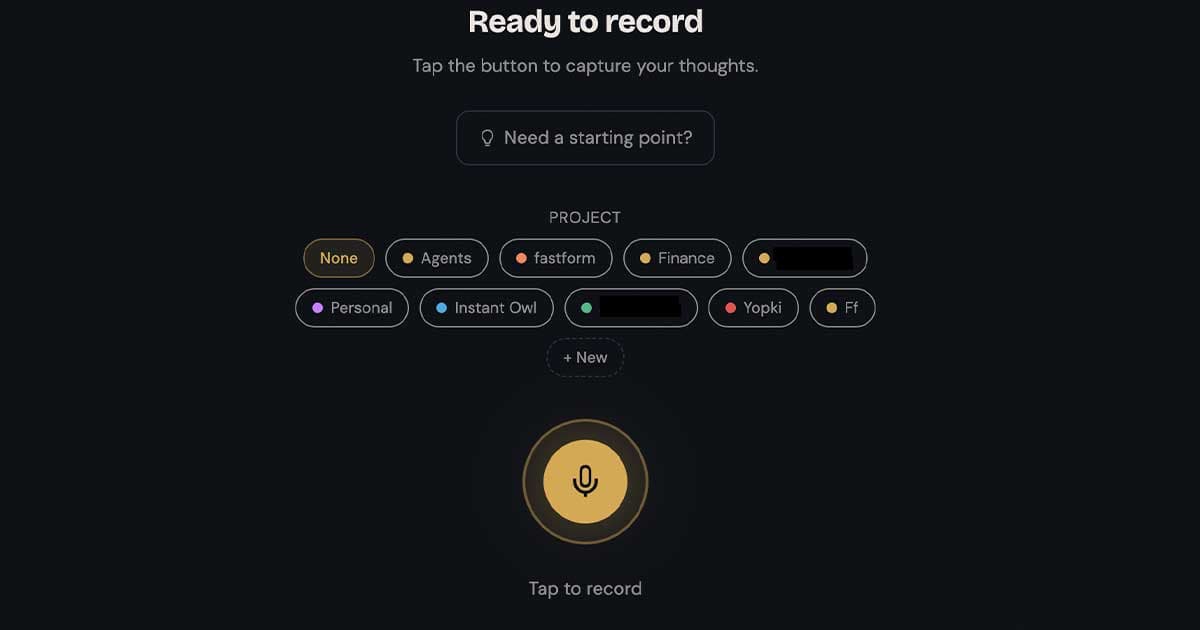
Full disclosure: InstantOwl is our product, and this blog belongs to it. It does not replace Apple Notes or Notion, and it is not trying to. You talk, and it turns the ramble into organized text in the moment, before you have opened either app or decided where the thought belongs. Whatever system you keep on the other end, Apple Notes, Notion, or both, InstantOwl is currently free to use.
Who should pick Apple Notes, Notion, or both?
Pick based on what your mind actually does with an idea, not which app has more features. If your problem is a racing mind that generates more thoughts than you can act on, start with whichever app is already one tap away and worry about structure later. Speed beats the "right" tool every time a thought is about to slip.
Someone who already leans on Claude or ChatGPT for real work gets the most out of Notion's databases: a project tracker or reading list built once keeps paying off. A parent working in three-minute windows between other things needs the fastest possible capture, which is Apple Notes on a phone that is already unlocked, not a workspace that has to load first.
Anyone who types slower than they think, or who talks better than they write, should lean on Apple Notes' new built-in transcription before reaching for either app's databases. A racing or distractible mind should treat both apps the same way: as a place things land after they are already captured, never as the capture step itself.
Most people who try to pick one end up running both, on a schedule, exactly like the guides above describe. That is not indecision. It is matching the tool to the job at the moment you actually need it, capture first, structure second.
Related reading
- How to capture ideas before they vanish: the friction-destination-review system that decides whether a note gets used at all, whichever app it lands in.
- What is Notion, literally?: a closer look at blocks, databases, and the overwhelm trap Notion's own users warn newcomers about.
- The second brain method: where captured notes go once you want real, long-term structure.
- The best note-taking apps in 2026: a wider roundup by use case if neither Apple Notes nor Notion is the right shape for you.
Frequently asked questions
Is Apple Notes good enough to replace Notion?
For most personal capture, yes. Apple Notes now records and transcribes audio inside a note, tags and Smart Folders sort what you save, and note links connect related notes since iOS 17. What it still lacks is databases, multiple views of the same information, and a backlink graph, so a structured system built on linked records still needs Notion.
Why are people moving away from Notion?
The two most common reasons are maintenance overhead and capture friction, not missing features. One tech writer described spending a major chunk of his morning just managing his Notion setup, and losing the spark of an idea by the time he navigated to the right page to write it down. Notion's mobile apps also compress a desktop-built database view onto a small screen, which slows everything down further.
Does Notion work offline?
Yes, but only through Notion's desktop or mobile apps, not a web browser. On the free plan you turn on offline access manually, one page at a time. Paid plans also auto-download recently visited and favorited pages. Databases are capped at the first 50 rows of the first view for offline use.
Is the Notes app shutting down?
No. Nothing supports that claim for Apple Notes. The actual news behind the headlines is Notion Mail, Notion's separate AI email client, which closes on September 22, 2026. The main Notion workspace app is unaffected and keeps working normally.

Written by
Jim BreeseJim Breese is the founder of InstantOwl. He's spent 15 years building companies, from an Airbnb host community he founded and exited to growth leadership at venture-backed SaaS startups. He built InstantOwl because his best ideas kept arriving mid-walk, out of order, and half-finished.
Stop losing good ideas.
InstantOwl turns a rambling voice note into a clean, organized document in moments. Just talk. We'll organize it.
 Try InstantOwl free