Why You Get Your Best Ideas in the Shower (and How to Stop Losing Them)
By Jim Breese · · Updated
Why do you get your best ideas in the shower?
You get your best ideas in the shower because showering keeps you moderately occupied while your mind wanders, and mind wandering is where good ideas keep showing up. A 2019 Psychological Science study by Shelly Gable, Elizabeth Hopper, and Jonathan Schooler found that professional writers and physicists traced about one fifth of their most significant daily ideas back to spontaneous mind wandering. A 2022 study by Zac Irving and colleagues found that effect only holds during moderately engaging activities, the kind a shower happens to be.
Neither study looked at showers directly. Both point at the same mechanism, and the shower is simply where most people meet it: alone, warm, phone-free, with just enough happening (water, soap, the motions of a routine you have done a thousand times) to keep your executive brain lightly busy while the rest of it wanders off and, sometimes, comes back with something good.
What does the research actually say?
About one fifth of big ideas arrive while your mind is elsewhere
A 2019 study published in Psychological Science followed professional writers (98 of them) and physicists (87 of them) as they logged their most significant idea each day, along with what they were doing and thinking about when it hit. Researchers Shelly Gable, Elizabeth Hopper, and Jonathan Schooler, whose work is recorded on PubMed, found that about one fifth of those big ideas showed up during spontaneous mind wandering, meaning the person was doing one thing while thinking about something else entirely.
The mind-wandering ideas were not just as common as the on-task ones, they were also more likely to feel like a sudden "aha" and more likely to break through a stuck problem. In plain terms: when you are stuck, walking away and letting your mind drift is not avoidance. Per this study, it is one of the more reliable ways an expert's brain actually solves the problem.
The "shower effect": moderate engagement beats boredom
A 2022 paper by Zac Irving, an assistant professor of philosophy at the University of Virginia, working with Caitlin Mills of the University of Minnesota and colleagues, gave the phenomenon its name: the shower effect. Their experiment, covered by UVA Today, had participants dream up creative uses for a brick or a paperclip, then watch a three-minute video, either two men folding laundry or a scene from When Harry Met Sally.
Mind wandering only predicted better ideas during the When Harry Met Sally clip, the moderately engaging one. During the laundry video, more mind wandering did not produce more creativity. Irving's explanation: "mind-wandering might help in some contexts, like taking a walk, but not others, like a dull psych task." A shower sits exactly where this study says creativity lives, engaging enough to hold your attention loosely, not so demanding that it pulls your whole mind onto the task.
What John Kounios says is happening in your brain
Drexel University psychologist John Kounios, co-author of The Eureka Factor: Aha Moments, Creative Insight, and the Brain, describes two separate paths to solving a problem: an analytical path, deliberate and step by step, and an insight path, where the answer arrives whole and "seems disconnected from your ongoing stream of thought."
As Kounios has explained through Headspace's reporting, insight moments come with a burst of activity in the right temporal lobe, the region that links separate ideas together. Just before the insight lands, researchers see a "brain blink," a rush of alpha waves that briefly quiets the visual cortex.
Per Kounios, relaxation broadens what your mind is willing to consider, while anxiety narrows it down to mental tunnel vision. This is the opposite end of attention from a locked-in flow state: flow narrows attention onto one task, while a shower loosens it enough for stray connections to surface. A shower supplies mild sensory deprivation (warm water, white noise, no phone, no screen) which, per Headspace's reporting on Kounios's work, stretches that brain blink out long enough for a stray idea to surface. Nobody has measured this specifically for showers. The pattern he describes, relaxed attention plus reduced sensory noise, matches a shower closely enough that it is worth taking seriously as the likely mechanism, attributed to his work rather than stated as settled fact.
Why is the shower the perfect spot for this, specifically?
A shower hits a narrow window: occupying enough to keep your executive brain from taking over, boring enough to let your mind wander, and private enough that nobody interrupts it. Compare that to scrolling a phone (too occupying, mind stays put) or lying in bed doing nothing (often too unstructured, and per the research below, that is exactly when it can turn on you).
Add the practical stuff a shower removes: no phone to check, no one talking to you, warm water that keeps you in one place for several uninterrupted minutes. Legend says Archimedes had his eureka moment in a bathtub, shouting "eureka" and running through the streets of Syracuse. Nobody alive verified that story. Take it as a fun, very old way of describing the same experience millions of people still have every morning, not as proof of anything.
The internet has its own tribute to this. The r/Showerthoughts community on Reddit, with millions of subscribers, exists entirely to collect the small, strange, sideways observations people have while their mind wanders in the shower. It is culture, not data, but it says something that an entire community formed around a feeling this common.
Does mind wandering ever go wrong?
Yes, for plenty of people it does. Letting your mind drift does not guarantee a pleasant destination. On the r/todayilearned thread where this research first got wide attention, one commenter described it this way: if their mind is given time to wander, it mostly bombards them with regrets and anxieties rather than good ideas. Other commenters in the same thread agreed this is common, especially, by their own account, among people with ADHD.
That is not a study, it is a shared self-report, and it lines up with what a lot of people already know about their own heads: an unstructured wandering mind does not just produce eureka moments, it can also produce a replay of everything you are stressed about. If that is your shower, the fix is not to force positive thinking. It is a brain dump, getting the thought out of your head and onto something else the moment you can, so it stops circling.
This is also why capture matters more for some people than others. If a wandering mind tends to surface anxious loops for you rather than ideas, as it does for a lot of people, that pattern shows up most for ADHD brains specifically, and getting a thought out fast is relief, not just productivity.
How do you stop losing your shower ideas?
Here is the part nobody covering the shower effect actually solves: the moment a good idea shows up, your hands are wet, your phone is in another room, and by the time you are dry it is gone. The fix has three parts, in order.
First, repeat the idea out loud, the second it forms, and keep repeating it until you can act on it. Saying a phrase over and over keeps it in working memory much longer than silently hoping you will remember it.
Second, keep a waterproof notepad in the shower if you want a low-tech option. Simple wipeable shower notepads exist cheaply and need no batteries or apps, just a finger and a wet surface. Third, and this covers the ideas a notepad cannot, get to a phone the second you are out and say the idea into it rather than typing it, because talking is faster than typing and works even with wet or soapy hands.
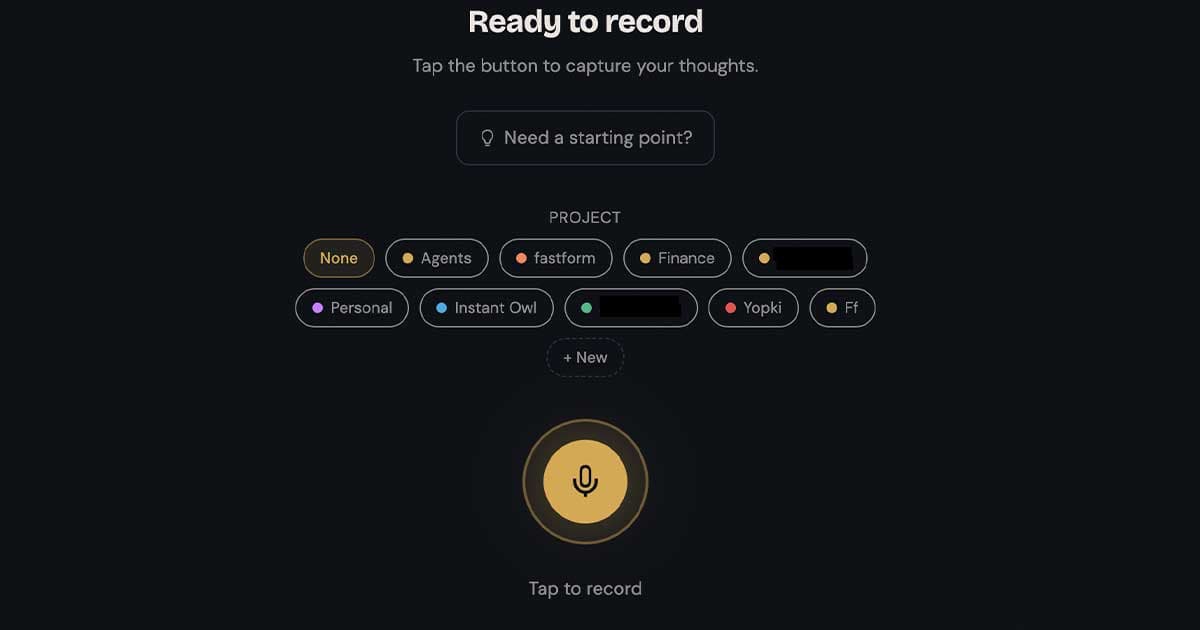
That third step is where InstantOwl fits, in full disclosure since this is our product and our blog. Say the idea into it the moment you can reach a phone, and it turns the ramble into an organized note instead of leaving you with a raw recording to sort through later. It is currently free to use.
None of this replaces a real capture system for the rest of your day, in the car, at your desk, walking the dog. How to capture ideas before they vanish covers the fuller version: one destination for everything you capture, and a short weekly review so ideas do not just pile up unsorted. And if talking your ideas out loud is new to you, what a voice note actually is and how people already use them is a good next stop.
The shower will keep handing you ideas whether or not you are ready for them. The only real fix is having somewhere fast to put them, so the good ones survive past the towel.
Frequently asked questions
Why do I get my best ideas in the shower?
Showering keeps your hands and senses moderately occupied while leaving your mind free to wander, and mind wandering is when a 2019 study found about one fifth of professional writers' and physicists' most significant ideas actually showed up. A shower is warm, private, and phone-free, which removes the usual distractions that stop a mind from wandering in the first place.
What is the shower effect?
The shower effect is the name researchers gave to the finding that mind wandering boosts creative thinking only during moderately engaging activities, like showering or walking, not truly boring or truly demanding ones. A 2022 study tested this directly and found a boring video produced no creativity boost, while a moderately engaging one did.
How do I remember shower ideas?
Say the idea out loud, on repeat, until you can reach something that captures it, since repeating a phrase keeps it alive in working memory far longer than remembering it silently. The moment you can reach a phone, record a quick voice note instead of typing, because talking is faster when your hands are wet or busy.
Does boredom make you more creative?
Not directly. A 2022 study found true boredom, watching a genuinely dull video, produced no link between mind wandering and creativity, while a moderately engaging video did. The sweet spot is an activity engaging enough to occupy you without demanding real thought, which is exactly what a shower, a walk, or folding laundry while half-distracted provides.

Written by
Jim BreeseJim Breese is the founder of InstantOwl. He's spent 15 years building companies, from an Airbnb host community he founded and exited to growth leadership at venture-backed SaaS startups. He built InstantOwl because his best ideas kept arriving mid-walk, out of order, and half-finished.
Stop losing good ideas.
InstantOwl turns a rambling voice note into a clean, organized document in moments. Just talk. We'll organize it.
 Try InstantOwl free