How to Stop Overthinking: What Actually Quiets a Loud Mind (and Where the Thought Goes)
By Jim Breese ·
How do you stop overthinking?
You cannot stop a thought from arriving. Thoughts show up on their own, uninvited, all day. What you can control is whether you engage with one once it has arrived, and for how long.
The move that actually works has two halves. First, a mental skill: notice the thought, decide not to chase it right now, and postpone it instead of solving it on the spot. Second, a practical step almost every article on this topic skips: get the loop out of your head and into something you trust, so your mind stops holding it "just in case."
The problem was never a lack of willpower. The problem is a loop with nowhere to land. This post covers both halves, in that order, and where a doctor or therapist fits in if the loop is bigger than a loud mind.
Why your mind loops in the first place
Overthinking starts with what therapist Pia Callesen calls a trigger thought: an automatic, involuntary thought that just shows up, like a worry about tomorrow or a replay of something you said. You did not choose it and cannot stop it from arriving.
According to Callesen's metacognitive guide for Psyche, it is not the trigger thought itself that wears you down. It is the time you spend afterward analyzing, arguing with, or replaying it. She compares thoughts to trains pulling into a station: they keep arriving whether you like it or not, but you choose which ones to board.
It helps to name the two flavors this loop usually takes. Both are trigger thoughts, and both get worse the longer you stay on the train.
| Loop type | Sounds like | Points toward |
|---|---|---|
| Worry | "What if this goes wrong tomorrow?" | The future, something that has not happened yet |
| Rumination | "What is wrong with me that I said that?" | The past, something already done |
Naming which one you are in does not stop it, but it makes the next step (postponing it) easier, because you know whether you are bracing for the future or replaying the past.
The technique that has real evidence behind it: postpone the worry
The technique with the most support behind it is not suppressing the thought. It is postponing it. Set a fixed daily slot, roughly 30 minutes, as your worry time. When a trigger thought shows up outside that window, tell yourself "I'll deal with this later" and let it pass, the way you would let an unanswered call go to voicemail.
This is the core move in metacognitive therapy, the clinical approach Callesen practices and writes about. In her Psyche guide, she is explicit that the point of worry time is not to sit and solve the problem in detail. It is to prove to yourself that a thought can wait, which weakens its grip on the rest of your day.
One caution matters if you are prone to insomnia: do not schedule worry time within an hour or two of bed. Processing worries too close to sleep can keep the loop running exactly when you need it to quiet down. Earlier evening works better for most people.
Postponement only works, though, if "later" actually feels safe. If part of you does not trust that the thought will still be there when worry time comes, you will not really let go of it. That trust gap is the part almost every article on this topic leaves unanswered.
The part the advice skips: where does the thought actually go?
The advice to "let it pass" only works if the thought has somewhere to go. Otherwise your brain keeps replaying it anyway, as insurance, in case you forget. Postponing a worry is not the same as parking it. It has to actually land somewhere you trust before your mind will leave it alone.
There is real evidence for this outside the therapy literature too. A 2018 study from Baylor's Sleep Neuroscience and Cognition Laboratory had participants write a to-do list of upcoming tasks for about five minutes before bed. Compared to a group who wrote about tasks they had already finished, the to-do-list writers fell asleep roughly nine minutes faster, and the more specifically they wrote the list, the faster they fell asleep. Lead author Michael K. Scullin described the mechanism in one word in the study's press announcement: writing the list will "offload" those thoughts. You can read the published study for the full detail.
That is the honest bridge between the mental skill and the practical one. Offloading is not the same as problem-solving. You are not sitting down to work through the worry in detail, which is the part metacognitive therapy actually warns against. You are getting it out of your head and onto something external, closing the loop, and leaving it alone until later.
If you want a fuller walkthrough of getting everything out of your head in one sitting, a brain dump is the more general version of this move: no sorting, no editing, just capture. Once it is out, turning the pile into something you can act on is the second, separate step, and it can wait.
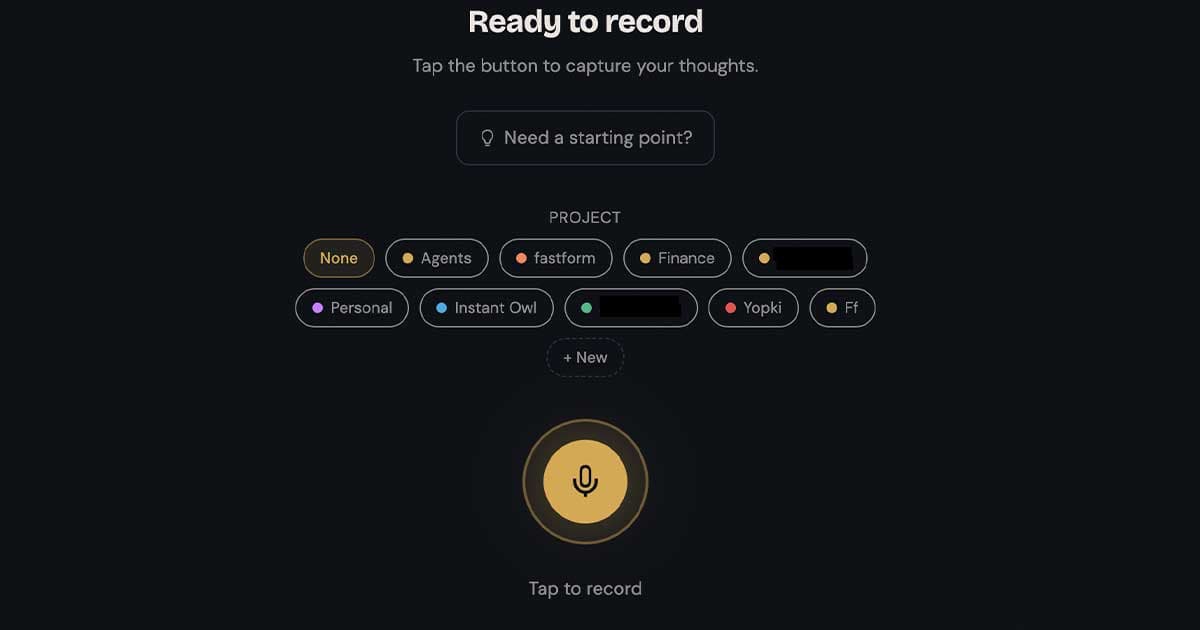
This is the exact gap InstantOwl was built to close. When a thought will not stop circling, you say it out loud and let it be captured, messy and unfiltered, no typing, no structuring first. It comes back organized on its own, so there is no relisten chore waiting for you later. It is currently free to try. It will not treat anxiety or replace the postponement skill above; it is the offload step, the place the thought actually goes once you have decided not to chase it right now.
What is the 3-3-3 rule for overthinking?
The 3-3-3 rule is a grounding technique: name three things you can see, identify three sounds you can hear, then move three parts of your body, like your fingers, shoulders, and feet. It shifts your attention from the loop inside your head to what is actually happening around you right now.
It is worth being honest about what this is and is not. The 3-3-3 rule is a popular, widely taught self-help practice, not a standalone clinical protocol with its own research base. It works on the same principle as the attention-training exercises used in metacognitive therapy: proving that your focus is under your control, separate from whatever thought is trying to hold it.
Think of it as a quick, physical version of choosing not to board the train. You are not arguing with the thought. You are simply looking somewhere else for thirty seconds until its pull weakens.
A few more things that genuinely help (kept honest)
A short, slow breath, in for four counts and out for six, gives your attention somewhere to go besides the loop. It is not a cure, just another attention-shift, the same principle behind the 3-3-3 rule.
A walk or a shower does something similar but slower. Without a screen or a task in front of you, your mind often wanders somewhere more useful than the loop it was stuck in. If you have ever solved a problem mid-shower, you already know what a wandering mind in the shower can do that forcing focus cannot.
If you think best out loud rather than on the page, say the thought instead of writing it. Talking a worry through, even to no one, is often faster than typing it, and processing verbally works especially well for anyone who knows what they feel before they know how to phrase it.
None of these fix the loop by themselves. They are attention-shifts and offload tools, the same two moves this whole post is built on, just in smaller doses.
When overthinking is more than a loud mind
If the loops are constant, are tangled up with real anxiety or low mood, or are costing you sleep night after night, this is a good moment to talk to a doctor or therapist rather than manage it alone. That is not a failure of the techniques above; it is the right next step when a loud mind has become something heavier.
Metacognitive therapy, the framework behind the postponement technique in this post, is a real clinical treatment delivered by trained therapists, not a self-help trick. What is here is a general wellbeing technique inspired by that work, not a substitute for it. If overthinking is wearing you down, a professional can tell you what is actually going on and help in ways a blog post cannot.
Frequently asked questions
How do you stop overthinking?
You cannot stop a thought from showing up, but you can choose not to engage with it right now. Postpone it to a set worry time instead of analyzing it on the spot, and get it out of your head into something you trust, whether that is a written note or a spoken one. The loop keeps running until both of those happen.
What is the 3-3-3 rule for overthinking?
The 3-3-3 rule is a grounding technique: name 3 things you can see, identify 3 sounds you can hear, then move 3 parts of your body. It redirects attention from the internal loop to the present moment. It is a popular self-help practice, not a formally validated clinical protocol, but it draws on the same attention-shifting principle used in metacognitive therapy.
What causes overthinking?
Overthinking starts with an automatic trigger thought, something like a stray worry or a replayed conversation. That part is normal and involuntary. What turns it into overthinking is the time spent re-engaging with it afterward: analyzing it, arguing with it, replaying it. The trigger is not the problem. The minutes you spend circling it are.
How do I stop overthinking at night?
Set your worry-processing time earlier in the evening, not right before bed, since revisiting worries close to sleep can make it harder to fall asleep. If a thought is a task or a loose end rather than a worry, write it down or say it into something that captures it. A specific to-do list written before bed has been shown to help people fall asleep faster than writing about tasks already finished.

Written by
Jim BreeseJim Breese is the founder of InstantOwl. He's spent 15 years building companies, from an Airbnb host community he founded and exited to growth leadership at venture-backed SaaS startups. He built InstantOwl because his best ideas kept arriving mid-walk, out of order, and half-finished.
Stop losing good ideas.
InstantOwl turns a rambling voice note into a clean, organized document in moments. Just talk. We'll organize it.
 Try InstantOwl free