How to Organize Your Thoughts (When They Won't Line Up on Their Own)
By Jim Breese · · Updated

How do you organize your thoughts?
You organize your thoughts by treating it as two separate jobs, done one after the other: first get everything out of your head, in whatever order it arrives, then sort what you have into groups and priorities, the way a ranked shortlist like the Ivy Lee method turns a pile of tasks into a clear order of what to do first. Skipping straight to organizing while thoughts are still arriving is the single most common reason people stall out and never start.
This shows up across every method that actually works, whether it uses paper, an app, or a recording. Sticky notes, mind maps, voice memos, and outlines all look different on the surface, but underneath they are all just different ways of keeping capture and organizing apart. Once a thought is safely out of your head, sorting it is easy. While it is still in your head, sorting is what makes it feel impossible.
If you have not done the first step yet, a plain brain dump is the fastest way to start: set a timer, get everything out unedited, and stop. Organizing only becomes hard when you try to do it before the dump is finished.
Why can't I organize my thoughts?
Usually you can. They are just not organized by the time they leave your mouth or your pen, and that is a problem of articulation under pressure, not a thinking deficit or laziness. It is one of the more common complaints in career and workplace forums, and it is rarely about intelligence.
In one career-advice forum thread on exactly this problem, a person described the gap precisely: "My thoughts are actually very well organized and coherent in my head, but as soon as I open my mouth it's complete chaos." That distinction matters. The organizing already happened. What failed was getting it out in real time, under the pressure of someone waiting for an answer.
One commenter in that same thread, who has ADHD, put a name to the delay: "I have a difficult time organizing my thoughts on the fly. I need time to absorb information and think." Their workaround was to tell people directly that they would share thoughts later rather than force an answer on the spot, and to write freely afterward, then edit that stream-of-consciousness into something clearer. They said editing a messy draft into sense "always clarifies my thoughts," which is worth remembering: the clarity often comes from the second pass, not the first.
Other people in the thread pointed to burnout, rumination, or being emotionally overwhelmed rather than a raw thinking problem. That distinction matters enough that it gets its own section below, because a better capture method will not fix exhaustion.
The dump-cluster-sort method
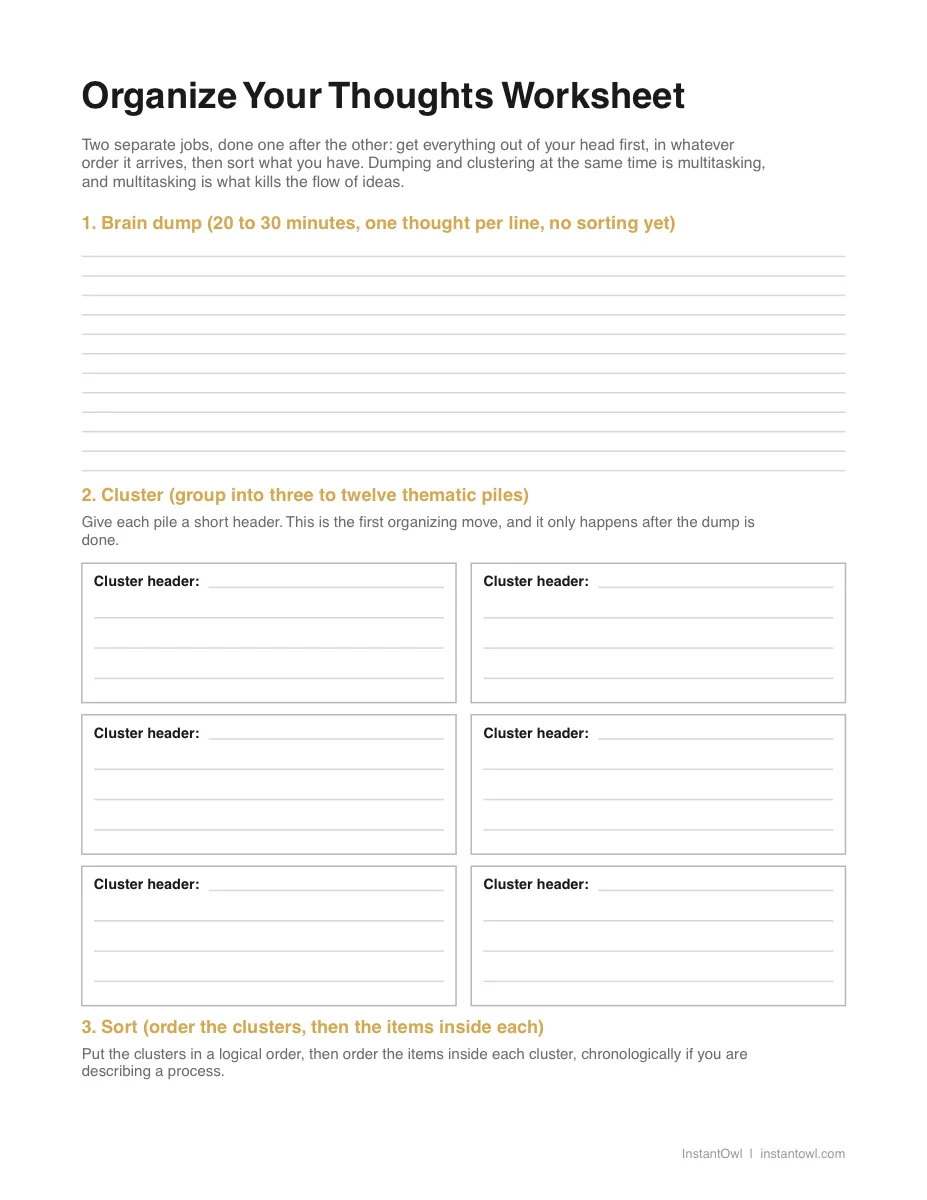
The clearest structural fix for this comes from writer Thomas Langhorst, who breaks the capture-then-sort split into four concrete steps in a guide aimed at writers with the same freeze: brain dump, cluster, sort, write.
- Brain dump. Spend 20 to 30 minutes getting ideas down, one per sticky note (or one per line, if you are not using paper), with no sorting or arranging yet. The instruction is explicit: do not sort as you go.
- Cluster. Group the notes into three to twelve thematic piles and give each pile a short header. This is the first organizing move, and it only happens after the dump is done.
- Sort. Put the clusters in a logical order, then order the items inside each cluster, chronologically if you are describing a process.
- Write. By this point, Langhorst notes, most of what you need to say is already sitting in front of you in the clusters, so writing becomes assembly rather than invention.
The insight worth keeping, even if you skip sticky notes entirely, is the strict separation of steps one and two. Dumping and clustering at the same time is multitasking, and multitasking is what kills the flow of ideas in the first place. Handling one step at a time, with full attention, is monotasking applied to your own thinking.
Get the worksheet as PDF, Word, or Excel
The dump-cluster-sort method above as a fill-in worksheet: a capture space, six cluster boxes with headers, and a sort order to finish with.
- PDF: print it or fill it on a tablet
- Word (DOCX): edit and reuse it as a doc
- Excel (XLSX): for column lovers, cluster by dragging rows
The DOCX and XLSX files open directly in Google Docs and Google Sheets, no download or conversion needed.
What is the fastest way to organize thoughts?
Talk, instead of writing. Most people speak roughly three times faster than they type, so a spoken capture clears more thoughts per minute than any written method, and you can do it walking, driving, or between meetings with no blank page to stare down first.
Real users have already found this on their own. In the same career-advice thread, the most upvoted piece of advice was to interview yourself: ask yourself questions out loud, answer them out loud, then write down the answers, split or duplicate them across sections, and organize under headers later. It is dump-cluster-sort again, just spoken instead of written.
A direct reply to that advice pushed it one step further: "A cheat for this first part is to use notes on iPhone and use the microphone to text. You can ask the questions and answer them and it will write everything you're saying. There will be some edits, but much more effective because you likely can't write as fast as you can talk. I use this for important presentations." That is a person independently inventing voice capture as a shortcut, with no product behind it, just a phone's built-in dictation.
Does writing or talking work better?
Both work, for different jobs. Writing forces a slower pace, which some people use to notice structure as they go, and it produces a page you can mark up later without needing to re-listen to anything. Talking is faster and skips the blank-page freeze entirely, which matters most when a thought is about to slip away.
A useful middle path from that same thread: write or talk out a rough stream-of-consciousness that no one will ever see, then edit and condense it more than once. The clarifying work happens in the editing pass, not the first draft, whichever way you captured it.
The honest tradeoff is what happens after you talk: a raw voice recording is fast to make and slow to sort through, which is why so many people default back to typing even though it is slower. InstantOwl exists to close exactly that gap: you talk the jumble out, and it comes back organized into notes, tasks, and ideas instead of a wall of transcript to sort by hand. It is currently free to use, and this is our product, disclosed plainly since we are the ones telling you about it.
How do I organize my thoughts when overwhelmed?
Skip organizing first. When you are overwhelmed, the fastest relief is getting everything out of your head into one place, unsorted, and worrying about order only after nothing is left inside. Trying to organize while thoughts are still arriving is what makes overwhelm feel unsolvable.
If the overwhelm does not lift once the thoughts are out, it is worth considering that the problem was never organization. People in the same forum thread pointed to burnout, rumination, and being emotionally overwhelmed as the actual cause behind their own "can't organize my thoughts" complaint, not a raw thinking deficit. Rumination in particular, replaying the same worry instead of holding too many thoughts, responds to a different fix, covered in our guide on how to stop overthinking. One person traced their struggle back far enough to discover they were neurodivergent, through this exact conversation.
Organizing your thoughts is not therapy, and no capture method replaces rest, movement, or a conversation with a doctor when that is what is actually needed. Short cardio, a walk, or simply sleeping before you try to answer something hard came up repeatedly as what actually worked. If your mind moves faster than you can hold onto it day to day, not just on hard days, an ADHD brain dump built around instant capture is worth a closer look, since frequency of capture matters more than any single technique there.
Tools that fit the method
Any tool works as long as it keeps capture and organizing separate. What differs is speed and what happens after you capture.
- Paper. Sticky notes or a notebook, one thought per note or line. Slow but nothing to open, and handwriting itself helps some people think. Best for a dump you plan to cluster by moving physical notes around.
- A notes app. Faster than paper, searchable, and easy to review later. If you want a structured system instead of a blank note, note-taking methods like Cornell or outlining give you a container to sort into.
- A mind map. Good once you already have themes and want to see how they connect visually. It still assumes you know your branches going in, which is worth knowing before you start; see how to make a mind map for the tool-agnostic version.
- Voice. The fastest capture there is, and the method real users keep inventing for themselves with nothing more than a phone's built-in microphone. InstantOwl is built for this specific step: talk the jumble out, and it hands back the sorted version instead of leaving you with a transcript to organize by hand. It is currently free to use.
Pick based on the moment, not identity. A fast-moving thought needs voice. A thought you will revisit for weeks needs paper or notes you can search. Most people end up using more than one, depending on where they are when the thought shows up.
Related reading
- What is a brain dump: the capture step on its own, with prompts and a five-minute version.
- ADHD brain dump: why instant, judgment-free capture matters most for a racing mind.
- How to make a mind map: a tool-agnostic method for organizing thoughts once you know your themes.
- Note-taking methods compared: Cornell, outline, mapping, and other structured systems to sort into.
Frequently asked questions
How do I organize my thoughts when overwhelmed?
Skip organizing first. Get everything out of your head into one place, unsorted, then sort it after. If the overwhelm does not lift once the thoughts are out, it may be burnout or rumination rather than a technique problem, and rest, movement, or talking to a doctor matters more than a better system.
Why can't I organize my thoughts?
Usually you can, they are just not organized by the time they reach your mouth or your pen, which is a problem of articulation under pressure, not a thinking deficit. People with genuinely well-organized thoughts describe this exact chaos the moment they try to speak, and it is common enough to have a name: capture and organize are two different jobs, and doing them at once is what jams people up.
What is the fastest way to organize thoughts?
Talk them out loud instead of writing them. Most people speak roughly three times faster than they type, so talking clears more thoughts per minute than any writing method, and you can do it while walking or driving. Sort what you said afterward, either yourself or with a tool that structures a recording for you.
Does writing or talking work better?
Both work, for different jobs. Writing slows you down enough to notice structure as you go, which helps for something you will review later. Talking is faster and removes the blank-page freeze, which helps when a thought is about to slip away. Many people now do both: talk first to capture fast, then read the result like a draft.

Written by
Jim BreeseJim Breese is the founder of InstantOwl. He's spent 15 years building companies, from an Airbnb host community he founded and exited to growth leadership at venture-backed SaaS startups. He built InstantOwl because his best ideas kept arriving mid-walk, out of order, and half-finished.
Stop losing good ideas.
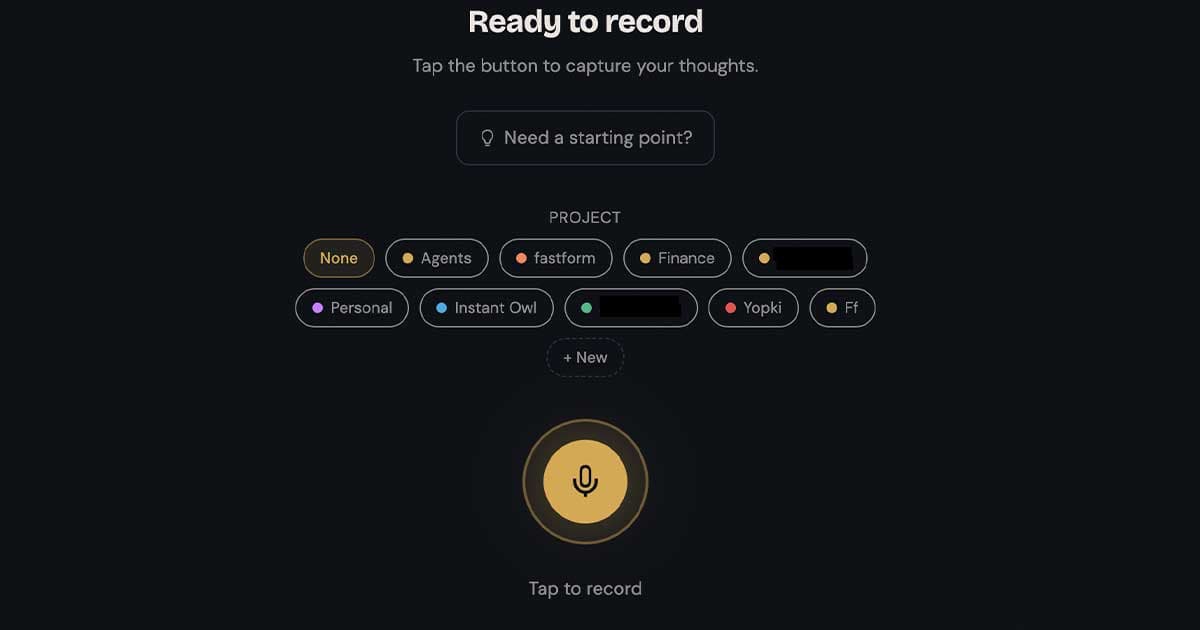
InstantOwl turns a rambling voice note into a clean, organized document in moments. Just talk. We'll organize it.
 Try InstantOwl free