The Ivy Lee Method: Six Tasks, and a Story Nobody Can Verify
By Jim Breese ·

What is the Ivy Lee method?
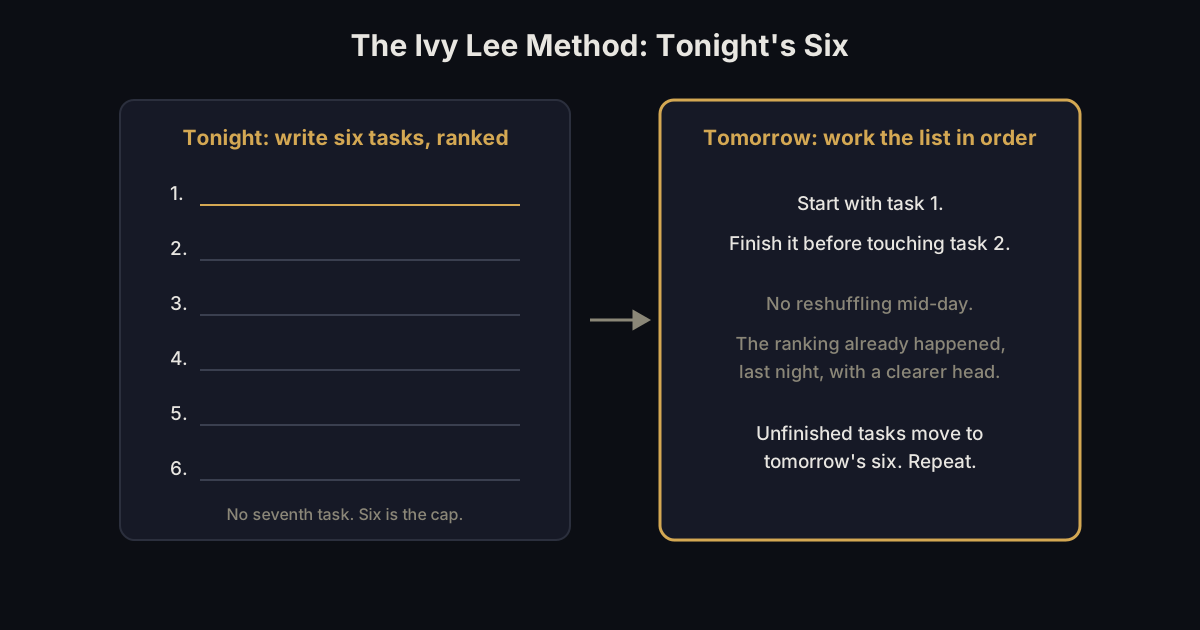
The Ivy Lee method is a six-step evening ritual: write down the six most important tasks for tomorrow, rank them by true importance, and the next day work through them in that order, one at a time, until each is finished. As James Clear lays it out on his own site, the steps are:
- At the end of each workday, write down the six most important tasks for tomorrow. No more than six.
- Rank the six by their true importance.
- The next morning, work on the first task only, until it's finished.
- Once it's done, move to the second task, worked the same way.
- Move anything unfinished at day's end into tomorrow's six.
- Repeat every working day.
That's the entire method. The constraint is the point: capping the list at six forces a real decision the night before, when you can still think clearly about what matters, so the morning becomes execution instead of another round of deciding. Clear's explanation for why it works comes down to three things: it's simple enough to actually use, it removes the friction of staring at a long list and not knowing where to start, and it enforces working on one thing at a time instead of splitting attention across several.
Is the $25,000 Schwab story true?
Unverified, not disproven. The story is usually told like this: in 1918, productivity consultant Ivy Lee met Charles M. Schwab, president of Bethlehem Steel, and offered to spend 15 minutes with each of Schwab's executives, for no upfront fee. Lee told Schwab to use the method for three months, then pay whatever he thought the advice was worth. Three months later, Schwab reportedly wrote Lee a check for $25,000, which Clear equates to roughly $400,000 in 2015 dollars.
Here's the honest problem with that story: nobody writing about it today, including the person most responsible for spreading it, can point to the original document. Clear footnotes his own retelling with the admission that he had difficulty locating original documentation, and credits Scott M. Cutlip's history book "The Unseen Power: Public Relations: A History" as his source for the 1918 date.
He also names UJ Ramdas and Cameron Herold as the people who told him the story in the first place. That means the version everyone quotes today, including ours, passed through at least three retellers before it reached print on his site, and none of them claim to have seen an original 1918 record.
Writer Mayo Oshin states the provenance problem more plainly than anyone else covering the method, calling the original source of the Schwab story "extremely hard to find." His citable secondary sources are the same two books that keep surfacing everywhere this story appears, Cutlip's "The Unseen Power" and R. Alec Mackenzie's "The Time Trap," both serious works, neither a primary 1918 record.
The dollar figure itself is the tell. Clear's version puts the check at about $400,000 in 2015 dollars. Fortune's 2022 retelling converts the same $25,000 to roughly $457,000. Todoist's own version of the story rounds it up further, to over $500,000. Three retellings, three different numbers, all converting the same fixed 1918 figure. When a fact keeps drifting like that across sources that all claim to be citing the same event, it usually means everyone is copying everyone else's convenient rounding, not checking a shared original.
What's actually verifiable: Ivy Lee and Charles Schwab were both real, well-documented people. Lee really was a famous, highly paid consultant to industrialists. The anecdote appears consistently across serious secondary literature going back decades. What isn't verifiable: any primary 1918 document, the exact $25,000 figure, or the quote often attributed to Schwab calling it the most valuable advice he ever received. Call it what it is: a well-worn legend built on a real consultant. The method's value doesn't depend on the anecdote being true.
Who was Ivy Lee, really?
Ivy Lee was a real and consequential figure, not just a name attached to a productivity anecdote. A former New York Times reporter, he became one of the founders of modern public relations, advising the Rockefeller family and Standard Oil through some of their biggest crises, per Fortune's account of his career.
His record gets darker late in life. Lee took paid consulting work for I.G. Farben, met with Hitler in 1934, and was the subject of a 1934 New York Times piece headlined "Ivy Lee, as Adviser to Nazis." He was later called to testify before the House Un-American Activities Committee. None of that erases the six-task method, but it's worth knowing the man behind a suspiciously tidy sales story was, in reality, a far more complicated figure than the anecdote lets on.
Running your six tasks tonight
Lee's original instruction was to write the list before leaving work, and that timing still matters. Deciding tomorrow's six at the end of today, while the day's context is still fresh, produces better ranking than trying to reconstruct priorities half-asleep the next morning. The list itself can be as simple as six lines on paper or a note on your phone.
Two problems come up constantly once people actually try it. First, ranking by "true importance" often puts the task you've been dreading at the top, and that placement is deliberate, not a bug. If a dreaded task keeps sliding to the bottom of your own rankings anyway, the eat-the-frog method exists specifically to argue for tackling the worst task first, on purpose, before anything else.
Second, interruptions will eat into your six regardless of how well you rank them. When something urgent shows up mid-day, trade it for a planned task rather than just adding a seventh item to the list. Treat carrying unfinished items forward into tomorrow's six as the system working as intended, not as falling behind. Six is a daily ceiling on what you commit to, not a score you're expected to clear every single day.
Six strict, ranked tasks is a tighter constraint than the 1-3-5 rule, which allows nine tasks sized by scope instead of strict rank order. Neither is more correct than the other; the Ivy Lee method suits anyone who wants a hard stop on decision-making, while 1-3-5 suits anyone who wants room for a mix of large and small work in one day.
Both methods share the same first move as any daily plan: get everything out of your head the night before, so ranking it the next morning is not also the moment you're trying to remember it. That's the same instinct behind Capture, the first step of GTD, which asks the same question in different words: what has your attention right now, before you decide what to do about it.
Full disclosure: InstantOwl is our product, and this blog belongs to it. The fastest version of Lee's evening ritual is saying it out loud instead of writing it: on the commute home or while shutting down for the day, talk through what tomorrow actually needs. InstantOwl extracts the tasks automatically and resolves any spoken due dates, like "by Friday," into real calendar dates, so nothing has to be retyped by hand.
A saved custom output type in Settings can be built to take that same ramble and pick the six most important tasks, ranked, with everything else listed under "not tomorrow." You still do the ranking judgment yourself; the tool removes the transcription step, not the thinking. There's no live calendar sync, but each task can be exported to your calendar individually. InstantOwl is currently free to use.
Frequently asked questions
What is the Ivy Lee method?
A daily planning method where you write down the six most important tasks for the next workday at the end of today, rank them by true importance, then the next morning work on task one until it's finished before starting task two, and so on. Anything unfinished carries over into tomorrow's six.
Is the $25,000 Ivy Lee story true?
Unverified, not disproven. Ivy Lee and Charles Schwab were real people, and the anecdote appears in serious secondary sources, but no primary 1918 document has surfaced. James Clear, who popularized the story most, says outright he could not locate original documentation, and the dollar figure changes with every retelling.
How is the Ivy Lee method different from the 1-3-5 rule?
The Ivy Lee method caps you at six tasks worked strictly in rank order, one at a time, with no starting task two before task one is done. The 1-3-5 rule allows nine tasks sized by scope (one big, three medium, five small) worked in whatever order fits your day.
What if I don't finish all six tasks?
That's the method working as designed, not failing. Move whatever's unfinished into tomorrow's six and rank the full list again. Six is a ceiling on what you commit to each day, not a score you're expected to hit every time.

Written by
Jim BreeseJim Breese is the founder of InstantOwl. He's spent 15 years building companies, from an Airbnb host community he founded and exited to growth leadership at venture-backed SaaS startups. He built InstantOwl because his best ideas kept arriving mid-walk, out of order, and half-finished.
Stop losing good ideas.
InstantOwl turns a rambling voice note into a clean, organized document in moments. Just talk. We'll organize it.
 Try InstantOwl free