Getting Things Done (GTD): The Five Steps, Why People Quit, and the One Habit That Survives
By Jim Breese · · Updated
What is the GTD method?
Getting Things Done, or GTD, "is a personal productivity methodology that redefines how you approach your life and work," according to David Allen's official GTD site. The idea behind it is simple: your brain is for having ideas, not holding onto them. Everything you might need to remember gets captured somewhere outside your head, then moved through a fixed sequence of five steps until it turns into action or a clear place to sit.
Those five steps have exact names and official one-line descriptions on Allen's own site. Quoted directly:
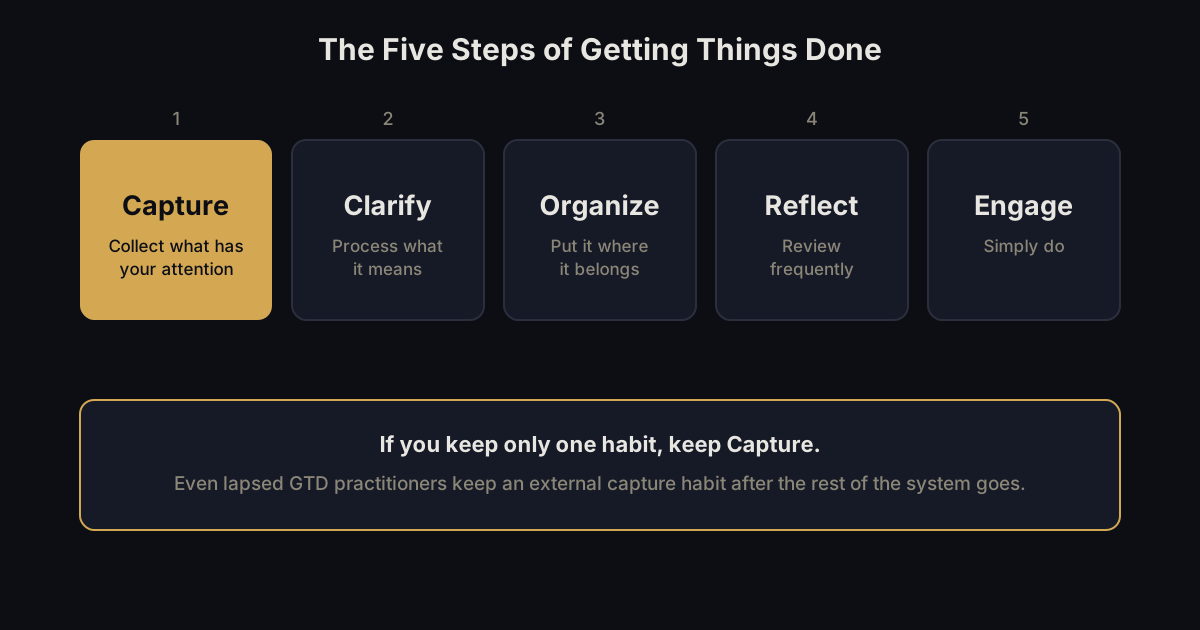
- Capture: "Collect what has your attention."
- Clarify: "Process what it means."
- Organize: "Put it where it belongs."
- Reflect: "Review frequently."
- Engage: "Simply do."
That is the whole method in five words. Everything else in GTD, the contexts, the next-action lists, the weekly review, is machinery built to support those five words. Learn them and you understand GTD; the books and courses mostly teach you how to run them consistently.
The five steps of GTD, explained
Capture: collect what has your attention
Capture means getting every task, idea, and half-formed worry out of your head and into a trusted place the moment it shows up, before you decide whether it matters yet. An open loop sitting in your head, an unpaid bill, a call you owe someone, a project you have not started, costs you attention whether or not you are actively thinking about it. Writing it down, typing it, or saying it out loud stops that cost immediately.
Clarify: decide what it means
Clarify is where you look at each captured item and decide what it actually requires: is it actionable, and if so, what is the very next physical action? Allen's own rule inside this step is the famous two-minute one: if the next action takes less than two minutes, do it right now instead of filing it. More on why that rule gets confused with a different one below.
Organize: put it where it belongs
Organize means giving every clarified item one specific home: a calendar entry if it has a date, a project list if it needs several steps, a context list such as calls or errands if it is a single next action, or a someday-maybe list if it is not a current priority. Which home matters less than that it has exactly one.
Reflect: review on a schedule
Reflect is the step most homemade systems quietly drop, and it is the one that keeps GTD from decaying into a pile of stale lists nobody trusts anymore. The ritual GTD calls the weekly review is where you look back over everything captured, clarified, and organized in the past week and bring the whole system current again.
Engage: simply do
Engage is choosing, in the moment, which next action to work on based on context, time available, energy, and priority, then doing it without re-deciding whether the system is right. This is the step where all the earlier setup pays off or does not: a working capture-clarify-organize routine should make Engage feel like picking from a short, honest list instead of guessing at everything you might be forgetting.
Why do people quit GTD?
People quit GTD for three documented reasons: the system starts out too complex, rigid adherence to it breaks under real life, and no productivity system can fix a workload that is simply too large. Cal Newport argued a version of this in his New Yorker essay "The Rise and Fall of Getting Things Done", and a long, detailed r/gtd thread reacting to that essay confirms it from the practitioner side, not just the critic's side.
The first failure mode is complexity at the start. In that thread, one commenter summarized it plainly: "GTD begins with an overly complex system." The commenters who stuck with GTD for years all describe the same fix: they "simplify that system" once the overhead stops paying for itself. One framed it as a standing rule for themselves: once a system "is giving you anxiety or isn't working, then it's time to break it down and rework it."
The second failure mode is dogmatism. Several commenters in the same thread warn against "methodological dogmatism," the trap of treating Allen's exact contexts, lists, and rituals as fixed rules instead of a starting template. Every long-term user in the thread was still using GTD years later only because they had modified it heavily: project lists instead of context lists, a kanban board instead of Allen's original folders, a hybrid built inside whatever app they already had open all day.
The third failure mode is the one Newport's essay actually argues: no organizing system can fix a workload too large for the hours available to do it in. One commenter reacting to the essay used a factory analogy: a worker who can build 100 toys a day but receives 110 a day fails no matter how organized the workstation is. "No system can do that."
Some commenters pushed back on Newport directly, arguing the essay had little to do with GTD specifically and should have been titled about personal productivity in general, and pointing out that his own proposed fix, morning task-board meetings, reinvents ideas from Agile and Scrum. That pushback matters too: GTD's own defenders exist in the same thread, arguing the method still works fine for people who apply it without turning it into a religion.
Another commenter, role-attributed here rather than quoted by any account name, compressed the whole critique into one line: "GTD is great as personal fire fighting equipment, but at some point we need to be asking, 'why is everything always on fire?'" That line is the honest summary of the whole section: a capture-and-organize system can only ever manage the fires. It cannot stop new ones from starting.
The one habit that survives: Capture
Across that same r/gtd thread, critics and lapsed GTDers who abandoned everything else about GTD all kept one habit: capturing into some kind of external brain. The arguments in the thread are entirely about the downstream machinery, contexts, weekly reviews, next-action lists, inbox zero, never about whether capturing your thoughts outside your head is worth doing at all. One commenter approvingly described a lapsed GTD user this way: they still "capture ideas" and "have an external brain," even though the rest of their system fell apart years earlier.
If you only keep one habit from GTD, keep Capture. It delivers most of the relief the whole system promises, with none of the maintenance burden that eventually breaks the other four steps. A capture habit does not need contexts, a weekly ritual, or a specific app; it needs one place you actually put things, and a fast enough way to get a thought there before it disappears.
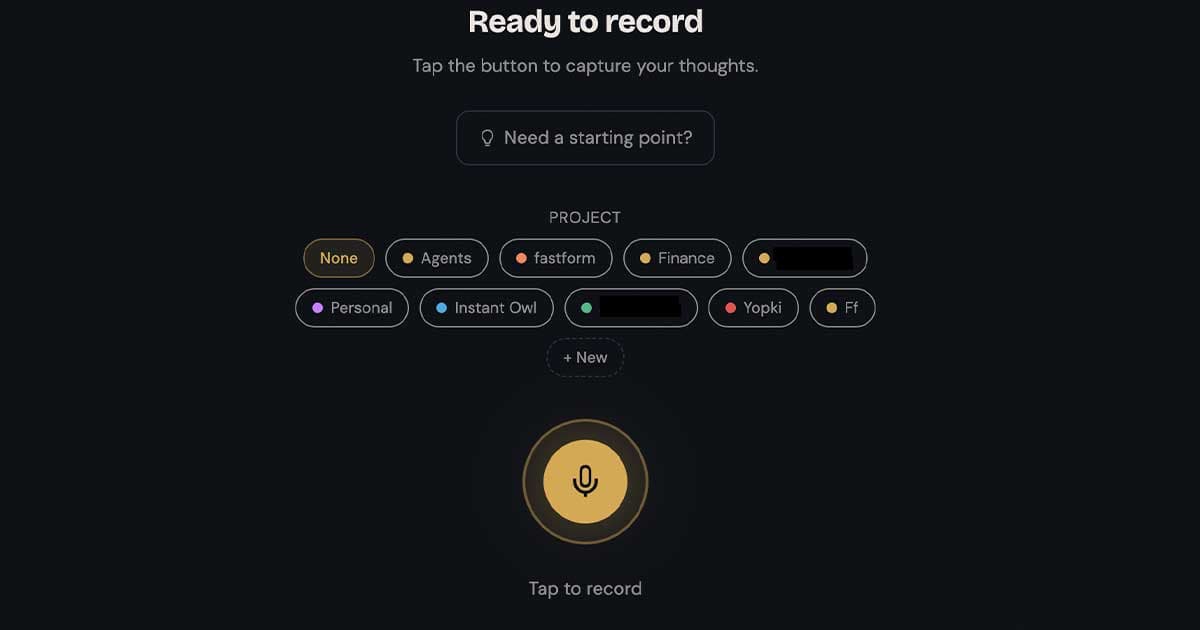
Full disclosure: InstantOwl is our product, and this blog belongs to it. Voice is the lowest-friction version of Capture there is: get everything out of your head in one pass by talking instead of typing, and InstantOwl turns the ramble into organized notes and tasks instead of a wall of transcript to sort through yourself.
If a whole capture system, not just a single recording, is what you are after, a fuller idea-capture system covers the destination and review habit that Capture alone does not solve, and turning a spoken ramble into a task list covers the same idea applied specifically to to-dos. InstantOwl is currently free to use.
The two-minute rule, disambiguated
GTD's two-minute rule and the popular two-minute rule from habit-building and ADHD content are not the same rule; they share a name and nothing else. Knowing which one someone means matters, because they tell you to do opposite things.
GTD's original two-minute rule lives inside the Clarify step: if the next action for something you just captured takes less than two minutes, do it right now instead of filing it for later. It is a rule about finishing small things immediately, so tiny tasks stop clogging a list built for bigger ones.
The habit-building version, popularized separately in productivity and ADHD content, says close to the opposite: start a big task for just two minutes to get past the resistance of beginning it, then stop or keep going, whichever happens. One rule is about finishing, the other is about starting. Why rigid systems like GTD often fight an ADHD brain covers this exact collision from the other side, including why the habit-building version tends to work better for that audience than GTD's original does.
What does "mind like water" mean in GTD?
"Mind like water" is Allen's own trademarked name for the state GTD is meant to produce: a mind that responds to whatever comes up with exactly the right amount of energy, neither overreacting nor underreacting, because nothing is being held onto that should have been captured already. It appears on Allen's official site only as a registered trademark, not as a passage available to quote, so treat it as the brand's name for the goal rather than a line to repeat verbatim.
Allen makes a related point about why the method matters at all: creativity, strategy, and simply being present do not require more time, they require space. Freeing that space, not finding more hours, is what Capture through Engage is actually for.
Frequently asked questions
What are the 5 steps of GTD?
The 5 steps of GTD are Capture, Clarify, Organize, Reflect, and Engage, described on David Allen's own site as Collect what has your attention, Process what it means, Put it where it belongs, Review frequently, and Simply do.
Is GTD still relevant?
Yes, with an honest caveat. A long r/gtd thread reacting to Cal Newport's New Yorker critique found the same three failure modes again and again, an overly complex start, dogmatic adherence, and a workload no system can shrink, but every practitioner in that thread who stayed with GTD in any form also kept its Capture habit.
What is the two-minute rule in GTD?
GTD's two-minute rule says that during the Clarify step, if a captured task's next action takes less than two minutes, you do it immediately instead of filing it, the opposite of the separate, popular two-minute rule that tells you to start a big task for just two minutes.
Do I need an app for GTD?
No. GTD is a set of steps, not a piece of software, so people run it with paper lists, plain notes apps, dedicated GTD apps, or a voice-based capture tool like InstantOwl, and the method works the same regardless of which container holds it.

Written by
Jim BreeseJim Breese is the founder of InstantOwl. He's spent 15 years building companies, from an Airbnb host community he founded and exited to growth leadership at venture-backed SaaS startups. He built InstantOwl because his best ideas kept arriving mid-walk, out of order, and half-finished.
Stop losing good ideas.
InstantOwl turns a rambling voice note into a clean, organized document in moments. Just talk. We'll organize it.
 Try InstantOwl free