The 1-3-5 Rule: One Big Thing, and Who Actually Invented It
By Jim Breese · · Updated

What is the 1-3-5 rule?
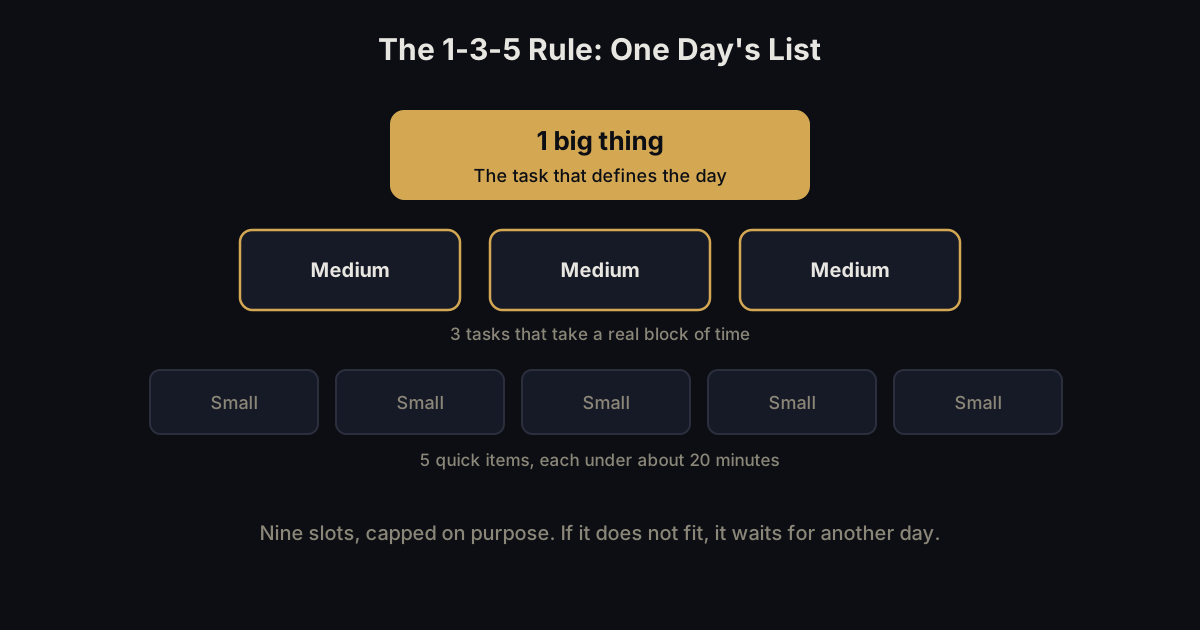
The 1-3-5 rule is a daily to-do list capped at nine tasks: one big task, three medium tasks, and five small tasks. You build the list before the day starts, work through it in order of size, and stop adding once all nine slots are full.
The numbers describe effort, not steps. A "big" task is not one that takes nine sub-steps to finish; it is the single item on your list that demands the most time or the most mental weight. The three mediums and five smalls fill in around it, from real work down to quick errands.
Here is the provenance most guides skip. The 1-3-5 rule is credited to Alex Cavoulacos, co-founder and president of The Muse, per The Muse's own article introducing the method. Todoist's guide to the rule credits her independently too, tying it to her book The New Rules of Work, co-written with Kathryn Minshew.
Betty Liu, an NYSE executive, is widely quoted saying she uses the list herself every day, which helped the rule spread. Several other top-ranking guides for this term never say who created it. That is not folklore with no clear source, the way some productivity legends are. It is a citable origin most pages simply leave out.
How do you run the 1-3-5 rule?
Build the list the night before, not the morning of. Write down exactly one big task, three medium tasks, and five small tasks for tomorrow, then stop, per Todoist's guide to the method. The original version from The Muse allows flexibility: cut the count on a meeting-heavy day, and it is fine to leave a medium or small slot open for whatever the day brings.
Sizing the nine tasks, not doing them, is the part people actually struggle with. A widely upvoted comment on a large productivity forum thread about the method put it plainly: "Sometimes it's even harder to get decided which is 'big', 'medium', 'small' than doing the task itself." That comment sits above 90 points and is the top reply in its thread, which tells you the sizing problem is common, not a sign you are doing the method wrong.
Use time as your first guide. Per Todoist's guide, a big task runs about 2 to 4 hours, a medium task runs 30 to 60 minutes, and a small task takes 5 to 15 minutes. When time alone does not settle it, size by dread instead.
Productivity coach Grace Marshall, quoted in HuffPost's coverage of the method, offers this test: "Does this feel like an intense piece of mental or emotional heavy lifting? Then that's your big thing." The task you keep avoiding is usually the real "1," even if it would not take the longest on a stopwatch.
Interruptions get traded, not stacked on top. If an urgent task lands mid-day, swap it for a planned task of roughly the same size instead of adding a tenth item, an approach one commenter in the same thread described using. The nine slots stay nine; what fills them can change.
The counts are a ceiling, not a quota. If your day genuinely has six real tasks instead of nine, stop at six. Coaches quoted in HuffPost's piece endorse variations like 1-2-3 or 1-1-5 on lighter days, adjusted weekly rather than forced to fit every day equally.
Worth saying plainly: no peer-reviewed study has tested the 1-3-5 rule directly. It is a structuring habit, not a clinical finding, and every source agrees on that by omission, since none of them cites one.
A worked example day
Say you run a small consulting practice and tomorrow is launch week for a client project. Your 1-3-5 list might look like this:
1 big: Finish the client's launch deck (2 to 4 hours of focused writing and design).
3 medium: Record a walkthrough video for the deck (45 minutes). Draft the follow-up email sequence (an hour). Review the contractor's first invoice (30 minutes).
5 small: Reply to the two outstanding client emails (10 minutes). Book the dentist appointment you have been putting off (5 minutes). Order more business cards (10 minutes). Confirm tomorrow's call time with the client (5 minutes). Pay the software renewal that is due this week (10 minutes).
Notice the shape: the big task gets a real block of the morning before anything else competes for it, the same hardest-thing-first logic behind eating the frog, the mediums are true work but bounded, and the smalls clear the small stuff that otherwise nags at you all day without ever needing focus.
Does the 1-3-5 rule work for ADHD?
It can help with parts of ADHD planning, but it is not a treatment and should not be framed as one. The clearest source on this is a clinician-reviewed piece on infocusfirst.com, written by a board-certified psychiatric nurse practitioner and reviewed by a psychiatrist. Its own framing is worth repeating exactly: "For some people, the 1-3-5 rule can be a helpful framework. For others, it falls short."
What it says the rule can help with, as a behavioral tool: task initiation, decision fatigue, the paralysis a long overwhelming list can cause, and the mental load of prioritizing. What it says the rule cannot do: address root causes, fix brain fog, ease emotional dysregulation, or account for inconsistent focus across the day. It also warns that rigid adherence "can increase guilt when it 'doesn't work,'" since the method assumes steady daily energy, which an ADHD brain does not reliably have.
The piece's own classification is the one worth carrying forward: the 1-3-5 rule is "a behavioral strategy, not a medical or diagnostic framework," and "not a clinically validated ADHD treatment." Suggested adaptations from the same source: pair it with timed work blocks, batch the five small tasks into one sitting instead of scattering them, use body doubling, break the big task into smaller pieces, and flex the counts with whatever energy the day actually brings. For a fuller look at why standard productivity advice misses the ADHD brain, see ADHD productivity.
Where does the list actually come from?
Every guide to the 1-3-5 rule assumes a list already exists in front of you, ready to sort into nine slots. None of them cover how that list gets out of your head in the first place. That capture step, done the night before, is the part that actually determines whether tomorrow's nine tasks are the right nine.
Talking through tomorrow's plan is faster than typing it into a task app, and it is what InstantOwl is built for. Full disclosure: InstantOwl is our product, and this blog belongs to it. Say what is on your plate the way you would tell a friend, and InstantOwl extracts the action items automatically, up to 25 per recording, with any spoken due date like "by Friday" resolved to a real date.
From there, a saved custom output type (Settings, then Custom Outputs) can be built to sort your ramble directly into a 1-3-5 shape: instructed to pick one big task, three medium, five small, and label everything left over as "not today." That last bin, a place for the tasks that do not make today's cut without losing them, is the anti-overwhelm piece a plain task app rarely hands you from a spoken list. Each task with a due date gets its own Calendar (.ics) download; there is no live calendar sync. InstantOwl is currently free to use.
For the fuller picture of getting a day planned well beyond just today's nine tasks, see how to plan your day. For where a captured task lives once it is out of your head, see task management.
If sizing by urgency and importance interests you more than sizing by effort, the Eisenhower matrix sorts the same kind of list a different way.
Related reading
- How to plan your day: the capture-first, buffer-included approach the 1-3-5 rule's evening list-building fits inside.
- Task management: where a captured task lives once it is out of your head and ready to size.
- The Eisenhower matrix: sorting by urgency and importance instead of by size.
- ADHD productivity: why standard planning advice, including rigid daily counts, often needs adapting for an ADHD brain.
Frequently asked questions
What is the 1-3-5 rule?
The 1-3-5 rule is a daily to-do list method: pick one big task, three medium tasks, and five small tasks, nine items total, for a single day. The numbers describe effort and time, not the number of steps inside each task.
Who invented the 1-3-5 rule?
Alex Cavoulacos, co-founder and president of The Muse, created the 1-3-5 rule, according to The Muse's own article introducing it and Todoist's independent guide, which ties it to her book The New Rules of Work, co-written with Kathryn Minshew.
Does the 1-3-5 rule work for ADHD?
It can help with task initiation and decision fatigue for some ADHD adults, according to a clinician-reviewed piece on the method by a board-certified psychiatric nurse practitioner, but the same piece calls it a behavioral strategy, not a medical or diagnostic framework, and not a clinically validated ADHD treatment.
What counts as a big task versus a medium task?
A big task runs roughly 2 to 4 hours or is the task you would most dread starting. A medium task runs about 30 to 60 minutes. A small task takes 5 to 15 minutes. When the size is unclear, size it by how much you would dread starting it, not by how long it takes.

Written by
Jim BreeseJim Breese is the founder of InstantOwl. He's spent 15 years building companies, from an Airbnb host community he founded and exited to growth leadership at venture-backed SaaS startups. He built InstantOwl because his best ideas kept arriving mid-walk, out of order, and half-finished.
Stop losing good ideas.
InstantOwl turns a rambling voice note into a clean, organized document in moments. Just talk. We'll organize it.
 Try InstantOwl free