The Eisenhower Matrix: The Four Quadrants, and Who Actually Invented It
By Jim Breese · · Updated

What is the Eisenhower Matrix?
The Eisenhower Matrix is a tool for sorting a task list by two questions: how urgent is this, and how important is this. Per Columbia University's guide, it is "a productivity, prioritization, and time-management tool designed to help you prioritize a list of tasks by categorizing them according to their urgency and importance." The same tool also goes by Eisenhower Decision Matrix, Eisenhower Box, or Urgent-Important Matrix, all names for the same four-box layout.
Urgent and important are not the same thing, and mixing them up is the whole reason most to-do lists fail. Per Columbia's guide, an urgent task requires immediate attention and has a clear consequence if you miss the window: an assignment due tonight, an emergency, studying for tomorrow's exam. An important task does not demand immediate attention but moves you toward a long-term goal and usually takes real planning: reviewing lecture notes, exercising, planning a project due in three months.
Most task lists treat every item the same, one flat column from top to bottom. The Eisenhower Matrix forces a second dimension. A task can be loud (urgent) without being valuable (important), and the reverse is just as common. Separating the two questions is what makes the four boxes below useful instead of decorative.
The four quadrants
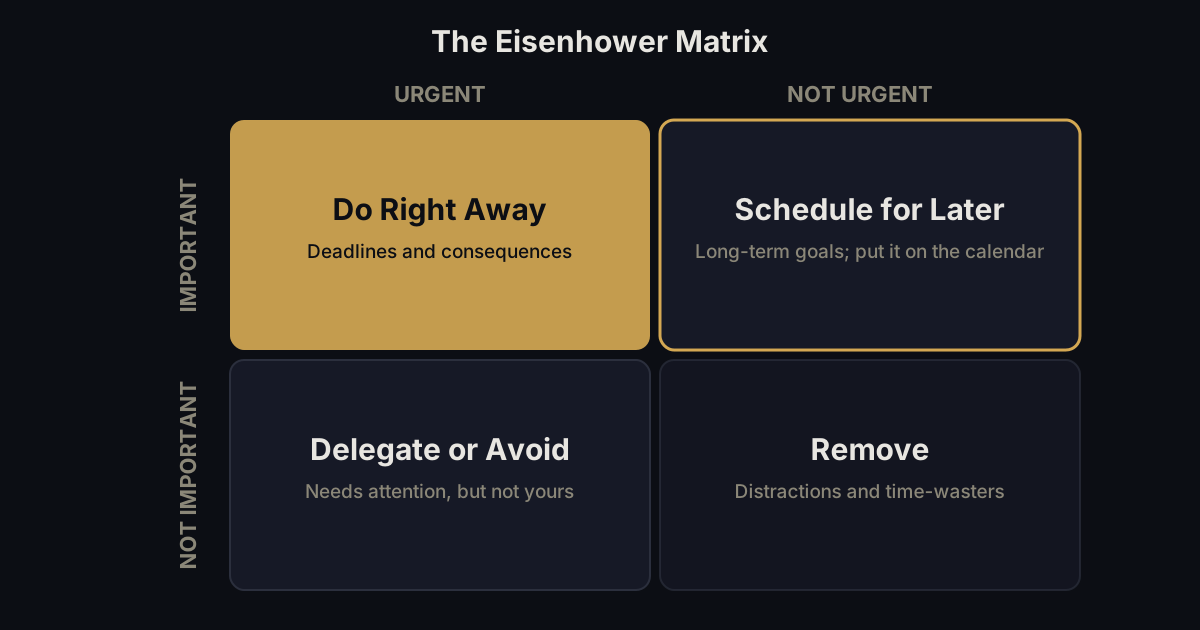
Label the four boxes by what they mean, not by "quadrant 1" through "quadrant 4." Columbia's own guide uses two different numbering systems for its list and its grid, so a bare number is exactly the kind of thing that gets misread. Traits are not.
Urgent and Important: Do Right Away. Per Columbia, these are "tasks with deadlines or consequences." Complete them as soon as possible. This is the box everyone already lives in, whether they planned to or not.
Important and Not Urgent: Schedule for Later. These are the tasks that "contribute to long-term success" but carry no hard deadline yet, per Columbia's guide. Put them on the calendar with a specific time, not on a list you keep meaning to get to. Columbia's guide calls this box key to academic success for students specifically, and the same logic holds for anyone with a job: the biggest wins live here, not in the urgent box. This is also the box where deep work lives, the demanding, no-deadline work that only happens if it gets a protected slot.
Urgent and Not Important: Delegate or Avoid. Per Columbia, this box covers tasks "that require your attention, but do not have deadlines or consequences" tied to your own goals: a co-worker's request, an unexpected interruption, a favor. Hand it to someone with the right skillset, or decline it. The trap here is treating urgency alone as a reason to drop everything.
Neither Urgent Nor Important: Remove. Per Columbia's guide, these are "unnecessary tasks, distractions, and time-wasters" that "get in the way of accomplishing your goals." Take them off the list entirely rather than letting them sit there unfinished.
A popular explainer site renders the same four boxes with shorter, more casual labels: Do first, Schedule, Delegate, and Don't do. The substance is identical to Columbia's version; only the wording is more clipped. Either set of labels sorts the same task the same way.
Who actually invented it (the part most explainers skip)
Here is the honest version, and it is more interesting than the shorthand everyone repeats. Per Columbia's guide, "the name was coined by Stephen Covey, the author of The 7 Habits of Highly Effective People, who took inspiration from a speech given by Dwight D. Eisenhower, the 34th President of the United States." Eisenhower did not name a matrix and did not build a four-box tool. Covey did, years later.
What Eisenhower actually did, per Columbia, was quote someone else. Columbia's guide states that "Eisenhower quoted an unknown university president during a speech," delivering a line about urgent and important problems. That is the detail almost every quick explainer leaves out: the famous line was never Eisenhower's own idea in the first place, by his own account in the speech.
The line itself is usually rendered as some version of "I have two kinds of problems: the urgent and the important. The urgent are not important, and the important are never urgent." That is the common phrasing you will see repeated across the web.
Columbia's printed guide captures it slightly differently, quoting Eisenhower as saying "I have two kinds of problems: the urgent, and the unimportant. The urgent are not important, and the important are never urgent." Treat the exact wording as slightly unsettled between sources, but the structure of the idea, urgent and important pull in opposite directions, is consistent everywhere it appears.
So the chain runs: an unnamed university president said something like this first, Eisenhower quoted it in a speech without claiming it as his own, and Covey later built a named framework around it and attached Eisenhower's name to the result. A popular explainer site skips straight past this and states plainly that Eisenhower "invented" the principle, with no mention of Covey or the borrowed quote. That framing is common, and it is not accurate. The tool you are using was named after a president who was, by the clearest documented account, quoting somebody else.
Step zero: capture first
Both sourced guides quietly assume something before you ever draw four boxes: a complete list of tasks already sitting in front of you. Columbia's guide walks through what to do "once your Eisenhower Matrix is filled in." A popular explainer site opens with the idea that putting to-dos on a list frees your mind. Neither one addresses how that list gets built in the first place.
You cannot sort tasks you never captured. If half your to-dos are still floating around in your head, on sticky notes, and in half-remembered conversations, the matrix has nothing real to sort. The step that comes before urgent-versus-important is getting everything out of your head and into one place, which is exactly what a brain dump does: capture everything first, with no sorting while you go, then organize second.
This is the gap InstantOwl fills. Full disclosure: InstantOwl is our product, and this blog belongs to it. Talk through everything on your plate, in whatever order it comes out, and InstantOwl turns the ramble into a structured task list you can then run through the four quadrants above. It is not a scheduling tool and does not compete with the matrix itself; it is the capture layer that has to happen before any prioritization framework has something real to work with. InstantOwl is currently free to use.
For a deeper look at building and organizing that first list, our task management piece covers the piece most guides skip: what happens before a task is ready to be tracked at all.
Using it well
Cap each quadrant instead of letting it grow forever. Columbia's guide recommends no more than 10 tasks per quadrant; a popular explainer site recommends a tighter cap of 8. The two sources disagree on the exact number, but they agree on the principle: an uncapped quadrant just becomes another unsorted pile, which defeats the point of sorting in the first place.
The Important and Not Urgent quadrant is where the real leverage sits, and both sourced guides point to it directly. Columbia calls it key to academic success for students. A popular explainer site puts it more broadly: professional time managers "leave fewer things unplanned and therefore try to manage most of their work in the second quadrant." The urgent box gets done regardless because it has to be. The important-but-not-urgent box only gets done if you protect time for it on purpose.
One list or several is a real preference, not a fixed rule. A popular explainer site recommends maintaining a single combined list for both business and private tasks. Columbia's guide allows separate matrices for work, school, and personal tasks. Neither is wrong. Pick whichever keeps you actually using the tool; a system you abandon inside a week does not help you regardless of which structure it uses.
Columbia's guide includes a student example matrix worth borrowing as a template. Do Right Away: homework due at 11:59pm tonight, a take-home exam due tomorrow. Schedule for Later: reviewing lecture notes, exercising, planning a project due in three months. Delegate or Avoid: responding to emails and phone calls, unexpected interruptions, doing a favor for someone. Remove: social media, unnecessary meetings, long video calls, binge-watching. Swap in your own tasks and the shape of the exercise holds for almost any week.
Tools
The Eisenhower Matrix does not require software. A blank page divided into four boxes, or Columbia's own printable template, does the job exactly as well as an app. Paper also removes any temptation to keep tweaking the layout instead of actually sorting tasks.
If you want it built into a task app you already use, TickTick lists an Eisenhower matrix feature on its features page, verified directly against the tool's own listing. Once a task list has been sorted into the four boxes, the natural next step is putting the tasks in Do Right Away and Schedule for Later onto an actual calendar, which is what time-blocking does with whatever the matrix hands it.
Whichever tool you pick, the matrix itself stays the same four questions asked of every task: is it urgent, is it important, and which box does that combination put it in. The paper version and the app version sort identically. The only real variable is whether the list you feed it was ever actually complete.
Related reading
- What is a brain dump: the capture step that has to happen before any sorting framework has a real list to work with.
- Task management: what happens before a task is ready to be tracked at all.
- Time blocking: putting sorted tasks onto an actual calendar once the matrix has ranked them.
Frequently asked questions
What are the 4 quadrants of the Eisenhower Matrix?
Urgent and Important (Do Right Away, tasks with deadlines or real consequences), Important and Not Urgent (Schedule for Later, the long-term work with no immediate deadline), Urgent and Not Important (Delegate or Avoid, tasks that demand attention but do not move your goals), and Neither Urgent Nor Important (Remove, distractions and time-wasters), per Columbia University's guide to the tool.
Did Eisenhower invent the Eisenhower Matrix?
No. Per Columbia University's guide, Stephen Covey coined the name Eisenhower Matrix. Eisenhower himself was quoting an unnamed university president when he gave a speech about urgent versus important problems. The matrix as a named tool came from Covey, built around a line Eisenhower borrowed rather than coined.
What is the difference between urgent and important?
Urgent tasks demand immediate attention and carry a clear consequence if you miss the window, like a deadline tonight or an emergency. Important tasks move you toward a long-term goal but have no immediate deadline, like reviewing notes or planning a project due in three months, per Columbia's definitions.
How many tasks should go in each quadrant?
Cap it. Columbia's guide recommends no more than 10 tasks per quadrant; a popular explainer site recommends capping at 8. The exact number matters less than having one, since an uncapped quadrant just becomes another unsorted list.

Written by
Jim BreeseJim Breese is the founder of InstantOwl. He's spent 15 years building companies, from an Airbnb host community he founded and exited to growth leadership at venture-backed SaaS startups. He built InstantOwl because his best ideas kept arriving mid-walk, out of order, and half-finished.
Stop losing good ideas.
InstantOwl turns a rambling voice note into a clean, organized document in moments. Just talk. We'll organize it.
 Try InstantOwl free