Deep Work: What It Is and How to Actually Do It (Even If You're Easily Distracted)
By Jim Breese ·
What is deep work?
Deep work is the act of focusing without distraction on a cognitively demanding task, in Cal Newport's own short definition of the term he coined. Newport is a computer science professor and author who introduced the phrase in a 2012 blog post, then expanded it into the 2016 book Deep Work: Rules for Focused Success in a Distracted World.
The book's fuller definition describes deep work as professional activity performed in a state of distraction-free concentration, pushed to the edge of your current cognitive ability. Efforts like this create new value, sharpen your skill, and are hard for anyone else to copy. That last part is the underrated piece: deep work is valuable partly because it is difficult to do, so most people avoid it.
Newport contrasts deep work with what he calls shallow work: logistical, low-cognitive-demand tasks that can be done while distracted, that create little new value, and that are easy for someone else to replicate. Email, status updates, and routine scheduling are shallow work. None of that is a judgment on the tasks themselves. Shallow work has to happen. The problem is when it quietly eats every hour that could have gone to something deeper.
If you are the kind of person whose mind generates ideas faster than any single task can hold your attention, deep work is not about becoming a different, more disciplined person. It is about protecting small, defended stretches of time where your full attention actually lands on one thing.
The first half of Newport's book argues what he calls the Deep Work Hypothesis: that the ability to focus without distraction on hard things is becoming both rarer and more valuable as the rest of the working world gets noisier. The rarity is the point. If most people are losing the ability to sustain deep focus, the people who protect it stand out, not because they work more hours, but because more of their hours actually count.
Deep work vs. shallow work
The fastest way to tell the two apart is to ask whether the task creates new value and whether someone else could do it just as easily while half-distracted.
| Deep work | Shallow work | |
|---|---|---|
| Cognitive demand | High, near your limit | Low |
| Can be done while distracted | No | Yes |
| Creates new value | Yes | Rarely |
| Easy to replicate | No | Yes |
| Typical examples | Writing, coding, designing, studying | Email, scheduling, routine admin |
Most jobs are a mix of both. The goal is not to eliminate shallow work, which is usually impossible, but to stop letting it fill every available hour by default.
What are Cal Newport's four rules of deep work?
Newport's book is split into two parts: the first argues why deep work matters, and the second, called "the rules," lays out four strategies for actually doing it. Here they are by name, attributed to the book, with a plain-language sense of what each one is aiming at rather than a quote from the text:
- Work deeply. Build a routine and a ritual around your focus time instead of relying on willpower to summon it fresh every day.
- Embrace boredom. Practice tolerating downtime without reaching for your phone, so your brain does not default to craving a distraction the moment a task gets hard.
- Quit social media. Audit which tools and platforms are actually earning your time, rather than keeping all of them by default.
- Drain the shallows. Cap and schedule the low-value logistical work on purpose, so it stops expanding to fill the hours meant for something deeper.
None of these are quick fixes. They are closer to a set of habits Newport built his own working life around, described at the level of a rule you can adapt rather than a script you follow line by line. The common thread across all four is that they replace in-the-moment willpower with a standing decision made in advance, since deciding whether to focus fresh every single time is exhausting in a way that following a routine is not.
Why does deep work feel so hard if your mind won't sit still?
It feels hard because a fast, idea-generating mind is not broken, it is just running a process built for volume rather than depth. Left alone, that kind of mind treats every new thought as worth chasing right now, which is useful for generating ideas and terrible for finishing any one of them.
The fix is not to quiet the mind down permanently. It is to give the extra thoughts somewhere to go that is not the task in front of you, so they stop competing for the same attention. That reframe matters: the obstacle is a capture problem, not a character flaw, and capture problems have practical fixes.
None of the scaffolding below is about forcing more discipline out of yourself. It is about lowering the number of decisions and open loops competing for the same attention a hard task needs, so the task actually gets a fair share of it.
How many hours of deep work can you actually do in a day?
Less than most people expect, and that is worth saying plainly. Even people who have spent years building the habit commonly report sustaining only a few hours of genuine deep work in a single day, often cited as up to around four hours at the very top end.
This is not a number Newport prints as a guarantee, and no one should treat it as a hard target to hit on day one. It is the practical ceiling reported by people who have tracked their own focus over time. Beginners should expect meaningfully less at first, sometimes as little as thirty or sixty minutes of real depth in a session.
That ceiling is a relief, not a disappointment. If four hours is close to the maximum for someone who has practiced this for years, one solid ninety-minute block on a normal day is already a real result, not a shortfall.
How do you do deep work if you can't focus?
This is the actual question for a distractible mind, and the honest answer is scaffolding, not discipline. None of the following requires becoming a calmer or more focused person first.
Schedule it instead of waiting to feel ready. A block that only exists if motivation shows up rarely happens. Put a specific window on the calendar, even a short one, the same way you would for a meeting you cannot skip. Time blocking as a broader scheduling habit is worth its own look if this clicks for you.
Start smaller than feels reasonable. Ten or fifteen minutes beats a two-hour block you keep postponing because it feels too big to start. A short session you actually finish builds the habit faster than a long one you keep skipping.
Take your phone out of the room, not just off the desk. Proximity matters more than silence mode. A phone within reach, even face down, still pulls at attention. Put it somewhere you would have to get up and walk to reach it.
Protect one block, not the whole day. Trying to make an entire day distraction-free is how this usually falls apart. Defend one window well instead of defending eight hours poorly.
Build a short shutdown ritual to close the loop. A minute of noting where you stopped and what comes next, at the end of a block, keeps your mind from replaying unfinished work later. That closing step is what makes it safe to actually stop.
Pick a fixed starting cue instead of waiting to feel focused. Same chair, same drink, same first three minutes every time. Waiting to feel ready before starting is one of the most reliable ways a block never starts at all; a repeated cue lets your brain skip that negotiation.
Missing a day does not undo the habit. A distractible mind that skips a block is not back at zero, it is exactly where it was, one block behind. The only version of this that actually fails is the one where a missed day turns into a reason to quit trying altogether.
Deep work and monotasking are close cousins. Monotasking is giving your full attention to one thing at a time in general; deep work is that same idea applied to your hardest, highest-value task specifically. And once a task's difficulty matches your skill closely enough that time seems to disappear, that is the on-ramp into what researchers call flow state, the state deep work is often trying to reach.
Here is the part that trips up a fast, restless mind more than anything else: the moment you sit down to focus, five unrelated thoughts surface at once, an idea for another project, something you forgot to reply to, a worry that has nothing to do with the work in front of you. Chasing them breaks the block. Suppressing them rarely works either; they just keep resurfacing.
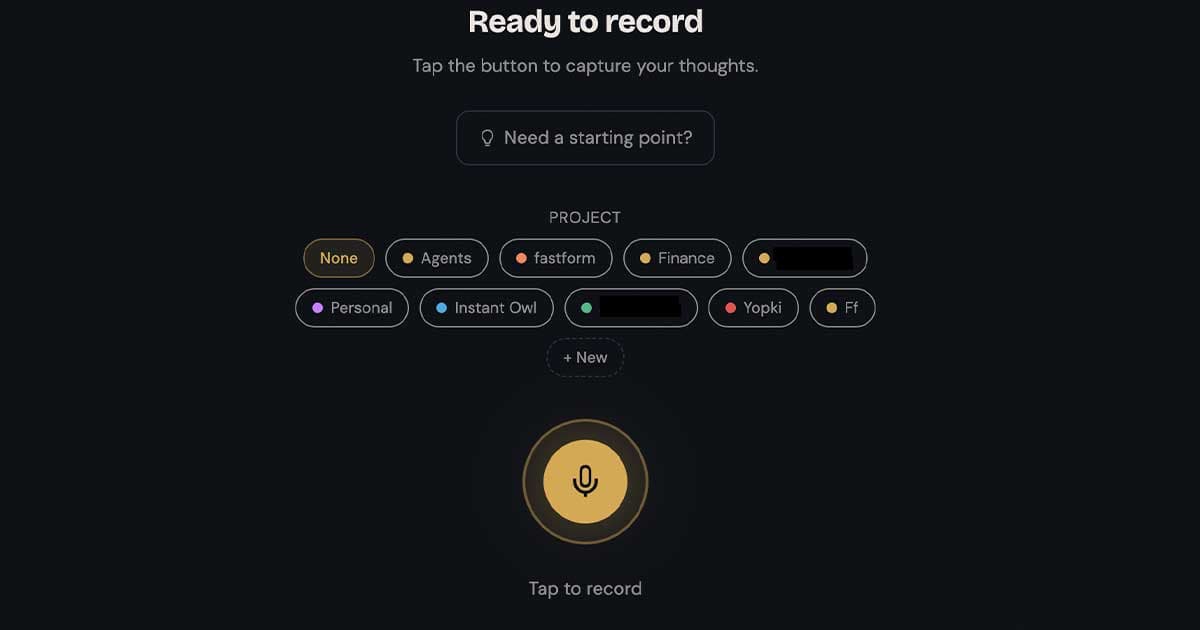
The honest fix is to get them out of your head before you fight to ignore them. A quick brain dump, spoken or written, moves the thought somewhere safe so your mind stops rehearsing it mid-task. That is the specific gap InstantOwl is built for: you say the stray thought out loud for ten seconds, it is captured and organized on its own, and you go back to the block without carrying it. It is a free feature you can use for exactly this, not a requirement for doing deep work at all, just a fast way to clear the noise that is actually in the way.
What are examples of deep work?
Deep work covers any task that is cognitively demanding, done without distraction, and hard for someone else to replicate. Two people can do the identical activity and only one of them is doing deep work, depending on whether their attention is actually undivided.
| Deep work examples | Shallow work examples |
|---|---|
| Writing a first draft | Answering email |
| Coding a feature | Updating a shared calendar |
| Studying a hard subject | Filing routine paperwork |
| Designing from a blank page | Sitting in a status meeting |
| Close reading for understanding | Scheduling logistics |
Shallow work matters and needs to get done. It just does not require, or reward, undistracted concentration the way deep work does, which is why it is the first thing worth batching or capping so it stops crowding out the deeper hours.
None of this requires an all-or-nothing overhaul of how you work. Most days will still be mostly shallow, and that is fine. The goal is a defended pocket of real depth, not a complete redesign of your calendar.
Frequently asked questions
What is meant by deep work?
Deep work means focusing without distraction on a cognitively demanding task, the definition Cal Newport uses on his own site. His 2016 book adds that these are professional efforts performed in distraction-free concentration that push your abilities to their limit, create new value, and are hard for anyone else to replicate.
How many hours of deep work per day?
Less than most people assume. Even experienced practitioners commonly report sustaining only a few hours of true deep work in a day, often cited as up to around four hours at the top end. Beginners should expect much less at first, and that is normal, not a failure.
What are examples of deep work?
Writing, coding, studying a hard subject, designing something from scratch, and close reading are common examples. What makes them deep work is not the activity itself but the state you do it in: single-tasked, undistracted, and pushed to the edge of your current skill.
How do you start deep work if you can't focus?
Start smaller than feels reasonable, ten or fifteen minutes, not two hours. Put your phone in another room, protect one block instead of the whole day, and get the stray thoughts competing for your attention out of your head first, by writing or saying them, so they stop pulling at you mid-task.

Written by
Jim BreeseJim Breese is the founder of InstantOwl. He's spent 15 years building companies, from an Airbnb host community he founded and exited to growth leadership at venture-backed SaaS startups. He built InstantOwl because his best ideas kept arriving mid-walk, out of order, and half-finished.
Stop losing good ideas.
InstantOwl turns a rambling voice note into a clean, organized document in moments. Just talk. We'll organize it.
 Try InstantOwl free