How to Plan Your Day (When the Plan Never Survives the Day)
By Jim Breese · · Updated
How do you plan your day?
You plan your day by getting everything out of your head first, picking three priorities instead of a full schedule, and building in buffer before you trust any time estimate. That pattern recurs across a long r/productivity thread on daily planning: capture first, choose a small number of priorities, then protect time for them instead of listing everything you might possibly do.
The thread's most detailed reply lays out a full sequence: pick one to-do app, write down "every single thing on your mind" in a 15-minute minimum session, then choose three to six items for today and write those on paper or a sticky note. The same commenter added a rule for stuck tasks: anything untouched for two days gets broken into two or three smaller tasks instead of sitting whole.
A small number of priorities beats an exhaustive list, per several other replies in the same thread. One put it directly: "Pick three priorities, do them, instead of 9472629485 things. The rest will fall into place." Another described a lighter version: list the big three, finish those, then add more only if there is time left. A third commenter's version aims higher, starting around nine tasks and expecting to land closer to six.
Two supporting habits showed up often without being the main system. Several commenters said they tackle the task they have been avoiding first thing, essentially eating the frog without naming it that way. Others treat a daily email inbox clean-out as a second to-do list, reviewing a broader digital list to decide what makes the shorter paper list each day.
A handful of commenters added accountability on top of the list itself: posting the day's plan to a small Discord of trusted friends, or booking blocked time through Focusmate so someone else is expecting to see them working. Neither replaces the plan, but both make it harder to quietly drop it partway through the day.
Why does the plan never survive the day?
Because a time block gets treated as a promise a task will finish inside it, when it is really just the amount of time you decided to give that task. The original poster in the same r/productivity thread named this exact gap: plans built to save decision-making energy fall apart because "what I do might take longer than expected."
Several replies reframed the fix directly. One commenter put it this way: "The key is not to say 'I'm blocking this time so I will finish this thing' but to block it saying 'this is the amount of time I will devote to it.'" That single reframe turns a broken plan back into a working one, since the block did its job the moment the time was spent, whether or not the task closed out.
Buffer was the second repeated fix. One reply described it plainly: "Time blocking. Generally about 2 hour chunks. Then I leave room next to it in the notebook for any needed improvisations." Another added buffer as its own separate habit: "Time blocking while also leaving some buffering time just in case!" A third commenter normalized the underlying problem: "People are terrible at estimating effort, you're not alone in this," and suggested tracking actual time spent for a stretch instead of guessing forever.
A different reply reframed the whole goal. If the point of planning is saving decision-making energy, that commenter argued, routines do more of that work than a detailed plan ever will: a fixed morning routine, a repeated evening wind-down, meal prep, even a set uniform. None of that requires deciding anything fresh each day, which heads off decision fatigue at the source, a different kind of relief than a tightly scheduled task list provides.
The thread's overall mood was skeptical of any single system claiming to work for everyone. One reply summed it up directly: "There isn't one best productivity method that works for everyone... take that experience over what someone writes online." In practice, that showed up as looser formats too, an ordered list or rough morning, afternoon, and evening sections instead of an hour-by-hour schedule.
Should you plan the night before or in the morning?
Either works. Todoist's guide to daily planning frames the choice honestly: run a 10 to 15 minute session, first thing in the morning or as an end-of-day shutdown ritual, whichever attaches more naturally to a habit you already have, like making coffee or closing your laptop. Attaching a new routine to one you already do without thinking is habit stacking in its simplest form.
The community thread shows both patterns in real use, without settling on one. Morning planning was the visible default: one commenter described opening a calendar first thing to figure out the day's blocks. Night-before planning showed up too, mostly through people who build a short daily list from a longer master list reviewed the evening before. Neither pattern read as a clear majority in the thread, so this is a personal-fit choice, not a rule to follow.
Two numbers from Todoist's guide are worth borrowing regardless of when you plan. Cap concurrent goals at five so a plan does not sprawl past what a day can hold, and aim for five to seven significant tasks across a full week rather than trying to make every single day equally heavy. For the estimation problem itself, Todoist's guide is blunt: double your first time estimate before you block it in, since most people guess low the first time.
Todoist's guide also frames the day around one marked priority rather than a flat list: pick a single daily highlight before anything else and mark it visibly, then treat everything else as secondary. It ties that daily pick back to a weekly sketch done on Sunday or Monday, so a goal-linked task gets scheduled before mandatory commitments crowd the day out entirely.
For the method itself, the same guide names four options rather than one: eating the hardest task first, a 25-minute Pomodoro sprint, time blocking with doubled estimates, or an Eisenhower matrix sorted into do, schedule, delegate, and delete. None is presented as the correct one. The guide's own advice is to pick whichever fits how you actually work, and change it the moment it stops working.
Where does the plan actually start?
The plan starts before any list or calendar block, with getting every task out of your head. A daily plan that opens with today's calendar already skipped a step, and skipping it is why an organized-looking plan can still miss half of what is actually pulling at your attention.
The r/productivity thread's most detailed commenter puts the head-clearing step first, before any app-organizing happens: get everything written down, unedited, and only then choose today's three to six items. What a brain dump actually is covers this exact move in more depth: capture everything first, sort second, never at the same time.
Once a task is captured, it still needs somewhere you will actually look at it again. Task management covers where a personal task app fits once the head-empty step is done and you are deciding what actually holds the day's list.
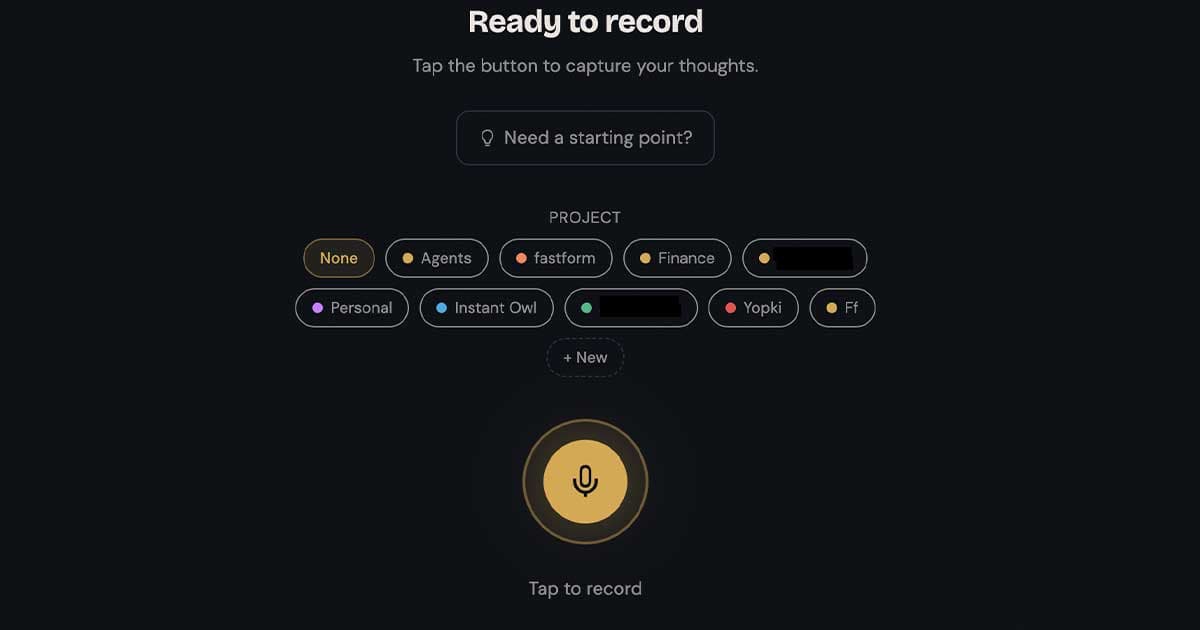
Saying a task out loud is faster than typing it into any app, which is the reason InstantOwl exists. Full disclosure: InstantOwl is our product, and this blog belongs to it. Talk through what is on your plate for the day, and get back a sorted list instead of a wall of things you still have to type in one at a time yourself. InstantOwl is currently free to use.
What method should you actually use for the rest of the day?
No single method wins here. Time blocking with buffer, a regular weekly zoom-out, and adjustments for a mind that does not work the way standard advice assumes are the three worth layering together, rather than picking just one and hoping it holds.
Time blocking was the most repeated method in the community thread, and every mention of it came paired with a buffer. Time blocking covers how to size blocks in practice and where the two-hour default the thread describes actually comes from.
A daily plan built without a weekly view tends to drift, which is why Todoist frames daily planning as partly a weekly exercise: sketch the week on Sunday or Monday, then let each day's plan pull from that instead of starting from zero. The weekly review covers a fuller version of that same zoom-out.
For a mind where the standard advice above does not land the way it is supposed to, the three-priorities and buffer advice still applies, it just needs different scaffolding around it. ADHD productivity covers why standard planning advice fails for a brain running on interest and urgency rather than a clean daily list, and what to layer on top instead.
One habit is worth borrowing regardless of method. When the day goes sideways, revise the plan on purpose instead of letting unplanned work quietly stack on top of the old one, and aim to end the day with every task either done or explicitly rescheduled, not just abandoned in place. That single habit is what keeps a broken plan from turning into a pile of silent carryover the next morning.
Related reading
- What a brain dump actually is: the capture step a daily plan depends on, done before you pick today's three priorities.
- Task management: where a captured task actually lives once the head-empty step is done.
- Time blocking: how to size blocks with buffer, so a plan bends instead of breaking.
- ADHD productivity: why standard daily-planning advice fails for a brain running on interest and urgency, and what works instead.
Frequently asked questions
How do I plan my day effectively?
Capture every task out of your head first, then pick three priorities instead of a full schedule, and give each one more time than you think it needs. A long r/productivity thread on planning converges on exactly this order: capture, choose a small number of priorities, then protect time with buffer built in.
Should I plan my day the night before?
Either works. Todoist's guide to daily planning frames it as a choice: plan first thing in the morning or as an end-of-day shutdown ritual, whichever fits an existing habit. Community discussion shows both patterns in real use, with morning planning slightly more visible, so treat this as personal fit, not a fixed rule.
How many tasks should I plan per day?
Three priorities is the number that recurs most often in community discussion, with five to six treated as a workable ceiling before a list turns back into a full day's worth of demands. Todoist's own guide caps concurrent goals at five and suggests five to seven significant tasks across a full week, not every day equally.
Why do my daily plans always fail?
Because a time block gets treated as a promise a task will finish inside it, not as the amount of time set aside for it. The fix people describe most often is buffer time next to every block and doubling your first time estimate, since most people underestimate how long a task will actually take.

Written by
Jim BreeseJim Breese is the founder of InstantOwl. He's spent 15 years building companies, from an Airbnb host community he founded and exited to growth leadership at venture-backed SaaS startups. He built InstantOwl because his best ideas kept arriving mid-walk, out of order, and half-finished.
Stop losing good ideas.
InstantOwl turns a rambling voice note into a clean, organized document in moments. Just talk. We'll organize it.
 Try InstantOwl free