Habit Stacking: The Formula, Who Really Invented It, and Examples That Stick
By Jim Breese ·
What is habit stacking?
Habit stacking is pairing a new habit onto a habit you already do automatically, using that existing habit as the cue instead of a time or a burst of willpower. James Clear coined the term and gives the formula, verbatim, on his habit stacking page: "After [CURRENT HABIT], I will [NEW HABIT]."
You fill in a habit you never skip on one side, and the behavior you are trying to build on the other. "After I pour my morning coffee, I will meditate for one minute" ties a habit that already runs on autopilot to one you are still trying to start.
Clear also describes a "Before" variant of the same formula, for a habit you want to do ahead of an existing routine rather than right after it. Same mechanic, reversed sequence.
The habit on the left is called the anchor. It has to be something you already do reliably, every day, without deciding to. That reliability is the entire point: it is what makes the cue fire without you having to remember it.
Who actually invented habit stacking, Fogg or Clear?
James Clear coined the term "habit stacking" in Atomic Habits, but he is explicit that the underlying mechanic is not his own invention. On his own habit stacking page, Clear credits behavior scientist BJ Fogg, who calls the same idea "anchoring" inside his Tiny Habits program.
Fogg is the founder of the Behavior Design Lab at Stanford and the author of Tiny Habits: The Small Changes That Change Everything, per his official site, Tiny Habits. His anchor-habit recipe pairs a tiny new behavior to an existing routine, the same cue mechanic Clear uses, but Fogg's version adds a step Clear's formula leaves out: a celebration, a small deliberate burst of positive emotion right after the new behavior, meant to wire the habit in faster.
Clear's habit stacking is Fogg's anchoring with the celebration step removed and the idea compressed into one reusable line. Same core insight (an existing habit is a stronger cue than a reminder or a deadline), two authors, one clear line of credit between them that most habit-stacking roundups skip entirely.
Why does habit stacking work?
Habit stacking works because it borrows a neural pathway that already exists instead of building one from nothing. Clear explains this on the same page: the brain strengthens connections it uses often and prunes the ones it does not, a process called synaptic pruning. An anchor habit you have repeated for years already has a strong, well-worn pathway attached to it.
Attaching a new habit to that anchor lets the new behavior ride along a route your brain has already paved, instead of carving one from scratch. That is the mechanical reason habit stacking tends to outperform a vague intention like "I'll meditate more." A vague intention has no cue, so it depends on remembering and deciding, twice, every single day. A stacked habit has the decision made in advance: the anchor happens, the new habit follows, no separate act of willpower required in the moment.
What is a habit stacking example?
Clear gives three examples on his habit stacking page, quoted directly:
- "After I pour my cup of coffee each morning, I will meditate for one minute."
- "After I sit down to dinner, I will say one thing I'm grateful for that happened today."
- "After I take off my work shoes, I will immediately change into my workout clothes."
Those three cover a morning routine, a mealtime moment, and a transition point in the day. Here are more stacks built the same way, spread across the parts of a day where an anchor already exists:
| Anchor (what you already do) | New habit stacked onto it | When |
|---|---|---|
| Pour your first glass of water | Take your vitamins or medication | Morning |
| Sit down at your desk | Write your top three priorities for the day | Work |
| Close your laptop for the day | Say out loud (or write) what you actually finished | Work |
| Hang up your coat at the door | Empty your pockets into one tray | Evening |
| Brush your teeth at night | Stretch your neck and shoulders for a minute | Evening |
Every row follows the same shape: an anchor you already do without thinking, and a small new habit riding on top of it. None of these need a reminder app or a new decision. The anchor is the reminder.
How do you find the right anchor for a habit stack?
The anchor has to match the new habit's frequency and context, not just be something you do "eventually." Clear addresses this directly in his section on "Finding the Right Trigger": if the new habit is daily, the anchor needs to be daily too, and it needs to happen in a context where the new habit is actually possible to do.
Three mistakes account for most stacks that fail:
- The anchor is too vague. "After breakfast" sounds specific but breakfast time, location, and context all vary day to day, so the cue does not fire consistently.
- The frequency does not match. Attaching a daily habit to a weekly anchor (or the reverse) means the new habit only gets triggered as often as the anchor does, which is rarely the schedule you actually wanted.
- The chain gets too long. Stacking five habits in a row feels efficient on paper, but skip one link and the rest of the chain tends to collapse with it. Shorter stacks survive a bad day; five-link stacks usually do not.
Is habit stacking good for ADHD?
Yes. Habit stacking suits ADHD because it removes two of the hardest parts of building a new habit: remembering to do it and getting started from a standing start. An anchor you already do without thinking becomes the reminder, so the new habit does not depend on memory or on generating motivation out of nowhere. For more on why ADHD makes standard habit and productivity advice harder, and what actually holds up, see our guide to ADHD productivity.
You may also see "the 3-3-3 rule" mentioned near habit content, and it is worth separating from habit stacking directly so the two do not get confused. The 3-3-3 rule most commonly referenced in productivity writing is a workday-structuring method popularized by Oliver Burkeman in Four Thousand Weeks: spend three hours on your single most important task, three hours on shorter urgent tasks, and three hours on maintenance work. It is about structuring a day around energy, not about attaching a new habit to an old one, so despite the shared "rule" framing, it is a different tool solving a different problem than habit stacking.
Where does habit stacking start, and where does InstantOwl fit in?
Habit stacking starts before you write a single "After X, I will Y" line: you have to know what your real anchor routines already are, and which habits you keep dropping because they had no anchor at all. That is a self-audit, and it is usually faster to talk through than to sit and write out.
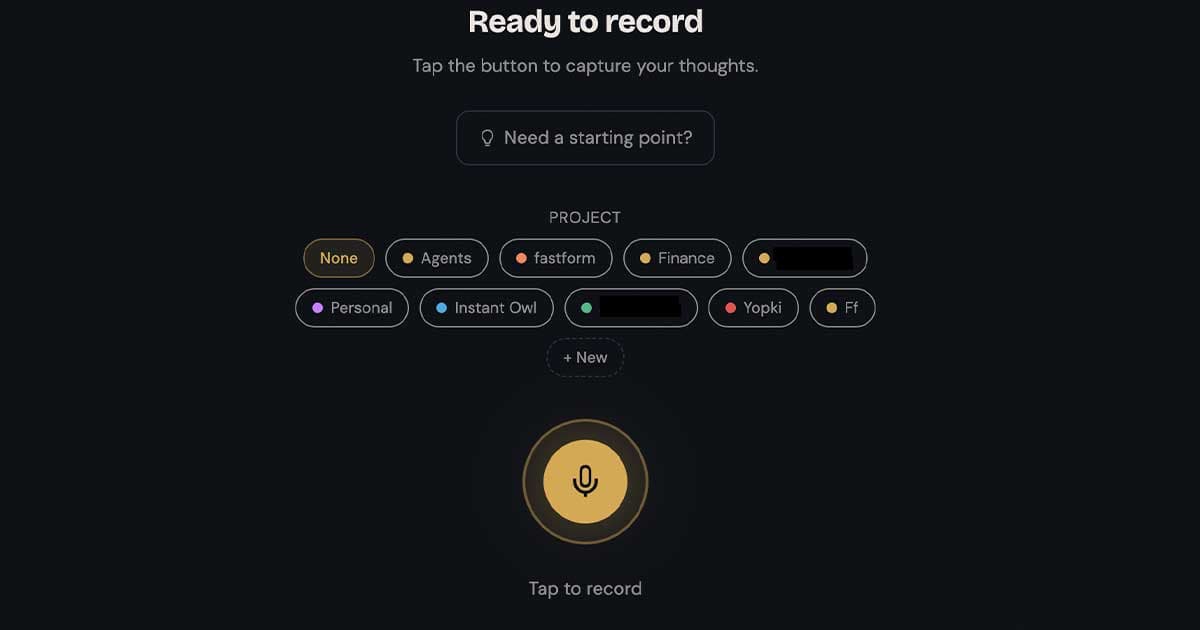
Full disclosure: InstantOwl is our product, and this is our blog. If you talk through your day out loud, an unedited daily routine, the things you always do without fail, the habits you keep meaning to start, InstantOwl turns that ramble into organized notes you can actually act on, rather than a recording you never revisit. It will not pick your anchors for you. It just makes the noticing part faster than journaling it by hand. InstantOwl is currently free to use.
Once a stack is running, the way you keep it alive is by keeping the new habit small enough that skipping it never feels easier than doing it. That is the same idea behind scaling any new habit down to under two minutes, which we cover in a companion post on the two-minute rule for building habits. For a deeper look at how a brain dump captures the anchors and dropped habits worth stacking on, see what a brain dump is and how to do one.
Related reading
- ADHD productivity: why standard habit and productivity advice often fails for ADHD, and what tends to work instead.
- Brain dump: the capture method for surfacing the anchor routines and dropped habits a stack should be built on.
- InstantOwl: talk through your day, and let the organizing happen after you capture it.
Frequently asked questions
What is a habit stacking example?
One of James Clear's own examples: after pouring your morning coffee, meditate for one minute. The idea is to attach a new habit to something you already do every day without thinking about it, so the existing habit becomes the reminder to do the new one.
What is the habit stacking formula?
James Clear's formula is: After [CURRENT HABIT], I will [NEW HABIT]. You name a habit you already do reliably, then name the new habit you want to attach to it. Clear also describes a Before variant for habits you want to do ahead of an existing routine instead of after it.
Is habit stacking good for ADHD?
Yes. ADHD makes it hard to remember a new habit or get started on it from a standing start, and habit stacking removes both problems by using something you already do as the trigger, so you are not relying on memory or willpower to begin.
What is the difference between habit stacking and Tiny Habits?
They describe the same core idea from two different people. BJ Fogg's Tiny Habits calls this mechanic anchoring and adds a celebration step right after the new behavior to reinforce it emotionally. James Clear coined the term habit stacking and stripped the idea down to one formula, crediting Fogg for the original concept.

Written by
Jim BreeseJim Breese is the founder of InstantOwl. He's spent 15 years building companies, from an Airbnb host community he founded and exited to growth leadership at venture-backed SaaS startups. He built InstantOwl because his best ideas kept arriving mid-walk, out of order, and half-finished.
Stop losing good ideas.
InstantOwl turns a rambling voice note into a clean, organized document in moments. Just talk. We'll organize it.
 Try InstantOwl free