Brainstorming: The Rules, the History, and What the Research Actually Says
By Jim Breese · · Updated

What is brainstorming?
Brainstorming is a method for generating ideas by separating the act of coming up with them from the act of judging them. You produce as many ideas as you can first, without stopping to evaluate, refine, or reject any of them, and you decide which ones are worth keeping afterward. The separation is the whole method. Judge while you generate and you generate less.
The term and the method both trace to one person: advertising executive Alex Faickney Osborn. Per Wikipedia's brainstorming entry, Osborn began developing creative problem-solving techniques in 1939, frustrated that employees at his ad agency could not develop creative ideas individually for ad campaigns. He first called the approach "organized ideation," and participants later coined the term "brainstorm sessions" themselves.
Osborn wrote about the idea across several books before it became widely known. "How to Think Up" (1942) was the first notable book where he mentioned the term brainstorming, per Wikipedia. "Your Creative Power" (1948) included a chapter titled "How to Organize a Squad to Create Ideas." The book that popularized the method broadly was "Applied Imagination" (1953).
Osborn's two core principles, per Wikipedia, are defer judgment and reach for quantity. Everything else in the method, including the four specific rules below, exists to protect those two principles during a session.
The four rules and why they exist
Osborn's four general rules, per Wikipedia, are: go for quantity, withhold criticism, welcome wild ideas, and combine and improve ideas. Each rule protects idea generation from a specific way that judgment creeps back in.
Go for quantity. Osborn's own summary was "quantity breeds quality": the more ideas you generate, the higher the odds that a genuinely good one is somewhere in the pile. This rule exists because people naturally slow down and self-select once they think they have found a decent answer. Quantity forces you past the first acceptable idea.
Withhold criticism. Suspend judgment during the session, extend or build on ideas rather than critique them, and save any evaluation for later. This is the rule most people already associate with brainstorming, and it is also the one broken most often, usually by a single skeptical comment that quietly ends the flow of ideas for everyone in the room.
Welcome wild ideas. Unusual or exaggerated suggestions stay on the table because they can be trimmed down into something workable, or because they spark a more practical idea in someone else. A session that only accepts safe, obviously feasible ideas rarely produces anything a competitor could not have thought of too.
Combine and improve ideas. Osborn's slogan for this rule was "1+1=3": association between two ordinary ideas can produce a better one than either idea alone. In practice this means listening for pieces you can merge, not just adding your own separate idea to the pile.
Osborn also held that the problem itself should be simple and narrowed down to a single target, and he recommended groups of around a dozen people mixing experts and novices, per Wikipedia. Both of those recommendations describe a specific 1950s advertising context. What has held up since, and what the next section covers, is a separate question: whether the group format itself is actually the best way to apply these rules.
What does the research actually say about brainstorming?
The research record, as documented on Wikipedia with its citations, found that groups brainstorming together produce fewer ideas than individuals working alone. Wikipedia states plainly: "a good deal of research refutes Osborn's claim that group brainstorming could generate more ideas than individuals working alone." This is the finding most tool vendors selling collaborative brainstorming software leave out of their own explanations of the method.
The landmark citation is a 1991 review by Michael Diehl and Wolfgang Stroebe. Per Wikipedia's summary of that review, the finding was that "overwhelmingly, groups brainstorming together produce fewer ideas than individuals working separately." Nominal groups, meaning individuals who generate ideas separately and only pool them afterward, consistently outperformed face-to-face brainstorming groups on both the quantity and the quality of ideas produced.
Wikipedia attributes this gap to several mechanisms working together, not one single cause.
- Production blocking. Only one person can speak at a time in a group session. While waiting for a turn, other participants may forget the idea they meant to contribute, or decide it no longer feels relevant by the time they can share it.
- Evaluation apprehension. When an authority figure is present, group effectiveness drops because members worry their idea will be judged negatively. Wikipedia notes that socially anxious individuals in particular become far less productive under these conditions.
- Collaborative fixation. Hearing other people's ideas out loud can narrow the range of directions a group explores, since everyone anchors on what has already been said instead of branching out.
- Social matching. Participants tend to adjust their own output to match the pace of the group, which pulls high performers down toward the average rather than lifting lower performers up.
- Illusion of group productivity. Group members tend to overestimate how much their group actually produced, per Wikipedia, partly because they mistake other people's ideas for their own in the moment.
None of this means groups are useless. It means the specific act of generating a large volume of ideas is measurably worse in a group session than the same people would produce working alone and combining lists afterward.
Should you brainstorm alone or in a group?
For raw idea generation, brainstorm alone first. The mechanisms above (production blocking most of all) are specific to being in a room with other people waiting their turn. Working alone removes every one of them: there is no turn to wait for, and nobody is present to feel judged by.
Wikipedia lists "free speaking" among the recognized individual brainstorming techniques, alongside free writing, word association, and drawing a mind map, and describes individual brainstorming as superior to traditional group brainstorming for generating ideas. Free speaking is exactly what it sounds like: talking through ideas out loud, alone, without writing anything down as you go.
Talking a stream of ideas into a phone or a recorder is solo brainstorming, a natural fit if you are someone who thinks best out loud, and it carries zero production blocking, since you are never waiting for a turn to speak. It also carries zero evaluation apprehension, since nobody is listening while you talk. Both of the biggest drains on group brainstorming simply do not apply when the "session" is one person and a microphone. That solo, out-loud pass is how a lot of founders think through a product or a pitch before bringing anyone else in.
This does not make groups pointless. A group is still useful for discussion, for building buy-in on a decision, and for combining separately generated lists into one, which is closer to Osborn's own "combine and improve" rule than a live group session ever manages to be. The honest version, per the research, is to generate ideas alone and bring a group in afterward to react to what already exists.
How do you run a brainstorm that actually works?
Run a brainstorm that works by generating ideas solo first, sharing them second, and keeping judgment out of the first phase entirely. This sequence follows the same logic as brainwriting, one of the alternatives Wikipedia describes: participants write ideas individually before a group ever discusses them, which sidesteps production blocking by design.
- Generate alone. Set a timer, pick one topic, and get out as many ideas as you can without stopping to judge any of them. Written, typed, or spoken, whichever is fastest for you.
- Defer judgment the whole way through. No editing, no ranking, no "that will never work" while you are still generating. Osborn's own core principle applies just as much solo as it does in a group.
- Go back for quantity, not quality. If you run dry after a few obvious ideas, keep going. The unusual ones tend to show up after the easy ones are already out.
- Bring a group in only to react. Share your list, or combine it with other people's separately generated lists, and let the group's job be evaluation and combination rather than generation from scratch.
- Capture everything before you sort. Nothing above works if the ideas evaporate before you get to step four. A full pass at how to structure and vary this process, including named techniques for each stage, is covered in brainstorming techniques.
Capturing what you generate
Solo brainstorming solves the group's production blocking problem, but it creates a smaller one of its own: talking generates ideas faster than typing can capture them, and a spoken list of ideas is genuinely harder to sort back through than a typed one. This is the same gap covered in what is a brain dump: speaking is the fastest form of capture, and it has always come at the cost of a messier result afterward.
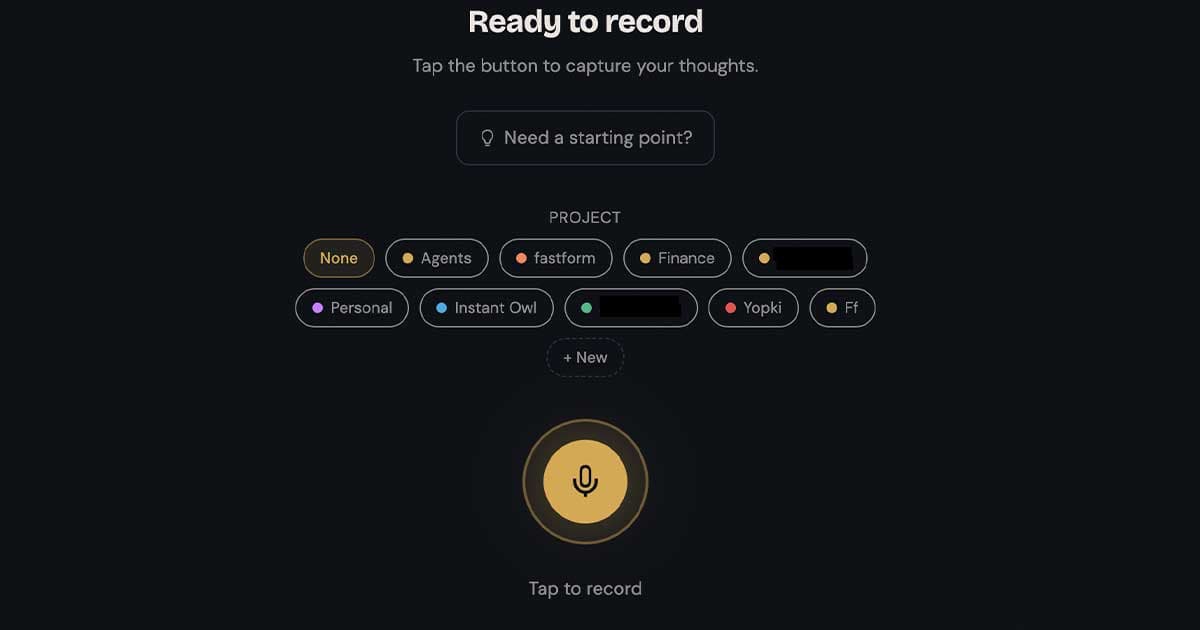
Full disclosure: InstantOwl is our product, and this blog belongs to it. InstantOwl exists for exactly this moment, talking through a brainstorm out loud and needing the result organized afterward instead of left as a wall of transcript. You defer judgment out loud the way Osborn's first rule asks, and InstantOwl turns what you said into an organized list of ideas, tasks, and notes you can actually work from. InstantOwl is currently free to use.
That fits the honest version of brainstorming this page has described: generate alone, judge nothing while you generate, and only worry about sorting once the ideas are already out and safely captured. For a deeper look at that same capture-first logic and where it came from, see second brain systems built around it.
Related reading
- Brainstorming techniques: named techniques for both the solo and group stages, including which ones work out loud.
- What is a brain dump: the same defer-judgment logic applied to clearing your head, not just generating ideas.
- Second brain: where captured ideas go once you have generated them, so they turn into something instead of sitting in a pile.
Frequently asked questions
What are the 4 rules of brainstorming?
Alex Osborn's four rules are go for quantity, withhold criticism, welcome wild ideas, and combine and improve ideas. Go for quantity assumes more ideas raise the odds of a good one. Withhold criticism means judging and refining come later, not during idea generation. Welcome wild ideas means unusual suggestions stay on the table since they can spark better ones. Combine and improve means building on an idea someone else offered rather than only proposing new ones.
Is brainstorming effective?
It depends whether you mean group or individual brainstorming. Research reviewed by Michael Diehl and Wolfgang Stroebe in 1991 found that groups brainstorming together consistently produce fewer ideas than the same number of people working alone and pooling results afterward. Individual brainstorming, following the same defer judgment and go for quantity rules solo, does not carry the same drawbacks.
What is an example of brainstorming?
A simple example: set a timer for ten minutes and write or say every idea for a blog topic without stopping to judge any of them, then review the list afterward. That single sequence, generate everything first and evaluate second, is Osborn's core principle applied to one person working alone.
Is it better to brainstorm alone or in a group?
For raw idea quantity, alone. The research record summarized by Diehl and Stroebe found individuals working separately and pooling their ideas afterward outperform the same people brainstorming together in a room, largely because a group session forces people to wait their turn and worry about how an idea will land. A group can still be useful for buy-in and discussion, just not for maximizing the number of ideas generated.

Written by
Jim BreeseJim Breese is the founder of InstantOwl. He's spent 15 years building companies, from an Airbnb host community he founded and exited to growth leadership at venture-backed SaaS startups. He built InstantOwl because his best ideas kept arriving mid-walk, out of order, and half-finished.
Stop losing good ideas.
InstantOwl turns a rambling voice note into a clean, organized document in moments. Just talk. We'll organize it.
 Try InstantOwl free