Brainstorming Techniques That Hold Up (Including the Solo Ones Nobody Covers)
By Jim Breese · · Updated

Which brainstorming techniques actually work?
The techniques worth using are the ones that show up again and again across the major guides, not the longest possible list. Asana's roundup names 29 techniques. Lucid and Miro each cover a shorter set. Cross-reference all three and five techniques appear in every one of them: brainwriting, mind mapping, starbursting, reverse brainstorming, and rapid ideation.
That overlap is the actual signal. A technique that only one vendor's blog mentions might be a rebrand of something older. A technique that Asana, Lucid, and Miro all describe independently has earned its place. This guide covers those five in detail, plus two more with hard numbers attached, then covers the one dimension almost none of these guides touch: brainstorming by yourself, out loud.
The five techniques every guide agrees on
Brainwriting. Each person writes ideas down instead of saying them aloud, then passes the ideas along for others to add to. Lucid frames this as removing bias and letting introverts contribute equally, since nobody has to speak up first. Asana's 6-3-5 version makes it concrete: six people each write three ideas in five minutes, repeated for six rounds, producing up to 108 ideas in about half an hour.
Mind mapping. A central topic sits in the middle of the page, with related ideas branching outward as they occur to you; our guide walks through how to make a mind map start to finish. Lucid describes it as a non-linear diagram capturing interconnected ideas; UNC's Writing Center, from the academic side, calls the same technique clustering or webbing: write related terms randomly, then circle and connect the ones that relate.
Starbursting. Put your idea in the center of a star and label each point with one of six questions: who, what, when, where, why, how. Asana and Lucid both describe it this way, and Lucid adds that the point is developing strategic questions before you commit to an answer, not answering them all at once.
Reverse brainstorming. Instead of asking how to solve a problem, ask how to cause it. Lucid's exact framing: "How can we cause this problem?" Then work backward from those answers. Asana describes the same idea as thinking of problems first, solutions second. It works well on a group that has gone quiet or gotten too polite to criticize anything out loud.
Rapid ideation. Set a strict time limit and generate as many ideas as possible before it runs out. Lucid explicitly invokes Parkinson's Law here, the idea that work expands to fill the time available, so a tight limit forces speed instead of padding. Asana describes the same mechanic: quantity, fast, no filtering yet.
Two more techniques are worth knowing for the numbers alone. Lightning Decision Jam, per Asana, runs 40 minutes to an hour and moves a group through positives, negatives, and solutions in that order. Stepladder brainstorming, also per Asana, works for groups of 5 to 15 people: two people start the discussion, then one more joins per round, so each new voice speaks before hearing what the group already thinks.
One correction while we're on sources: Lucid's own page is titled "12 effective brainstorming techniques," but the body only defines nine of them. The other two, reverse brainstorming and stepladder brainstorming, are defined only in the page's FAQ section, not the numbered list. The count in a listicle's headline is not always the count in its body. We would rather give you the techniques that are actually defined than repeat a number that does not match the page.
Get the cheat sheet as PDF, Word, or Excel
Every technique above on one page, each with its one-line description, plus a section on which one to reach for.
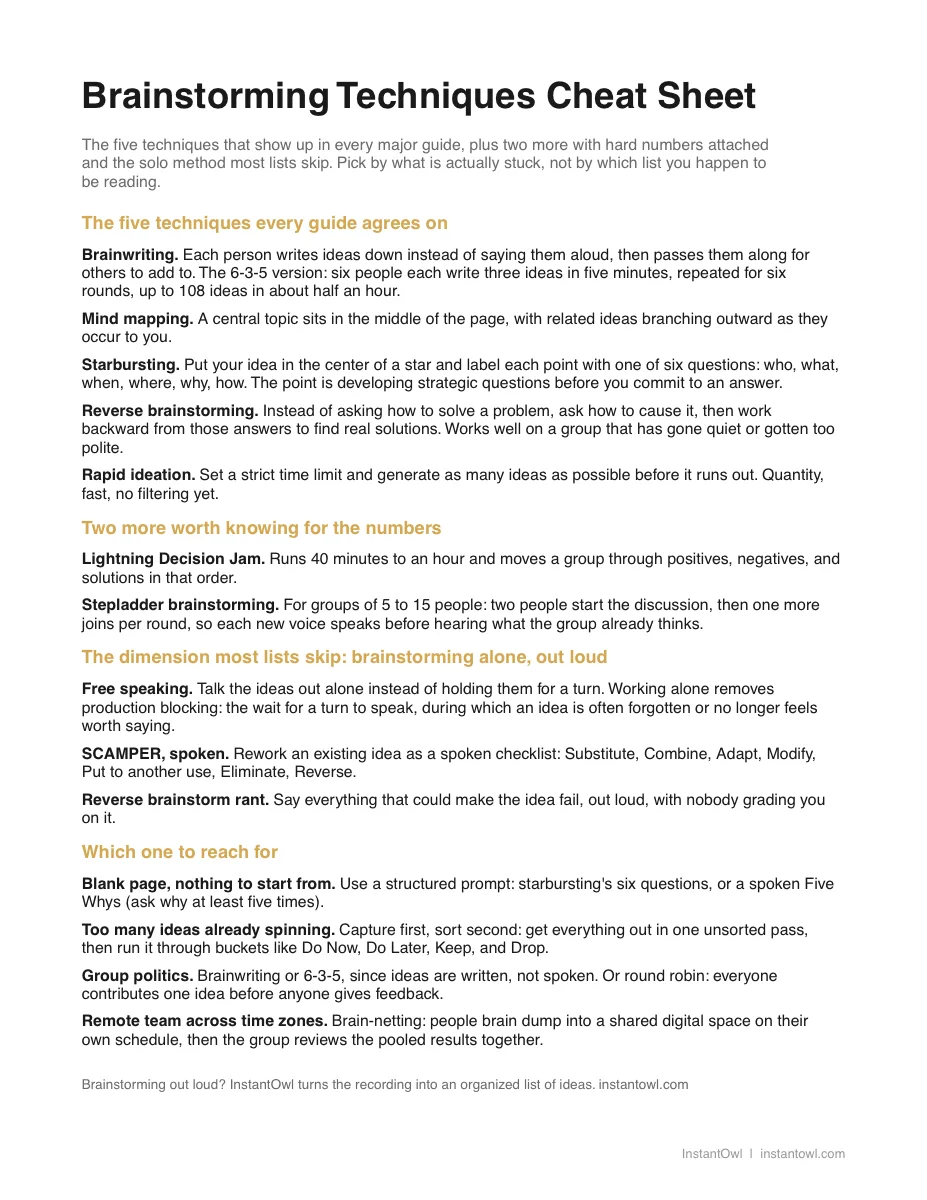
- PDF: print it or keep it open during a session
- Word (DOCX): edit it down to the techniques your team actually uses
- Excel (XLSX): for column lovers, one technique per row
The DOCX and XLSX files open directly in Google Docs and Google Sheets, no download or conversion needed.
The dimension nobody covers: brainstorming alone
Every technique above assumes a group in a room or a shared doc. Almost none of the SaaS guides mention that brainstorming alone, out loud, is a documented technique with its own name and its own research behind it. Wikipedia's brainstorming entry lists individual brainstorming as a distinct variation, covering "free writing, free speaking, word association, and drawing a mind map," and states plainly that individual brainstorming is superior to traditional group brainstorming.
The research behind that claim has a name: production blocking. In a group, only one person can speak at a time, so everyone else has to hold their idea in working memory while they wait for a turn. By the time the turn comes, per Wikipedia's summary of the underlying research, the idea is often forgotten or no longer feels worth saying. Talking alone removes the wait entirely. There is no turn to hold an idea for.
This turns every technique above into a solo tool for anyone who works ideas out by talking. Starbursting's six questions can be asked and answered out loud on a walk. SCAMPER, Asana and Miro's technique for reworking an existing idea (Substitute, Combine, Adapt, Modify, Put to another use, Eliminate, Reverse), works the same way as a spoken checklist. A reverse brainstorm becomes a rant: say everything that could make the idea fail, out loud, with nobody grading you on it. We go deeper on why solo-first often beats group-first in our brainstorming guide, which covers the full research picture.
How do you pick a brainstorming technique?
The right technique depends on what is actually stuck, not on which list you happen to be reading. Four situations cover most of what comes up.
Staring at a blank page with nothing to start from calls for a structured prompt, not an open invitation to "just brainstorm." Starbursting's six questions or a spoken Five Whys, asking why at least five times per Asana, both give you somewhere concrete to start talking.
Too many ideas already spinning, the opposite problem, calls for capturing first and sorting second. Get everything out in one unsorted pass, then run it through simple buckets like Do Now, Do Later, Keep, and Drop. Our brain dump template is built exactly for that second step.
Group politics, where one voice dominates or nobody wants to criticize an idea out loud, calls for a technique that removes the social pressure. Brainwriting and the 6-3-5 method work because ideas are written, not spoken, so nobody knows whose idea is whose until later. Round robin works differently: everyone contributes one idea before anyone gives feedback, per Asana.
A remote team spread across time zones calls for async techniques over live ones. Brain-netting, per both Asana and Lucid, has people brain dump into a shared digital space on their own schedule, then the group reviews the pooled results together.
How do you capture what a brainstorm produces?
Full disclosure: InstantOwl is our product, and this blog belongs to it. A brainstorm, solo or group, only helps if what comes out of it goes somewhere. A spoken brainstorm session, in particular, tends to produce a stream of ideas with no built in structure: the six answers to a starbursting question, a rapid ideation list, a reverse brainstorm rant, all said out loud and then gone unless something catches them.
InstantOwl is built for exactly that moment. Talk through a starbursting prompt, a Five Whys, or a reverse brainstorm out loud, and InstantOwl turns the recording into an organized list you can actually use afterward, not a wall of transcript text to sort through by hand. It fits the brain dump method for the same reason: speaking is the fast part, organizing what you said is the part most tools never solve. InstantOwl is currently free to use.
Frequently asked questions
What are the most effective brainstorming techniques?
The techniques that show up across every major ranking, Asana, Lucid, and Miro, are brainwriting, mind mapping, starbursting, reverse brainstorming, and rapid ideation. Beyond naming the techniques, the research behind them, summarized by Wikipedia's review of Michael Diehl and Wolfgang Stroebe's 1991 study, found that individuals working alone and pooling ideas afterward outperform face to face group brainstorming on both quantity and quality of ideas.
What is brainwriting?
Brainwriting has each person write ideas down silently instead of saying them out loud, then pass the ideas along for others to build on. In the 6-3-5 version, per Asana, six people each write three ideas in five minutes, repeated for six rounds, which can produce up to 108 ideas in about thirty minutes.
What is reverse brainstorming?
Reverse brainstorming flips the usual question. Instead of asking how to solve a problem, per Lucid it asks "How can we cause this problem?" and then works backward from those answers to find real solutions. Asana describes the same technique as thinking of problems first, then solutions, useful for groups stuck staring at a blank page.
How do you brainstorm alone?
Talk it out loud instead of writing or typing it. Wikipedia lists free speaking as an individual brainstorming technique alongside free writing, word association, and mind mapping, and describes individual brainstorming as superior to traditional group brainstorming. In practice, that means saying starbursting's six questions aloud, running a spoken Five Whys, or ranting through a reverse brainstorm without waiting for a turn or worrying who is listening.
Related reading
- Want the fuller research picture on why solo often beats group? See our brainstorming guide.
- Too many ideas and nowhere to put them? Sort them with the brain dump template.
- New to the underlying method? Start with what a brain dump is.
- Prefer talking to typing or writing? InstantOwl turns a spoken brainstorm into an organized list automatically.
Frequently asked questions
What are the most effective brainstorming techniques?
The techniques that show up across every major ranking, Asana, Lucid, and Miro, are brainwriting, mind mapping, starbursting, reverse brainstorming, and rapid ideation. Beyond naming the techniques, the research behind them, summarized by Wikipedia's review of Michael Diehl and Wolfgang Stroebe's 1991 study, found that individuals working alone and pooling ideas afterward outperform face to face group brainstorming on both quantity and quality of ideas.
What is brainwriting?
Brainwriting has each person write ideas down silently instead of saying them out loud, then pass the ideas along for others to build on. In the 6-3-5 version, per Asana, six people each write three ideas in five minutes, repeated for six rounds, which can produce up to 108 ideas in about thirty minutes.
What is reverse brainstorming?
Reverse brainstorming flips the usual question. Instead of asking how to solve a problem, per Lucid it asks 'How can we cause this problem?' and then works backward from those answers to find real solutions. Asana describes the same technique as thinking of problems first, then solutions, useful for groups stuck staring at a blank page.
How do you brainstorm alone?
Talk it out loud instead of writing or typing it. Wikipedia lists free speaking as an individual brainstorming technique alongside free writing, word association, and mind mapping, and describes individual brainstorming as superior to traditional group brainstorming. In practice, that means saying starbursting's six questions aloud, running a spoken Five Whys, or ranting through a reverse brainstorm without waiting for a turn or worrying who is listening.

Written by
Jim BreeseJim Breese is the founder of InstantOwl. He's spent 15 years building companies, from an Airbnb host community he founded and exited to growth leadership at venture-backed SaaS startups. He built InstantOwl because his best ideas kept arriving mid-walk, out of order, and half-finished.
Stop losing good ideas.
InstantOwl turns a rambling voice note into a clean, organized document in moments. Just talk. We'll organize it.
 Try InstantOwl free