The Commonplace Book: What It Is, Its 2,000-Year History, and How to Start One
By Jim Breese · · Updated
What is a commonplace book?
A commonplace book is, in the words of the online community built around keeping one, "any collection of knowledge and reflections, drawn from various sources and kept in analog or digital format," per the r/commonplacebook community's own description. That definition is deliberately wide, and the community treats it that way in practice.
The same description places Sei Shonagon's eleventh-century Pillow Book and Virginia Woolf's journals on one end of the range. On the other end sits "that catch-all Word document you add to every time you read something neat." A commonplace book can be a leather notebook passed down for a century, or a text file you started last week. The format is not what makes it a commonplace book.
What makes it a commonplace book is the habit: pulling ideas, quotes, and observations out of what you read and the life you live, and putting them somewhere you can find them again later. That is a narrower goal than note-taking in general, which also covers capturing lecture material or meeting decisions in the moment. A commonplace book is specifically for what you want to keep long after the source is gone.
Where did commonplace books come from?
Commonplace books are not a modern invention. The habit is close to 2,000 years old. According to Wikipedia, "the Ancient Greeks developed hypomnema, personal records on important subjects," the earliest documented ancestor of writing down what you want to keep.
The practice kept resurfacing under different names for the next two millennia. Wikipedia notes that "in pre-digital times, people used many kinds of notebooks, including commonplace books, accounting waste books, and marginalia," three separate habits all pointed at the same problem: catch a thought before it disappears.
The philosopher John Locke gave the format its most influential structure. Wikipedia records that Locke "developed and published a popular indexing system which served as a model for commonplace books and inspired at least ten different published editions of commonplace book templates in Europe and the Americas." One of those templates was Bell's Common-Place Book, published in London in 1770, built directly on Locke's index.
Locke did not invent the commonplace book. He gave people a way to actually find what they had written down months later, which is the same problem the format still has to solve today, whether your commonplace book is a notebook or an app.
What is Ryan Holiday's commonplace book method?
Ryan Holiday's notecard system is the version most people encounter first today. On his own site, Holiday describes a commonplace book as a repository for "ideas, quotes, anecdotes, observations and information" gathered from reading and from life, kept so it can be used later in writing, speaking, and work. He credits the method to Robert Greene, who taught it to him.
The method has a specific order. Read widely, and mark passages or jot marginalia while you read, not after. Focus on wisdom, not facts, the kind of line you will still care about in a year. Let a book sit for about a week after you finish it, so what actually mattered has time to surface, before you transfer anything out of it.
Then comes the step Holiday is best known for: writing the passages you kept by hand onto 4x6 ruled index cards, one idea per card (the same atomic-note principle behind the Zettelkasten method), with a category label in the top right corner. He does not sort cards into a rigid system up front. He lets themes emerge as the collection grows, processes new cards regularly so nothing piles up unsorted, and pulls the relevant cards when he starts a new project.
Holiday cites Marcus Aurelius, Petrarch, Montaigne, Thomas Jefferson, Napoleon, H.L. Mencken, Bill Gates, Ronald Reagan, and F. Scott Fitzgerald as historical keepers of some version of a commonplace book. The point of the list is not that you need Jefferson's discipline. A habit this old, still practiced by a working writer today, has outlasted a lot of productivity trends that came after it. The harder question is not who kept one, it is how you actually remember what you collect instead of just filing it away.
How do you start a commonplace book?
Start by picking a home. The community around commonplace books blesses more than one answer: a paper notebook, the most common choice among people who already keep one; loose index cards, Holiday's format; or a digital catch-all document or app, organized loosely like a digital second brain if you want more structure later. Pick whichever one you will actually reopen, since the wrong home is the most common reason a commonplace book gets abandoned.
Capture with attribution every time. Note where a passage or idea came from, the book, the person, the conversation, right next to what you wrote down. A great line with no source attached is much less useful a year later, when you want to quote it correctly or track down the rest of the argument.
Label lightly as you go. Holiday's version is a category written in the top right corner of each card. Other keepers use a colored dot system, one of the most common organizing questions the community asks itself. The label does not need to be a permanent taxonomy. It only needs to help future you find this entry again.
Revisit on purpose. How often people look back through their own commonplace pages is one of the community's most repeated questions, and it points at the real risk: a commonplace book nobody reopens is just a pile of index cards. Holiday builds a revisit step directly into his method, the week he lets a book percolate before transferring anything from it. Put a recurring date on your own calendar to look back through what you have collected, not just to keep adding to it.
Does a commonplace book have to be about quotes?
No. Great-quotes culture is the most visible version of a commonplace book, but the community that keeps them treats theme as wide open. Real examples people keep: a history journal, a work commonplace book for job-specific ideas, a general "book of things I find interesting," fiction worldbuilding pages, and at least one dedicated commonplace book about zombies.
The common thread is not subject matter. It is the same behavior Sei Shonagon and John Locke both practiced centuries apart: notice something worth keeping, and put it somewhere you will find it again. A commonplace book organized entirely around your favorite hobby, your job, or a single novel you are writing is still a commonplace book. Pick a theme that matches what you actually want to remember, not the version you assume a commonplace book is supposed to look like.
Can you keep a commonplace book with your voice?
Yes, for the step where most beginners actually get stuck: the transfer, moving marginalia into cards, or a highlighted passage into a notebook. Speaking a passage out loud, along with your own thought about it, into a digital catch-all is a legitimate, low-friction way to capture an entry. The community's own definition of a commonplace book already includes digital format, so this is not a stretch of the idea.
To be clear about what this is not: voice capture is not more traditional than paper, and it is not a better method than Holiday's index cards or a hand-kept notebook. Writing by hand is part of the appeal for a lot of people who keep commonplace books, arguably half of it. Voice is simply another honest way to get an idea out of your head and into your collection when writing is not possible in the moment, in the car, on a walk, mid conversation.
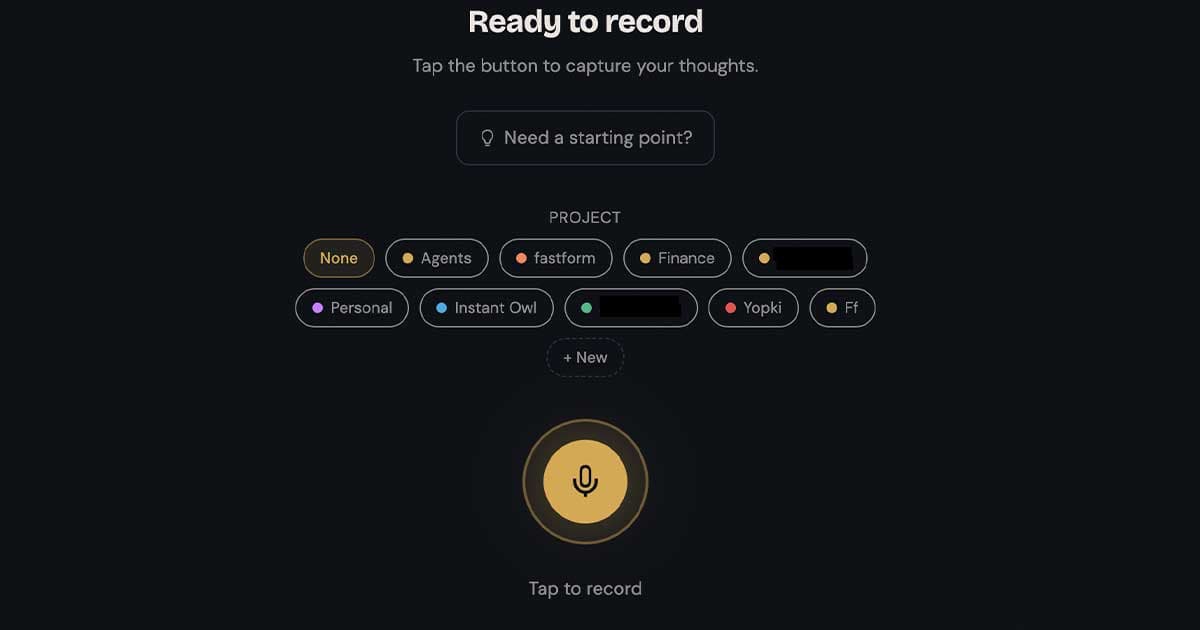
Full disclosure: InstantOwl is our product, and this blog belongs to it. It is built for exactly that gap: talking through a passage and your own reaction to it the moment it happens, so the idea gets captured before the window to write it down closes. It is currently free to use, and it does not replace the paper ritual. It just gives you somewhere to put an idea when paper is not in reach.
Related reading
- Note-taking: why note-taking works and the speed problem no method fixes.
- Second brain, CODE and PARA explained: where captured ideas go once you want to organize them long-term.
- How to remember things: the honest split between remembering facts and offloading tasks and ideas.
Frequently asked questions
What is a commonplace book used for?
A commonplace book is used to keep the ideas, quotes, and observations you gather from reading and everyday life so you can find and reuse them later, in writing, conversation, or your own thinking. It is a working collection, not an archive you never reopen.
What is the difference between a commonplace book and a journal?
A commonplace book collects what you gather from outside yourself: quotes, ideas, and passages from things you read. A journal records what happens inside you: your own days, feelings, and reflections. Many people keep both; if a blank page is what stops you from journaling, prompts sorted by what you need right now can help.
What did famous people keep in commonplace books?
Ryan Holiday, who popularized the modern notecard version of the method, cites Marcus Aurelius, Petrarch, Montaigne, Thomas Jefferson, Napoleon, H.L. Mencken, Bill Gates, Ronald Reagan, and F. Scott Fitzgerald as historical keepers of some version of a commonplace book.
Can a commonplace book be digital?
Yes. The community that keeps commonplace books today defines one as a collection kept in analog or digital format, and counts everything from index cards to a running Word document among legitimate examples.

Written by
Jim BreeseJim Breese is the founder of InstantOwl. He's spent 15 years building companies, from an Airbnb host community he founded and exited to growth leadership at venture-backed SaaS startups. He built InstantOwl because his best ideas kept arriving mid-walk, out of order, and half-finished.
Stop losing good ideas.
InstantOwl turns a rambling voice note into a clean, organized document in moments. Just talk. We'll organize it.
 Try InstantOwl free