How to Remember Things: Two Different Problems, Two Different Fixes
By Jim Breese · · Updated

"How to remember things" hides two different problems
Most advice on remembering things answers only one question, and it is usually the wrong one for you. There are actually two separate problems hiding under the same phrase. The first is facts you genuinely need to know cold: a name, a new language, material for a test. The second is tasks and ideas you should never try to hold in your head in the first place: buy milk, that idea from the shower, what your coworker just asked you to do.
These two problems need opposite fixes. Facts respond to real memory techniques: understanding, testing, spacing, and vivid encoding, built up over repeated effort. Tasks and ideas respond to the opposite move entirely: get them out of your head the moment they show up, onto paper or into a recording, so you never have to test your recall at all. Confusing the two wastes effort on the wrong one. This post covers both, starting with the one people actually mean when they picture "improving your memory."
How do you remember facts you need to know cold?
You remember facts by understanding them first, testing yourself instead of rereading, spacing practice out over several sessions, and encoding them in vivid, meaningful ways, according to the University of North Carolina Learning Center. None of this happens instantly. All of it beats passively rereading a page and hoping something sticks.
Understand it, connect it, group it
UNC's list starts before memorization even begins: "try to understand the information first," because information that makes sense to you is easier to store than a string of unconnected facts. Its next strategy is to "link it," tying new material to something you already know, and to "create meaningful groups" instead of memorizing a long list item by item. A phone number is easier to hold as three chunks than as ten separate digits. The same idea scales up to exam material, vocabulary, or a set of names.
Test yourself, space it out, mix it up
Once you understand the material, UNC's strategies shift to how you practice it. "Self-test" means quizzing yourself on the material rather than rereading your notes, which forces your brain to retrieve the information instead of just recognizing it. "Use distributed practice" means spreading study sessions out over days instead of cramming in one sitting. "Practice interleaving" means mixing different types of problems or topics within a single study session instead of drilling one type at a time.
UNC frames its research support carefully here, noting only that students who use memory tricks tend to perform better than those who do not, without attaching a number to that claim.
Make it memorable: mnemonics and the memory palace
For material that resists plain repetition, UNC lists "use mnemonics," building a memorable word, phrase, or image out of what you are trying to remember, alongside the memory palace technique: picturing a familiar place and mentally placing facts at specific points along a route through it. Its broader visual category includes memorable visual images, songs and jingles, engaging more than one of the five senses, and lively visual metaphors or analogies. The common thread is that vivid, specific encoding beats flat repetition.
Sleep and exercise still make the list
Two of UNC's strategies have nothing to do with study technique at all: "sleep on it" and "exercise!" Both stay on a university learning center's list of memory tools, which is worth noting only because some corners of the internet quietly drop them. A credible source keeps the boring, physical basics next to the clever mental tricks, because both feed the same system.
If what you actually want is not to pass a test but to keep the interesting things you read around for later, that is a related but different habit: closer to what a commonplace book is built for than to exam-style memorization.
Should you write it down or say it out loud?
Yes to both, according to UNC's own list. Two of its strategies, "write it out" and "talk to yourself," are literally about getting information out of your head and into a form you can see or hear again. That is not a shortcut around memorization, it is one of UNC's own memory techniques.
Writing something out works partly because it forces you to select and rephrase material instead of copying it word for word, a pattern Wikipedia's overview of note-taking also describes when comparing handwritten and typed notes. Talking to yourself about material, rather than silently rereading it, works the same way: producing the information out loud is a different, more demanding act than recognizing it on a page.
There is a practical reason writing and speaking are not interchangeable, though. Wikipedia's overview of note-taking puts average speech at 120 to 180 words per minute against handwriting at only 12 to 18. Speaking a thought is roughly ten times faster than writing it down by hand. That gap barely matters when you are carefully encoding one fact into memory. It matters enormously once you leave the world of facts and enter the world of tasks and ideas, which is an entirely different problem.
How do you remember tasks and ideas you don't want to lose?
You don't. Stop trying to hold a task or an idea in your head at all. Write it down or say it out loud the moment it appears, then let something outside your head hold it for you. This is not a compromise or a lesser version of memorizing it. For this category of remembering, offloading it is the correct strategy, not a fallback.
Psychologists have a name for why unfinished tasks and half-formed ideas behave differently from facts you have deliberately studied: the Zeigarnik effect. Unfinished tasks tend to stay active in your working memory, quietly pulling at your attention, until you either complete them or write them down. An idea you have not captured competes for the same limited space as everything else you are trying to hold onto that day.
This is also the entire reason note-taking exists as a practice. Wikipedia's account of it puts the payoff simply: writing something down means "freeing their mind from having to recall everything." Capture is not a productivity trick layered on top of memory, it is a way to stop asking your head to be a storage system it was never built to be.
This mechanism, moving information out of working memory and into a place you trust, is sometimes called cognitive offloading. It is the mechanism behind every capture habit, from a paper to-do list to David Allen's Getting Things Done to a note-taking method to a voice recording.
Because tasks and ideas arrive at the speed of thought, the speed of capture matters as much as the will to capture at all. The same ten-times gap between speech and handwriting from the section above means a fast-moving idea can outrun your pen before you have written the first sentence. Talking closes that gap immediately, which is the whole argument behind treating speaking as the fastest form of capture rather than a shortcut for people who dislike writing.
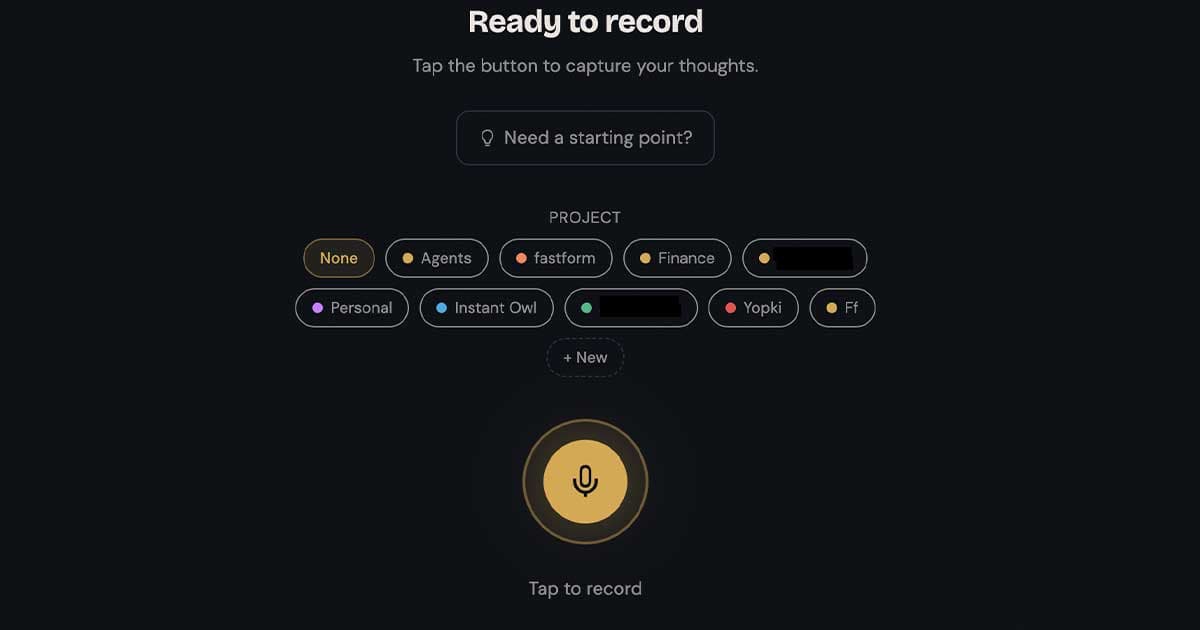
Full disclosure: InstantOwl is our product, and this is exactly the category of remembering it is built for. Say the task or idea out loud the moment it shows up, and it gets captured and organized into something usable, instead of sitting as an audio file or a scribbled note you have to sort through later. It does not replace the UNC strategies above for facts you need to know cold, it replaces the effort of trying to hold onto something you were never meant to memorize in the first place. InstantOwl is currently free to use.
If you want the fuller system for building this habit day to day, our guide on how to capture ideas covers it in more depth.
Which problem do you actually have?
If you are studying for an exam, learning a language, or trying to remember someone's name at a party, you have the facts problem. Use the UNC-backed strategies above: understand it first, test yourself, space out practice, and encode it vividly.
If you are trying to remember to buy milk, that idea that showed up in the shower, or what someone just told you, you have the tasks-and-ideas problem. Stop trying to remember it. Write it down or say it out loud right away, and let a system outside your head keep it.
Most days involve both problems at once, and the split still holds: the fix is never the same fix twice. One more thing worth saying plainly. Ordinary forgetfulness, the kind covered above, is normal and fixable with better habits. If forgetting feels different from that, sudden, worsening, or getting in the way of daily life, that is worth raising with a doctor rather than trying to out-technique it with a mnemonic.
What to avoid: the "remember things faster" genre
Be skeptical of any guide promising you will memorize things a specific multiple faster, or citing an exact recall percentage from a study it does not name or link. Real memory research, like UNC's, tends to describe its own evidence in soft, honest terms rather than precise multipliers, because memory performance varies enormously by person, material, and method. A page confident enough to hand you a clean percentage is usually the one skipping its sourcing, not the one that found something real.
One more tell: credible sources keep the boring basics, sleep and exercise, on the list, while flashier hack content tends to drop them in favor of pure mental technique. It is also fine to hear about the Ebbinghaus forgetting curve, the standard observation that forgetting happens fastest in the period right after you first learn something, which is exactly why spacing out review beats a single long cramming session. Treat any version of that idea attached to a specific decay percentage or timeline with the same skepticism as the multiplier claims above.
Related reading
- What is a brain dump: why speaking is the fastest way to get a thought out of your head.
- How to capture ideas: a full system for building the capture habit day to day.
- Note-taking: why the practice exists and the speed problem no method fully solves.
- The commonplace book: for keeping the facts and ideas you want to revisit, not just recall once.
Frequently asked questions
How can I remember things better?
It depends which kind of remembering you mean. For facts you need to know cold, use university-backed strategies: understand the material first, test yourself instead of rereading, space out practice, and build vivid mental images. For tasks and ideas, the better move is to stop trying to remember them at all and capture them the moment they appear instead.
Why do I forget things so quickly?
Your working memory, the part of your mind holding information you are actively using, can only hold a small amount at once. Anything you have not deliberately encoded into long-term memory, or externalized by writing or saying it down, gets crowded out by whatever shows up next. Forgetting quickly is not a flaw, it is what an unencoded, uncaptured thought does by design.
What is the memory palace technique?
The memory palace technique is one of the visual strategies on the University of North Carolina Learning Center's list of memory tools: you picture a familiar place, like your childhood home, and mentally place the facts you need to remember at specific spots along a route through it, then walk that route in your head to recall them in order.
Should I write things down or memorize them?
Write it down if it is a task, an idea, or anything you only need once, since holding it in your head risks losing it and offers no benefit once it is captured. Memorize it only if you genuinely need it available in your head with nothing to check, like a language, a name you are about to use, or material for a closed-book exam.

Written by
Jim BreeseJim Breese is the founder of InstantOwl. He's spent 15 years building companies, from an Airbnb host community he founded and exited to growth leadership at venture-backed SaaS startups. He built InstantOwl because his best ideas kept arriving mid-walk, out of order, and half-finished.
Stop losing good ideas.
InstantOwl turns a rambling voice note into a clean, organized document in moments. Just talk. We'll organize it.
 Try InstantOwl free