Note-Taking: Why It Works, Which Method Fits, and the Speed Problem
By Jim Breese · · Updated

What is note-taking for?
Note-taking is, in Wikipedia's own words, "the practice of recording information from different sources and platforms." The reason anyone bothers is stated just as plainly: "By taking notes, the writer records the essence of the information, freeing their mind from having to recall everything." You write something down so your head does not have to hold onto it.
Wikipedia calls note-taking "a foundational skill in personal knowledge management," which sounds abstract until you trace the practice back. The Ancient Greeks developed hypomnema, personal records on important subjects. Students in the Renaissance and early modern period learned note-taking in schools, academies, and universities, "often producing beautiful volumes that served as reference works after they finished their studies." Long before laptops, people filled commonplace books, accounting waste books, and margins with the same instinct: get it down before it disappears.
Philosopher John Locke took that instinct further. He "developed and published a popular indexing system which served as a model for commonplace books and inspired at least ten different published editions of commonplace book templates in Europe and the Americas." Note-taking has always had two separate parts bundled together: capturing the thought, and organizing it well enough to find again later.
The two jobs a note has to do
Wikipedia frames note-taking as cognitive work, not clerical work: "Note-taking is a central aspect of a complex human behavior related to information management involving a range of underlying mental processes and their interactions with other cognitive functions." You have to take in the source, filter what matters, fit it against what you already know, write it down, then store it for later. Wikipedia sums up the payoff in one line: "The result is a knowledge representation, and a memory storage."
That is two jobs, not one. The first is encoding: getting the raw material out where you can look at it. The second is storage: making sure it stays organized and usable. Wikipedia's own research backs the value of doing this at all. "Note-taking is a good strategy to enhance learning and memory, as it allows the notetaker to be selective and reorganize ideas during a lecture." Notes also help you "process, recall, and use information that has been rapidly gone through" earlier, and taking notes on new vocabulary "fosters vocabulary learning."
The two biggest note-taking apps on the market split cleanly along this same line, in their own words. Simplenote positions itself around the first job: "The simplest way to keep notes," a frictionless place to capture and sync. Evernote positions itself around the second: "Your second brain," a place to "remember everything and tackle any project." One optimizes for getting a thought in. The other optimizes for finding it again months later. Neither one addresses what happens between those two jobs, which is where most people actually get stuck.
The speed problem nobody names
Here is the number that explains why note-taking feels hard even when you know exactly what you want to say. According to the cognitive psychology research Wikipedia cites, "the average rate of speech is 2-3 words per second (which is 120-180 words per minute)," while the average handwriting speed is only "0.2-0.3 words per second (which is 12-18 words per minute)." That is roughly a tenfold gap between how fast a thought leaves your head as speech and how fast the same thought can leave your hand as ink.
You do not think at 15 words per minute. You think at conversational speed, closer to the 120-180 range. Every method built on writing things down by hand is racing to keep up with a brain moving ten times faster than the pen. That mismatch, not a lack of discipline or the wrong notebook, is the actual bottleneck in note-taking.
This is not a theory. Real note-takers keep discovering the workaround on their own. In one Reddit thread about organizing thoughts, a commenter described an "interview yourself" method: ask yourself questions out loud, answer out loud, then write down what you said afterward. Another replied with the natural shortcut: dictating into a phone's notes app instead, because "you likely can't write as fast as you can talk." People are already solving the speed problem by talking first and structuring the result second, which is the thesis this whole cluster is built on.
Which note-taking method should you use?
Note-taking methods split into two families. Linear methods, like outlining and the sentence method, follow the material in the order it arrives; Wikipedia notes the sentence method works well for "fast-paced lessons" because it just means "writing down each topic as a short, simple sentence." Non-linear methods, like Cornell notes, mapping, charting, and SQ3R, rearrange the material into a structure while you write.
Here is the honest part most guides skip. Wikipedia states plainly: "Cornell notes may be more effective for understanding concepts or producing readable notes, but studies have found that they had no significant effect on student performance." A structured method can make your notes nicer to read without making you learn more from them. Methods are containers for information you already captured. They cannot capture faster than your hand moves, and none of the six major methods changes the 12-18 words per minute ceiling from the section above.
Wikipedia's own systems taxonomy lists Cornell, mapping, charting, and SQ3R as the main non-linear approaches, alongside outlining and the sentence method as the linear ones. Each fits a different situation: charting suits material "that can be broken into categories, such as similarities, differences, date, event, impact," while linear notes carry a real risk, since "the potential to just transcribe everything that is being said or on the presentation slide is quite high." Picking a method is really picking how much structure you want to impose while the material is still coming at you.
That does not mean methods are worthless, only that they solve a different problem than capture speed. Our full breakdown of note-taking methods walks through Cornell, outlining, mapping, charting, and the sentence method one at a time, including which one fits which situation and which one to skip.
Which note-taking app should you use?
The note-taking app market splits into roughly three lanes: free-native apps built into your phone (Apple Notes, Google Keep, Microsoft OneNote), structured workspaces built for organizing over time (Notion, Obsidian), and legacy do-everything apps like Evernote that built their reputation on being "your second brain." Choosing between the archive model and the workspace model is its own decision, one our Evernote vs Notion comparison breaks down with current pricing. Every one of them, from Simplenote's minimalism to Evernote's total recall, is built around the same input method: typing.
That is the gap. None of the mainstream note apps treats speaking as a first-class way to get information in, even though speaking is roughly ten times faster than typing or writing by hand. Our full note-taking apps comparison covers the honest tradeoffs, storage limits, and prices across the field, verified against each app's own current pricing page rather than recycled from an old roundup.
Note-taking by context
The best note-taking approach depends heavily on where you are and what is happening, not on a fixed personal style. A few situations come up often enough to deserve their own answer.
In a live lecture, the professor keeps moving whether or not you keep up, so speed and structure both matter at once. In a meeting, you are usually trying to capture decisions and owners, not every sentence spoken.
If your mind moves faster than your hand naturally, an ADHD-friendly note-taking approach has to remove friction from the very first second, or the thought is gone before you start. And when the goal is simply getting everything out of your head with no structure yet, a brain dump is the rawest, fastest form note-taking can take.
Each of these situations is really the same speed problem from a different angle. What changes is how much structure you need immediately versus how much can wait until later.
Closing the speed gap
Full disclosure: InstantOwl is our product, and this blog belongs to it. Everything above holds regardless of what tool you use: note-taking exists to free your mind, the methods you pick change the shape of your notes, and none of it changes how fast your hand can move. The one part of the equation you can actually change is which input speed you're using in the first place.
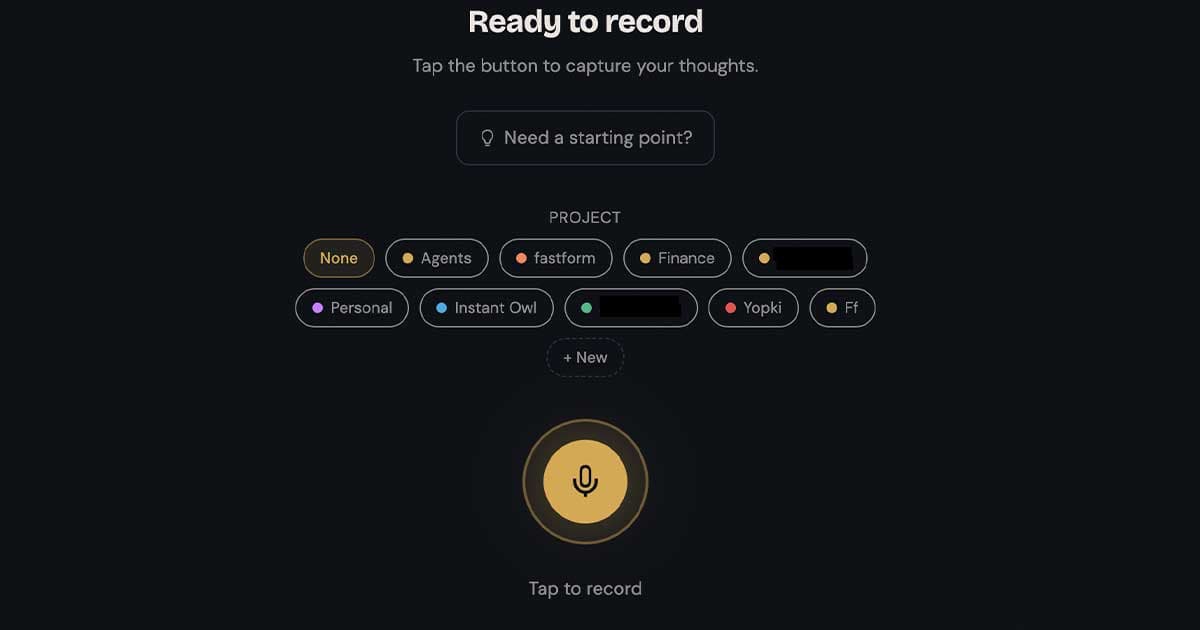
Speaking closes the 10x gap in the section above instantly, because you are already talking at thinking speed. InstantOwl is built around that idea: you talk the way you already think, and the organizing, the structure, the sorting into a note, a task list, or a summary, happens automatically afterward instead of being something you have to do by hand mid-thought. It is currently free to use.
This matters most for the people note-taking methods were never really built for: someone whose thoughts arrive faster than they can write, someone with three minutes between other things and no time to structure anything, or someone who thinks out loud better than they write. The job is unchanged from the one Wikipedia describes: get the essence of the information out of your head. The only thing that changes is how fast you're allowed to do it.
Related reading
- Note-taking methods: Cornell, outlining, mapping, charting, and the sentence method, compared honestly.
- Note-taking apps: verified pricing and honest tradeoffs across the field.
- What is a brain dump: the fastest, least structured form of getting a thought out of your head.
Frequently asked questions
Why is note-taking important?
Note-taking matters because it frees your mind from having to recall everything, according to Wikipedia, and because it lets you be selective and reorganize ideas as you hear them instead of trying to hold every detail in memory. Taking notes on new vocabulary also stimulates learning in people who stay actively engaged with the material.
What is the most effective note-taking method?
There is no single winner. Wikipedia notes that Cornell notes may be more effective for understanding concepts or producing readable notes, but studies found they had no significant effect on student performance. The honest answer is that methods organize information you already captured; they do not fix a capture problem, so the right method depends on the material and the moment.
Is typing or handwriting better for notes?
Research summarized on Wikipedia found that students who took handwritten notes performed better on exams than students who typed, hypothetically because handwriting forces selective rephrasing instead of word-for-word transcription. Neither method solves the underlying speed problem: speech runs 120-180 words per minute, while handwriting runs only 12-18, so both are far slower than a thought moving through your head.
How do I take notes faster?
Talk instead of writing. Speech runs 120-180 words per minute; handwriting runs 12-18, roughly a tenth of the speed, per Wikipedia's cognitive psychology sourcing. Speaking a thought out loud and dealing with organization afterward closes that gap immediately, which is why note-taking apps and recorders that turn speech into structured notes exist.

Written by
Jim BreeseJim Breese is the founder of InstantOwl. He's spent 15 years building companies, from an Airbnb host community he founded and exited to growth leadership at venture-backed SaaS startups. He built InstantOwl because his best ideas kept arriving mid-walk, out of order, and half-finished.
Stop losing good ideas.
InstantOwl turns a rambling voice note into a clean, organized document in moments. Just talk. We'll organize it.
 Try InstantOwl free