Journal Prompts That Go Somewhere (Organized by What You Need Today)
By Jim Breese · · Updated

What makes a good journal prompt?
A good journal prompt picks at something specific instead of asking something generic. "What are you grateful for" is a fine warm-up, but a prompt that asks what boundary you keep meaning to set, or what you are still punishing yourself for, gets a real answer instead of a polite one. Community threads on journaling call this "mind-picking," and it is the quality that separates a prompt worth answering from one you skim past.
The two ranking pages we checked for this topic each miss a piece of that. One is a plain numbered list of 100 questions with no organization at all, so there is no way to find "a prompt for X" without scrolling the whole thing. The other sorts everything into four broad, sunny categories: gratitude, reflection, goals, values. Neither covers the categories a journaling community actually asks for most: processing a hard feeling, naming a boundary, or reframing a regret.
The most-recommended prompt source in journaling discussions is not a listicle at all. It is a psychologist's book of prompts, and the prompts people quote from it are the ones that "pick at the mind," in one commenter's words, not the ones that repeat a familiar question. Every prompt below is original, written for this page, in that same spirit: specific enough to get a real answer, organized by what you actually need right now instead of a generic theme.
That organizing idea has two layers. First, where you are with the habit: never started, gone stale, or restarting after a lapse. Second, what you need in that moment: to process a feeling, decide something, see yourself clearly, or feel gratitude without the greeting-card version of it. The 39 prompts below are grouped by both.
What are good journal prompts when you have not started?
The best prompts for a blank page are light, specific, and low-stakes, since a heavy question is the fastest way to make someone close the notebook before they open it. Start with something you can answer in one honest sentence, not a question about your whole life.
Self-discovery. These ease you in by asking about something small and concrete, not your grand purpose.
- What is a small thing about you that has not changed since childhood?
- What do you do differently when nobody is watching?
- Which of your habits would surprise someone who just met you?
- What part of your day do you look forward to without ever admitting it out loud?
Gratitude, without the cliche. Skip the sunset and the coffee. Name something you would actually miss. If this is the category that sticks, a full gratitude journal practice is worth building around it.
- What is something ordinary from today you would miss if it disappeared?
- Who did something small for you this week that you never thanked them for?
- What is a comfort you have gotten so used to that you stopped noticing it?
- What went right today that you almost overlooked?
Fun, low-stakes hypotheticals. Nothing at stake, which makes them a good first prompt of the week.
- If you had to hand your current week to someone else to live, what would you warn them about first?
- What rule would you break if nobody would ever find out?
- If your mood right now were a weather forecast, what would it say?
- What would you do with a free afternoon and zero obligations?
What are good journal prompts when journaling has gone stale?
When a habit has gone stale, the fix is depth, not novelty. A generic new question will not out-interest a mind that is bored of its own thoughts. A specific one, aimed at a feeling or a boundary you have been avoiding, will.
Emotional processing. These ask you to name a feeling you have been carrying but not saying.
- What feeling have you been pushing to the back of the day instead of naming it?
- What is something you are angry about that you have not said out loud yet?
- When did you last cry, and what was actually underneath it?
- What feeling do you avoid in other people because it is hard to sit with in yourself?
Reframing and self-compassion. The kind of prompt one journaling commenter described as making them cry, in a useful way.
- What is a mistake you are still punishing yourself for long after it stopped mattering to anyone else?
- What would you tell a friend who made the exact choice you are judging yourself for?
- What is something you deserve credit for that you never gave yourself?
- Which regret would loosen its grip if you told the whole story instead of just the worst part?
Boundaries and hard questions. Nowhere on the ranking pages, and exactly where the real thinking happens.
- What is a boundary you keep meaning to set and keep not setting?
- What question about your own life are you avoiding answering?
- Where are you saying yes lately when you actually mean no?
- What are you tolerating right now that you would tell someone else to leave?
What are good journal prompts for restarting after a lapse?
Restarting after a lapse works best with prompts that move you forward, not ones that make you account for the gap. Skip anything about why you stopped. Pick something that gets you deciding, connecting, or looking ahead instead.
Deciding something.
- What decision have you been circling without landing on?
- What would you do next if you already knew you would not fail?
- What is the smallest next step on the thing you have been avoiding?
Values.
- What do you complain about that is actually a value being stepped on?
- What would you refuse to do even if it paid well?
- What is something you believe now that you did not believe five years ago?
Relationships.
- Who in your life makes you feel most like yourself, and why?
- What is a conversation you keep rehearsing but have not had yet?
- What is something you appreciate about someone you argue with often?
Letters. Sending is optional. The point is saying it, not delivering it.
- Write a letter to yourself one year from now.
- Write a letter to the version of you who got through last year's hardest month.
- Write a thank-you letter to someone who will never know you wrote it.
Morning and evening. One fixed question, answered at a fixed time, is easier to keep than a fresh one every day.
- Morning: what does today need from you, not the other way around?
- Evening: what is the one moment from today you want to remember?
- Evening: what did you carry today that you can set down before sleep?
Get all 39 prompts as a printable PDF, Word, or Excel
Every prompt above, grouped the same way, in one file you can print or keep within reach.
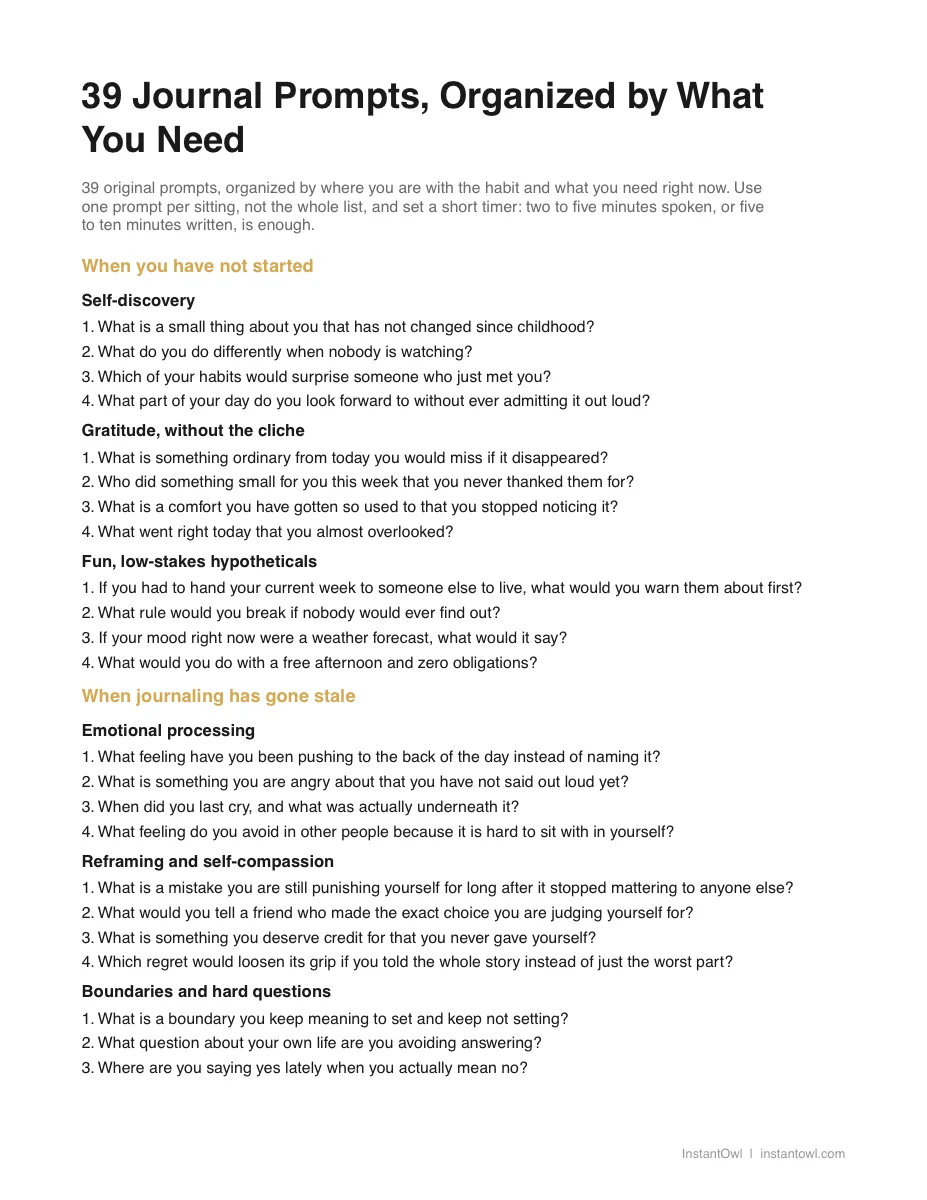
- PDF: print it or keep it on a tablet
- Word (DOCX): edit it down to the prompts you actually use
- Excel (XLSX): for column lovers, one prompt per row
The DOCX and XLSX files open directly in Google Docs and Google Sheets, no download or conversion needed.
Which journal prompts work spoken out loud?
Prompts that ask you to reflect, decide, vent, or address someone directly work well spoken, since answering them out loud is really no different from answering them on paper, just faster and less filtered. Every emotional processing, boundary, deciding, and relationship prompt above works this way. A letter prompt works spoken too, if you talk as though the person is actually in the room.
Prompts that do not translate are the ones built around a visual or physical constraint: counting words down to an exact number, filling a page with a drawing, arranging something you can only see on paper. Those need a pen because the constraint itself is visual, not because the thinking behind them is somehow deeper. None of the prompts above ask for that, on purpose.
This is where a spoken version of prompt journaling has a real advantage over the page: you can answer a hard prompt on a walk or a commute, when a notebook is not in reach but the thought is right there anyway. Our guide to voice journaling covers how to build that into a daily habit, and morning pages covers the classic pen-and-paper version these morning and evening prompts are a lighter cousin of.
How do you use a journal prompt without it becoming homework?
Use one prompt per sitting, not the whole list, and give yourself a short timer instead of an open-ended session. Two to five minutes spoken, or five to ten minutes written, is enough. A prompt is a starting push, not an assignment you have to finish completely.
Keep going past the first easy sentence if you can, since the more honest material tends to show up right after the obvious answer, not instead of it. It is also fine to answer a completely different question than the one the prompt asked, if that is where your mind actually goes. The prompt did its job the moment it got you writing or talking.
Skip the pressure to reread what you wrote right away. Some prompts bring up something heavier than expected, and that is normal, not a sign you picked the wrong one. Set it down, come back to it later if you want to, and never treat a journal entry as something you have to grade.
Where InstantOwl fits
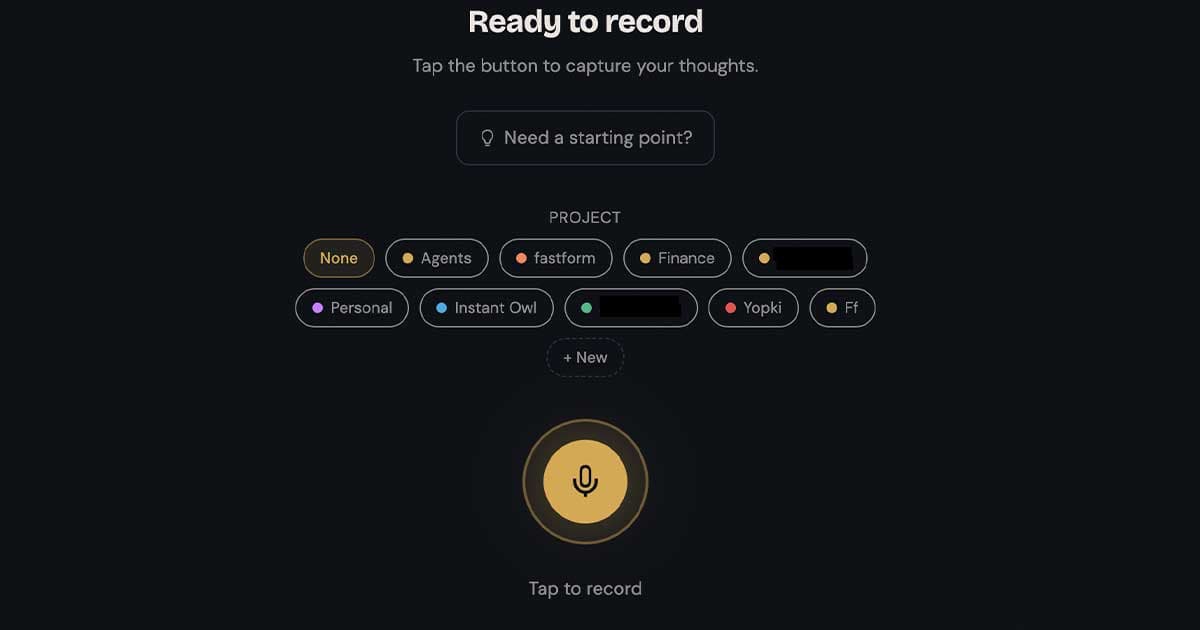
Full disclosure: InstantOwl is our product, and this is our blog. Pick any prompt above, say it out loud, and hit record. InstantOwl turns what you said into an organized, readable entry instead of a raw recording you have to sort through yourself later, which matters most for the prompts above built to be spoken.
InstantOwl is not a prompt library or a guided journaling app with its own question bank. It is built for the moment right after you have picked a prompt, when you would rather talk through your answer than type it. InstantOwl is currently free to use.
Related reading
- Voice journaling: how to build a daily habit of answering prompts like these out loud.
- Morning pages: the classic longhand daily practice the morning prompts above are a lighter version of.
- The brain dump journal: a faster, unfiltered release valve for the days a prompt feels like too much structure.
- Journal apps: where to keep the prompts and entries once you have picked a habit that sticks.
Frequently asked questions
What are good journal prompts for beginners?
Good beginner journal prompts are light and specific: a small memory, an ordinary comfort, a low-stakes hypothetical, something from today rather than a heavy question about your whole life. Start there before moving into prompts that ask you to sit with a harder feeling.
What are deep journal prompts?
Deep journal prompts pick at something specific instead of inviting a generic answer: a boundary you have not set, a regret you have not reframed, a feeling you have been avoiding naming out loud. They tend to produce a real reaction, sometimes discomfort, because they ask a genuine question instead of a warm-up one.
How do I use journal prompts?
Pick one prompt per sitting instead of working through a list, set a short timer so it stays a habit and not homework, and keep going past the first easy sentence, since the more useful material tends to show up after that. You do not have to reread what you wrote right away, and it is fine to answer a different question than the one the prompt asked.
Can I journal out loud?
Yes. Prompts that ask you to reflect, decide, vent, or address someone directly translate well to speaking, since they are really just questions answered in your own words. Prompts built around counting, drawing, or filling a physical page do not translate, since the constraint is visual, not conceptual.

Written by
Jim BreeseJim Breese is the founder of InstantOwl. He's spent 15 years building companies, from an Airbnb host community he founded and exited to growth leadership at venture-backed SaaS startups. He built InstantOwl because his best ideas kept arriving mid-walk, out of order, and half-finished.
Stop losing good ideas.
InstantOwl turns a rambling voice note into a clean, organized document in moments. Just talk. We'll organize it.
 Try InstantOwl free