The Best Journal Apps for Actually Sticking With It (2026)
By Jim Breese · · Updated
What makes a journal app worth it?
A journal app is worth it if you are still opening it at week three, not the day you set it up. That is the honest measure, and it comes straight from the people actually living the search for a good one, not from a features checklist.
In a r/digitaljournaling thread asking what app people actually use daily, "not the one collecting dust," the original poster described the cycle exactly: "The pattern is always the same - I get excited, set it up perfectly, use it for two weeks, then friction creeps in." He had tried Day One ("felt like I was scrapbooking my life"), Obsidian ("spent more time on plugins than writing"), and Notion ("turned into task management somehow").
His real question is the one worth answering: "what are you actually opening when you're anxious at 11pm or processing something on your commute? Not your ideal setup - your real one." One reply put it even more plainly: "Best one is the one you use, right?" This guide is organized around that standard, not around feature counts.
One more thing worth naming up front: some ranking lists of journal apps are written by companies that make one, and rank their own product first. We flag that below, including our own stake in the answer.
Is Apple Journal good enough on its own?
Yes, for most people, Apple Journal is good enough to stop the search entirely. It is free, built into iOS since iOS 17.2, and the app real users in that same thread kept coming back to. The original poster settled on it himself after trying everything else, and it was also the thread's top comment by points.
Per Apple's own newsroom page, entries can include text, photos, videos, audio recordings, and location. Journaling Suggestions use on-device machine learning drawn from your photos, places, and workouts to prompt reflection on gratitude, kindness, and purpose, and you can schedule reminders to write. Apple states plainly: "When iPhone is locked with a passcode, entries in the Journal app are encrypted," and "All Journal entries are end-to-end encrypted when stored in iCloud, so that no one but the user can access them."
The thread's community adds detail Apple's own launch page does not cover, since the app has expanded since 2023. The original poster reports it now syncs across iPhone, iPadOS, and macOS "almost in real time," and that "you can add audio (you can even transcribe it after recording), video, location, mood, photos, even calls and workouts," with a biometric lock and PDF export. A second highly upvoted comment summed it up: "It's simple, effective and checks all the boxes... The best part? It's free and doesn't need any subscriptions, at least for now."
The honest limits, per the same users: formatting is "very basic," it only really works if you live in Apple's ecosystem, and there are no AI-driven insights yet, something one user hopes Apple adds "once they figure out their AI direction." If you have an iPhone and just want to start journaling today, start here. Paid apps have to beat this baseline, not just match it.
The established paid picks: Day One and Journey
Day One and Journey are the two paid apps real users actually stick with, though both carry the subscription tax that drives some people away. Day One calls itself "the #1 journaling app" and shows over 150,000 five-star reviews on its homepage.
Per dayoneapp.com's pricing page, Day One's free tier covers unlimited text entries and unlimited journals, capped at one photo per entry. Paid tiers are Silver at $49.99 a year or Gold at $74.99 a year, and both audio recording and its transcription are paid-tier features starting at Silver. Day One states, "You own the data, we keep it safe," and offers true end-to-end encryption even on the free tier.
In the r/digitaljournaling thread, three users called Day One their daily app, one specifically for recording audio on walks and revisiting it years later. Others defected, citing the subscription or data lock-in: "I don't want my notes and entries locked up in there," said one, while another switched to a one-time-fee app once their subscription expired.
Journey, per journey.cloud/membership, prices its annual membership at $4.17 a month billed annually, roughly $50 a year, and also offers a lifetime purchase with no price shown on the page itself. It claims "millions of users" and Journey Cloud Sync capped at 10GB or 5,000 entries. Its paid tier adds Odyssey AI, a GPT-powered feature for chatting with your own entries.
Journey's own site claims end-to-end encryption "throughout its Journey to the cloud," while also selling a cloud AI chat feature that reads your entries. Both claims are Journey's own; we are not resolving the tension between full encryption and an AI feature reading your entries, just naming that it exists. Journey supports uploading audio, but no transcription feature was found on its site.
| App | Price | Where your data lives | Audio |
|---|---|---|---|
| Apple Journal | Free | Your iCloud, end-to-end encrypted | Records and transcribes on-device |
| Day One | Free tier; Silver $49.99/yr; Gold $74.99/yr | Day One's servers, end-to-end encrypted | Paid tiers only, transcription included |
| Journey | $4.17/mo billed annually; lifetime option, price at checkout | Journey Cloud, claims end-to-end encryption | Upload only, no transcription found |
| Diarium | Free; Pro is a one-time purchase per platform | Your own cloud (OneDrive, Google Drive, Dropbox, iCloud, WebDAV) | Records, no transcription mentioned |
The own-your-data pick: Diarium
Diarium's whole pitch is that your journal never touches its servers at all. Per diariumapp.com, the app is built by a solo developer, Timo Partl, for iOS, iPadOS, macOS, Android, and Windows. Its pricing, stated verbatim on the site: "Pro version: One-time purchase per platform. No subscription!" Windows is the one platform sold as paid with Pro already included; the rest are free with an optional Pro upgrade.
Diarium syncs only through cloud storage you already control, OneDrive, Google Drive, Dropbox, iCloud, or WebDAV, and needs no Diarium account at all. The site states plainly there are no Diarium servers involved. Entries lock behind a password, PIN, or biometrics, and the app supports unlimited attachments including audio recordings, though no transcription feature is mentioned. Export runs to Word, plain text, HTML, or JSON.
One r/digitaljournaling commenter said, "Feature-wise, it's similar to Day One, but I find Diarium more straightforward." Another explained the appeal directly: "I like that it is one fee and not a subscription, it allows you to control your data not on their servers." If subscription fatigue or where-does-my-data-live is your real objection, Diarium answers both at once.
What about AI journaling apps?
AI journaling apps are a separate category worth understanding before you pick one, since they trade some privacy simplicity for a feature the apps above do not offer: a response to what you wrote. Rosebud is the community's clear favorite, priced at $12.99 a month or $107.99 a year, and Mindsera's paid Genius tier runs $14.99 a month or $129 a year with voice input built in.
Their privacy postures differ in a way worth knowing before you pick: Mindsera states outright that your data is not used to train AI models, while Rosebud names its AI processors without making that same promise. Our full AI journal guide covers pricing, privacy fine print, and whether AI actually helps journaling in more depth.
Is there a voice journaling app?
Yes, and it is the gap this whole category keeps skipping. One of the most actively maintained ranking lists for journal apps, updated as recently as yesterday at the time of this research, ranks seven apps and mentions audio recording exactly once, for Apple Journal. No dedicated voice journaling app appears anywhere on it. That same list also ranks its own maker's app first, disclosed plainly on the page: "Full disclosure: Reflection is built by the Holstee team." Worth knowing when you read any "best journal apps" list, including this one.
Meanwhile, in the r/digitaljournaling thread this guide draws from, voice dictation came up organically four separate times, people talking while walking, driving, or recording audio memos, without anyone framing it as unusual. Untold - Voice Journal is the one purpose-built app named in that thread, rated 4.9 stars from about 2,100 App Store ratings in Health & Fitness, free to download with in-app purchases. Untold Premium costs $12.99 a month or $107.99 a year.
Per its listing, Untold records voice, transcribes it with automatic paragraph breaks, and follows up with AI-generated questions in a style you choose, nurturing, psychological, or thought-challenging. It also tracks emotions, maps people and relationships mentioned in entries, and builds mood calendars. Its privacy claim, in its own words: "Everything you share is fully encrypted, meaning nobody but you can access" it.
Two Reddit users praised Untold organically, one noting it "creates charts of most noted people, places, emotions." A reply captured the tension well: "i'm using this too and low key so scared this app knows such intimate things about me." A critical App Store reviewer said the app appears free, then "getting you hooked into using the software" before revealing the paywall; the developer replied the paywall exists because "as we grow, we need it." Weigh both sides before you commit.
Where InstantOwl fits
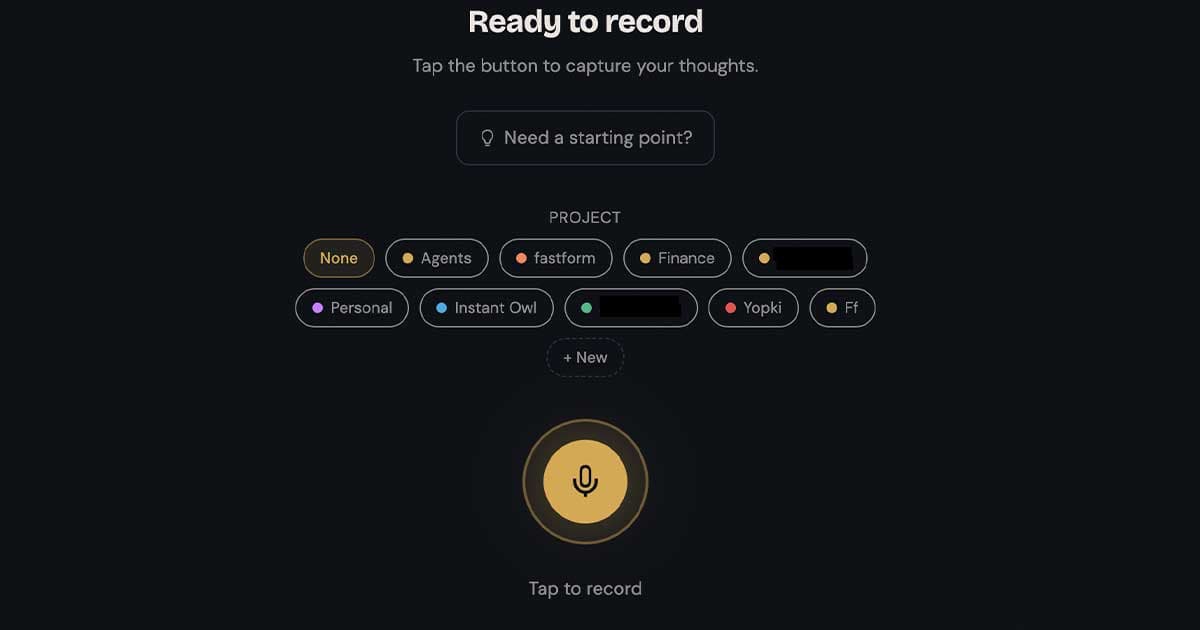
Full disclosure: InstantOwl is our product, and this blog belongs to it. InstantOwl is voice-first journaling built around the same gap: you talk, and it organizes what you said instead of leaving you with a raw transcript to sort through. It skips the journal-app ceremony of choosing a template or format first. You just talk, the way you would to a friend, and get back something organized. InstantOwl is currently free to use, with no prices to weigh against the apps above.
The honest not-for: if what you want is a structured audio archive with mood graphs and dream tracking, the dedicated apps above are built for that job. InstantOwl is built for the daily habit of thinking out loud and wanting it organized afterward.
How do you choose a journal app?
Choose based on where you are most likely to quit, not on features. Three risks explain nearly every abandoned journal app in the community's own account: too much setup, a blank page with nothing to say, and too much friction between having a thought and getting it down.
Setup risk killed Obsidian and Notion for the original poster above: plugins and task-management sprawl ate the time meant for writing. If that sounds like you, Apple Journal or Diarium's simpler structure is the safer bet. Blank-page risk is real too; if you stare at nothing to write, a list of journal prompts solves that better than any app feature does.
Capture-speed risk is the one voice solves directly. If your actual failure mode is not opening the app fast enough before a thought slips away, typing adds friction that talking does not. Subscription fatigue is the last honest risk, and it shows up repeatedly as the reason people defect from paid apps back to something free or one-time. Pick the app that removes your specific risk, and the retention problem mostly solves itself.
Related reading
- AI journal: what AI journaling apps like Rosebud and Mindsera actually cost, store, and promise about your data.
- Voice journaling: keeping an audio journal as its own daily practice, with or without AI.
- Morning pages: the classic longhand daily writing ritual, and how a spoken version compares.
- Journal prompts: prompts for blank-page days, restarting after a lapse, and speaking your answers out loud.
Frequently asked questions
What is the best free journal app?
Apple Journal is the best free journal app for most people. It costs nothing, comes built into iOS, and end-to-end encrypts entries stored in iCloud. Real users report it ended their search for something better, citing text, photo, video, audio, and location entries with no subscription required.
Is Apple Journal good?
Yes, with real limits. It is free, private, and syncs across Apple devices, and users describe it as simple enough to actually stick with. Its honest weaknesses are basic formatting, an iPhone-first ecosystem, and no AI-driven insights yet, unlike paid AI journaling apps.
What journal app is most private?
Diarium and Day One both offer strong privacy in different ways. Diarium has no company servers at all; it syncs only through your own cloud account and needs no account with Diarium itself. Day One offers true end-to-end encryption, including on its free tier, but your data still lives on Day One's servers.
Is there a voice journaling app?
Yes. Untold - Voice Journal is a purpose-built option rated 4.9 stars from about 2,100 App Store ratings, priced at $12.99 a month or $107.99 a year. Apple Journal and Day One also support recording audio, with Apple transcribing on-device for free and Day One charging for transcription. InstantOwl is a voice-first alternative built for organizing what you say, and is currently free to use.

Written by
Jim BreeseJim Breese is the founder of InstantOwl. He's spent 15 years building companies, from an Airbnb host community he founded and exited to growth leadership at venture-backed SaaS startups. He built InstantOwl because his best ideas kept arriving mid-walk, out of order, and half-finished.
Stop losing good ideas.
InstantOwl turns a rambling voice note into a clean, organized document in moments. Just talk. We'll organize it.
 Try InstantOwl free