Voice Notes for Sales: The Sending Playbook and the Capturing Habit Nobody Talks About
By Jim Breese ·
Voice notes for sales means two different things
"Voice notes for sales" covers two different jobs, and almost everything written about it answers only one. The first meaning is sending a recorded voice message to a prospect, as a cold-call follow-up or a soft nudge on LinkedIn or WhatsApp. The second meaning is capturing your own notes by voice right after a call ends, so what the prospect actually said survives the walk back to your desk.
Nearly every guide on this topic is written for the first meaning. That makes sense: it is the flashier tactic, and vendors selling voice tooling have an obvious reason to write about it. The second meaning gets almost no coverage, even though every seller who has ever talked for a living has lived the problem it solves. This post covers both, in the order a working seller actually needs them.
The sending playbook: what one agency owner does with voice notes
The clearest public version of this playbook comes from an agency owner on Reddit, describing how they use voice notes as a low-volume outbound touch, not an automated campaign. The core idea: a voice note is a bump message, a gentle nudge back toward something you already sent, not a new pitch. The favorite moment to send one is right after a cold call the prospect did not pick up, so the touchpoint does not feel wasted.
The framework has four parts. First, define the goal before recording: you are reminding the prospect about an email or video you already sent, not opening a new ask. Second, keep the message short and soft. The agency owner's own example ran under 30 seconds: a name, a reference to the earlier email, one concrete result for a similar company, and a closing line that removes pressure entirely, something like "no need to call me back."
Third, pick the channel. The agency owner favors LinkedIn and WhatsApp voice notes over voicemail, on the theory that prospects check messaging apps more often and replying is lower friction since they can type a quick response in the same app. They are candid that this is a hunch, not a measured result: "I don't have the data on why." Fourth, stay authentic. The advice is to practice by sending a note to yourself first and adjusting tone before sending it for real, since delivery matters more than a polished script.
One detail matters more than the framework itself: this is a manual, low-volume tactic. The agency owner prospects roughly 50 accounts at a time and sends a handful of voice notes a week, not hundreds. Nowhere in that discussion, and nowhere in the broader conversation around it, does anyone publish a reply rate. The tactic is asserted as effective. It is not measured as effective. Keep that distinction in mind before you build a process around it.
The same discussion includes pushback worth repeating. At least one reader found voice notes from a stranger intrusive rather than personal. The agency owner's defense is the same soft-touch discipline described above: keep the note non-committal, point the prospect toward something they can read on their own time (an email, a video) instead of asking them to call back. That framing, a nudge instead of a demand, is what keeps a voice note from feeling like pressure. Drop the soft close and the same tactic reads as pushy.
The sending rules that hold up
Length and framing matter more than any script. AiSDR, a company that sells voice tooling, publishes tactical guidance for voice notes that lines up with the Reddit playbook on the fundamentals: a good note runs about 25 seconds, 45 at the most, and the first 5 seconds need to be immediately relevant. Skip the "hi, my name is" opener entirely and lead with the actual reason you are reaching out.
Beyond length, the same guidance recommends one idea per note (a single specific benefit, not a list), a soft call to action rather than a hard ask, and a conversational tone. Practical delivery tips: smile while you record it (it changes how the voice sounds), and treat your first take as usually the most natural one rather than over-rehearsing.
Two things this guide does not do: it does not cite a source for its own claim that voice notes get "higher reply rates" and "faster conversations," and it does not describe any official platform limit on voice note length or recording method for LinkedIn. Treat both as marketing claims from a company that sells the tooling, not as verified platform rules or measured outcomes. If a guide tells you LinkedIn caps voice notes at a specific duration, that is not something either source here backs up.
The real problem: voice is easy to send, hard to keep as a record
Even AiSDR's own guide admits the honest downside: a voice note is "harder to reference later" than text. That line is the whole reason this post exists. Every seller who talks for a living, whether or not they ever send a voice note to a prospect, has the same problem the moment a call ends: the details are in their head, not in the CRM, and they decay fast.
This is where the sending playbook and the capturing habit connect. A voice note is a great way to reach a prospect. It is a bad way to hold on to what a prospect told you, unless something turns it into text you can actually search and act on later. Nobody covering the sending side of voice notes talks about this at all, because it is not their product.
The result, for most sellers, is the familiar CRM full of "called, LM" and "spoke, follow up" entries that mean nothing three weeks later. The pain point the prospect mentioned, the objection they raised, the personal detail that would have made the next touch feel human instead of generic, all of it lives in memory for about as long as the drive back to the office.
This is not a discipline problem. It is a friction problem. Typing a full call recap into a CRM field takes longer than the next call is worth, so it gets shortened to two words, or skipped entirely once the day fills up. The seller is not lazy. The tool for capturing what just happened simply asks for more effort than the moment can spare between one call and the next.
The 60-second after-call debrief that keeps every detail
The fix is a short voice debrief recorded the moment a call ends, before moving to the next one. Five things, in order: who you talked to, their main pain point, the objection they raised, the agreed next step, and one personal detail (a kid's name, an upcoming trip, anything that makes the next touch feel specific instead of templated). Say all five out loud in about 60 seconds, in the car, walking between meetings, or in the gap between two Zoom calls.
In practice it sounds unpolished, and that is fine: "Just got off with Priya at Meridian. Her main hang-up is price versus their current vendor, not the product itself. She wants a comparison sheet before she brings this to her boss. Send that by Friday. She mentioned her team is slammed through quarter end, so keep the follow-up light until then." Rough, out of order, exactly how a real call recap comes out of someone's head. That is the point: the debrief exists to catch the details before they are gone, not to sound like a finished report.
This is the same discipline covered in our full guide to meeting notes: capture selectively right after the conversation, rather than trying to transcribe the whole thing while it is happening. It also fits inside a broader habit, one our system for capturing ideas before they vanish covers in more depth: one destination for everything you capture, and a short regular review so none of it goes stale.
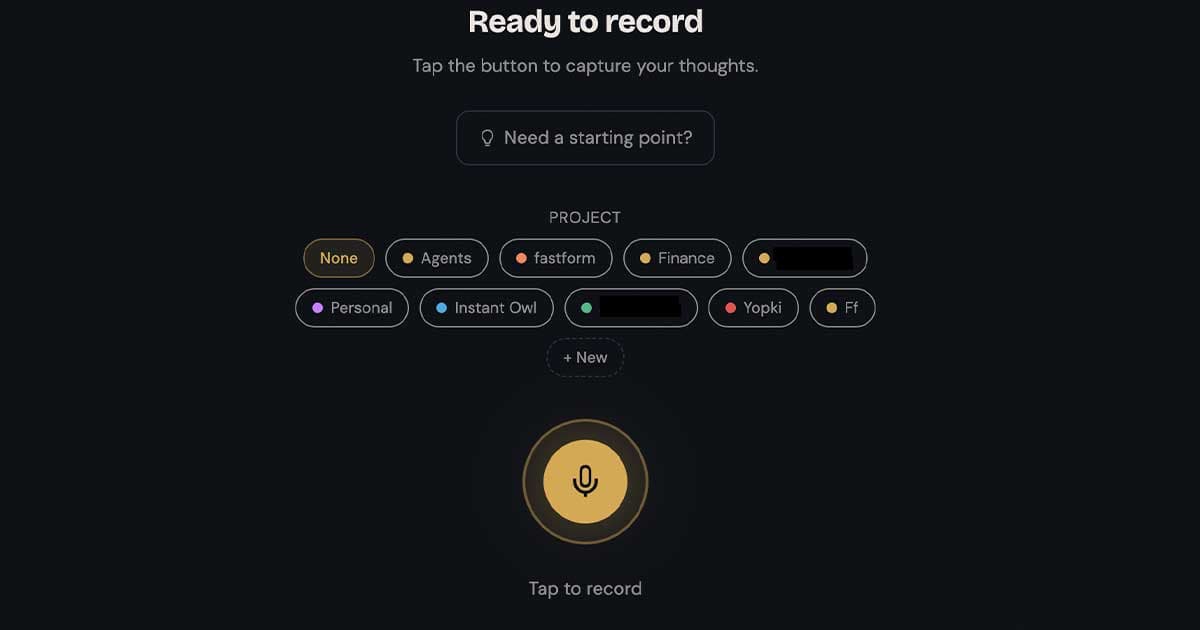
Full disclosure: InstantOwl is our product, and this is exactly the lane it is built for. Say the five-point debrief out loud, and InstantOwl turns the ramble into structured notes instead of a wall of transcript to sort through yourself, ready to paste into the CRM or turned into a task list for the follow-ups you promised. InstantOwl is currently free to use. If you would rather do it with a plain voice memo and type it up yourself afterward, that works too. The habit matters more than the tool.
If you sell real estate, your debrief looks a little different
Everything above applies to a general sales cycle: calls, objections, next steps. Real estate has its own version of the same problem, built around showings instead of calls: buyer reactions room by room, price signals, seller feedback, and the follow-up promises made walking out the door. If that is your world, our guide to voice notes for real estate agents covers the between-showings debrief built specifically for it, including the hands-free safety rules that matter when you are recording from the car.
Whichever side of the sales process you are solving for, sending or capturing, the same rule holds: a voice note is only as useful as what happens to it after you stop talking.
Frequently asked questions
Do voice notes work for sales prospecting?
Practitioners who use them like them, and the playbook (short, soft-touch bump messages after a missed call) is genuinely reasonable. But nobody publishes measured reply rates for voice note prospecting, not in forum posts and not in vendor content. Treat it as a promising manual tactic, not a proven-at-scale one.
How long should a sales voice note be?
Keep it short. One vendor guide on the format recommends 25 seconds, 45 at the most, with the first 5 seconds carrying the actual point instead of a greeting. One idea per note, not a pitch.
How do I remember what happened on sales calls?
Record a 60-second voice debrief right after the call ends, before you move to the next one, covering who you talked to, their main pain point, the objection they raised, the agreed next step, and one personal detail. Do this before typing anything into the CRM.
What should I say in a prospecting voice note?
Name the prospect, reference something specific you already sent them (an email, a video, a proposal), give one concrete reason to care, and close with a soft, no-pressure line rather than a request for a callback. Skip the self-introduction opener and get to the point in the first few seconds.

Written by
Jim BreeseJim Breese is the founder of InstantOwl. He's spent 15 years building companies, from an Airbnb host community he founded and exited to growth leadership at venture-backed SaaS startups. He built InstantOwl because his best ideas kept arriving mid-walk, out of order, and half-finished.
Stop losing good ideas.
InstantOwl turns a rambling voice note into a clean, organized document in moments. Just talk. We'll organize it.
 Try InstantOwl free